----------------------------------
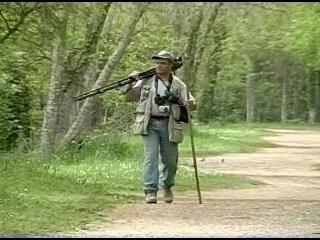
Welcome to the Visitor's Center at Brazos Bend State Park. That's me on a trail (03/29/2004). As I get more pictures, these pages expand. I've gotten
enough images of snakes to put them on the snake pages.
Snakes page 1 nonvenomous 2001 -2002 Snakes page 6 Rat Snakes 2002 - 2021
Snakes page 3 nonvenomous 2004 -2006 Snakes page 7 venomous 2002 -2021
Snakes page 4 nonvenomous 2006 -2021
Snakes page 5 nonvenomous 2022 -2023
----------------------------------
Welcome
to the Visitor's Center at Brazos Bend State Park. That's me on a trail
(03/29/2004). As I get more pictures, these pages expand. I've gotten
enough
images of snakes to put them on the snake pages.
--------------------
--------- -
-
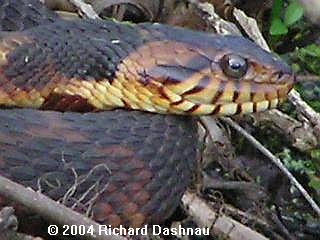
GORGEOUS BROADBANDED
February
21 & 22, 2004
While I didn't notice any snakes Saturday, there were quite a few of them
visible Sunday. While I was walking, I encountered two park visitors whom
I've seen often.
They told me about a spot not far along where you could
look to one side of the trail (40 Acre Lake trail, face Pilant Lake), and
see one snake, and then turn to the *other* side of the trail
without
moving a step, and see ANOTHER snake. So, of course I went there.
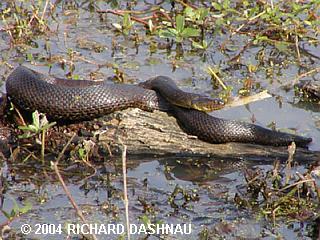
About 15 feet from me, I saw this excellent snake (see GREEN WATER SNAKE,
below). It is definitely NOT
venomous (compare with the Water Moccasin
and Copperheads further above on this page). Water Snakes are sometimes
hard to tell apart, and I tried to get clear pictures so I could
identify
it. It was pretty far off, but I did the best I could with my Olympus C-700.
 -
- -
-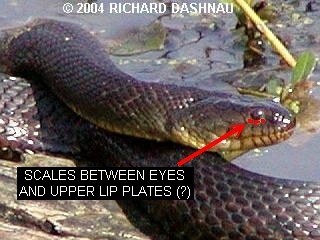
GREEN WATER SNAKE
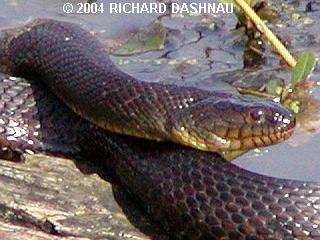
GREEN WATER
SNAKE HEAD
SUBOCULAR SCALES?
- -
-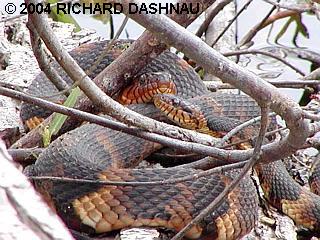
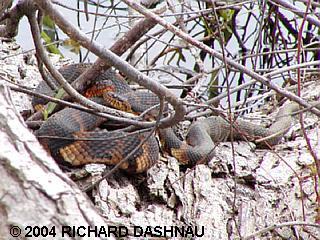
BROADBANDED WATER
SNAKES
TWO OF THEM, SEE?
I wasn't
thinking clearly, though, and tried to get the entire snake instead of
trying to focus on the head, which, it turns out, could have identified
the snake for sure. Still, I think it's a Green
Water Snake (according
to Audubon Field Guide to North American Reptiles and Amphibians); or Mississippi
Green Water Snake (according to Texas Snakes, by Werler and Dixon
(3rd
printing)); both common names for Nerodia Cyclopion. The coloration
is correct, although I can't see the snake's belly. The scales are keeled,
which means that they each have a
slight ridge in their center (see GREEN
WATER SNAKE HEAD, above). But, the *key* indentifier for this species is
the presence of a single row of scales under the eye, the "subocular
scales"
(see SUBOCULAR SCALES?, above), which divide the eye from the scales of
the upper lip. According to Werler, "no other Texas water snake has scales
between the eyes and
the upper lip plates...". My picture isn't quite clear
enough to pick these out for sure, but there appears to be a space there.
So, I'm going to guess that's the snake (and not a Yellowbelly
Water Snake,
which some visitors guessed).
The
snake on the other side of the trail was one of our Broadbanded Water Snakes,
although when I went back later, there were TWO snakes
in the same spot!
(see BROADBANDED WATER SNAKES, above) So, actually one could see *three*
snakes from the same spot. The smaller snake, over a period of about 15
minutes,
slowly moved from behind the larger snake, and then climbed onto
it as shown here (see TWO OF THEM, above). The larger one moved its head
to face the smaller one, and they stayed
face-to-face for a few minutes,
until the large one lightly bumped the smaller one with its face. Then,
the smaller snake "jumped" into the water.
And
just think, it isn't even Spring, yet!
December
28, 2003Today's
weather was a lot nicer than promised. It didn't rain, and the temperature
was above 60. It was also sunny for most of the day. Evidently some
snakes found
the weather pleasent as well. No more than 100 yards from
an alligator family, I saw a Cottonmouth (found by one of the sharp-eyed
park visitors); a very nice Broadbanded Water Snake
(see WALKING, below),
that was about 30 feet away.
-----------------------------------------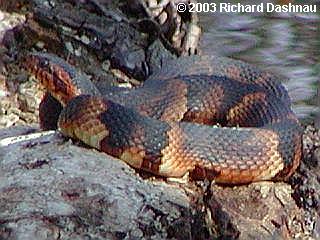
WALKING WITH A WINTER WATERSNAKE
(YOU SING WINTER SONGS YOUR WAY, AND I'LL SING THEM MY WAY)
I tried
to get a little closer, but it got spooked when I moved off the trail,
so I backed off. The Cottonmouth also tired of our attention, and
moved under a log before I could position the camera.
Just past pier number
1, I also encounterd a very nice Ribbon Snake crossing the trail. I moved
to bring up my camera, and it slithered off before I could get a picture,
though. Oh, well, at least
I got to see them. Quite nice for
a December day! Have I mentioned how much I enjoy living in Texas?
April
19, 2003One
further little adventure happened while I was doing the Alligator Hike
(with the help of Mark and Nancy. THANK YOU!). As I was back at the culvert,
talking about the Old
Warrior, one of the visitors suddenly yelled
out "there's a snake!" and there was---about 15 inches from my left foot.
It was Broadbanded Water Snake, and had come out of the grass near my
foot.
It stayed there and watched us (there were between 20 and 60 people looking
down at it) for at least 5 minutes. Of course, this was something
else to talk about, and we all watched as it
tired of our company and moved
on down towards the water. I was talking, of course. Imagine that!
Snakes can't even hear and I was able to drive him away. Ha!
ADDITIONAL--04/22/2003
--------------
--------
WHAT'S UP?
Speaking
of snakes, the next day was Easter Sunday, which is always crowded at the
park. As I was on the trail, I saw a group of visitors looking under a
tree. When I got closer, I saw that they
were looking at a medium-sized
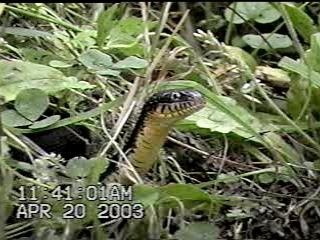
snake (about 2.5 feet long). I believe it was a Yellowbelly Water Snake
(Nerodia erythrogaster flavigaster), though it's hard to tell some species
of water snakes
apart (for me, anyway). The picture above (WHAT'S UP?)
shows it doing the "periscope"--that is, it's raising its head above the
grass to see what's around it. Click this link to see a
short video
clip (flv video 852kb) of it gliding through the vegetation.
Note the yellow underside, and the dark lines around the mouth, and the
lack of mottling or shading on the top. Also note the
general shape of
the head (rounded--like a thumb), and the fact that the pupils of the eyes
are round. These are indications that it is NOT a venomous snake,
such as a cottonmouth.
January
26, 2003
I suppose we are in our 2nd season. Houston has only two seasons, and not
the four commonly known elswhere. These are: Season Number 1--the
Hot and Really Humid
and Therefore Really Miserable to Some Folks Season;
and Season Number 2--the Cold and Really Moist and Damp and Therefore
Really Miserable to Other Folks Season. Today was a good
day to stay
inside and be warm, or watch a movie, or watch that big football thing.
Sometime in the night, my brain must have frozen, because I went
out to the park. On the way I drove through three
cloudbursts, and witnessed
lightning and thunder. Yet, I continued on to the park.
Anyhow,
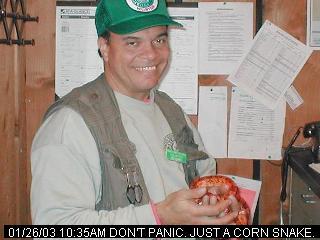
the picture below left (HANDY SNAKE) shows me at the counter of the VC/NC
at Brazos Bend State Park allowing a Corn Snake to warm itself around my
hand and forearm while I waited
to greet and inform the hordes of park
visitors who actually were smart enough to stay home. Did those
folks wander around in the cold dampness picking up firewood, or riding
in an open vehicle
carrying this wood around? Did they walk out
while it was still sprinkling to see if a mother alligator would be visible
today? (she wasn't) Did they wade around in the cold water while
cutting down
wild rice with a hedge trimmer? No. Of course not! THEIR brains
weren't frozen!
The
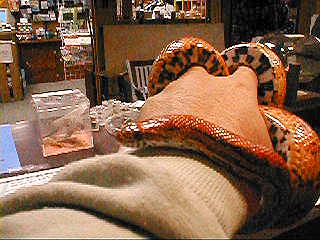
picture below right (CORNY CLOSEUP) is an image from a short movie clip
which you can see by clicking here.
(flv video 512 kb). Isn't it a beautiful snake? Note. in the
very beginning of the clip,
how the skin on the snake's underside shifts
slightly, out of synch with the movement with the main part of the snake.
This is due to the muscles underneath shifting the scales against me, in
an effort
to pull the snake along. Also note how much of the snake's body
surface is being held in contact with mine. This is because I was warmer
than the snake, and it was trying to gain some energy from
me. Although
they are termed "cold blooded", reptiles actually function most efficiently
at internal body temperatures similar to ours. They just don't have a metabolism
that allows them to manufacture
heat internally.
------ -----------
HANDY SNAKE
CORNY CLOSEUP
Snakes page 1 nonvenomous 2001 -2002 Snakes page 6 Rat Snakes 2002 - 2021
Snakes page 3 nonvenomous 2004 -2006 Snakes page 7 venomous 2002 -2021
Snakes page 4 nonvenomous 2006 -2021
Snakes page 5 nonvenomous 2022 -2023
Go back to my home page, Welcome
to rickubis.com
Go
back to the RICKUBISCAM page.