CRITTERS AT BRAZOS BEND STATE PARK--  Wading Birds!
This page was born 04/06/2004.  Rickubis designed it.  (such as it is.) Last update: 04/24/2011
Images and contents on this page copyright © 2002-2006 Richard M. Dashnau

Here are my other Brazos Bend and/or critter pages:
 ----------------------------------------------------------------                  OR,  FOR OTHER ANIMALS:
Alligators at Brazos Bend State Park Introduction            Critters at Brazos Bend State Park Page 1
Snakes-nonvenomous 1-------------------------------------------Critters at Brazos Bend State Park Page 3
Snakes-nonvenomous 2-------------------------------------------------Insects, non-toxic
Snakes-nonvenomous 3------------------------------------------------Spiders
Snakes-venomous------------------------------------------------------Mammals
Birds-Raptors- Birds-Anhingas-----------------------------------Lizards!--Turtles!

----------------------------------
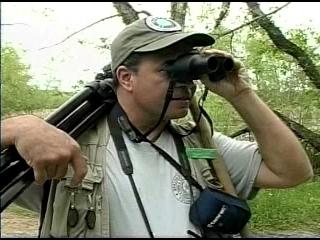
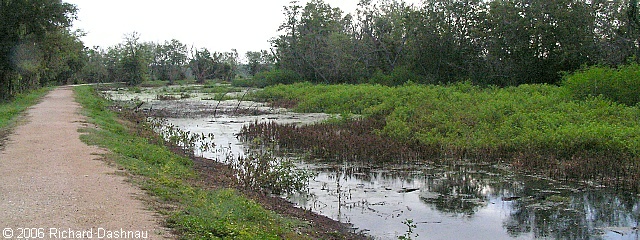
Welcome to Brazos Bend State Park. That's me on the trail. One of the most popular reasons for people to visit BBSP is to see the birds. Although *I* started going to the park mainly for the alligators, one cannot be there for long without learning to enjoy the birds. Over the years, I've captured a few pictures and video clips of them, and here they are.

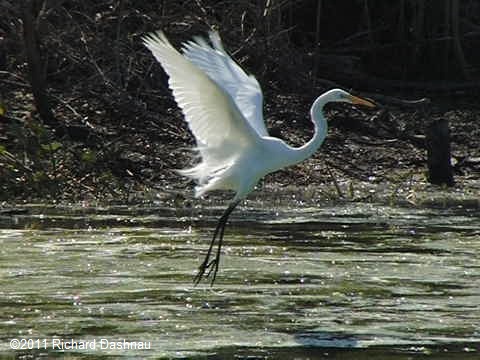
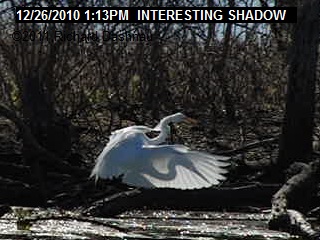
December 26, 2010 The three images below are frame captures from video clips I shot that morning, and which I edited into this movie clip (25 mb).
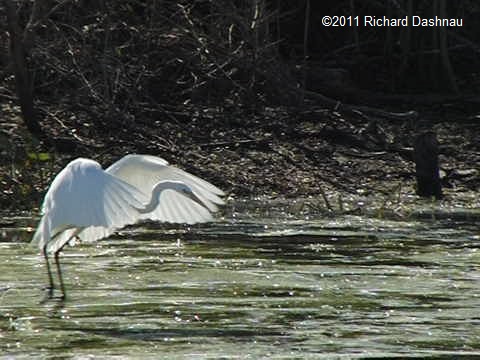
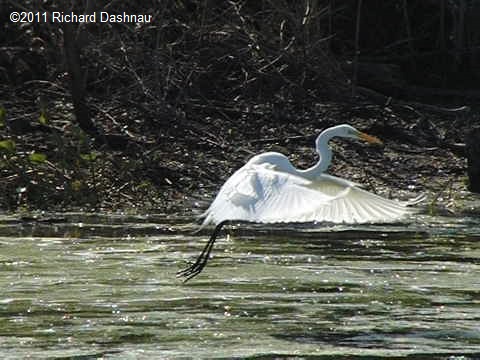
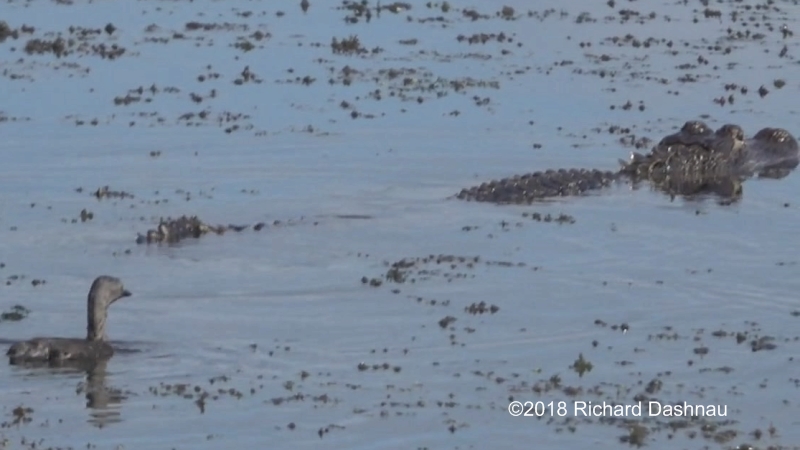
The morning of Sunday, December 26, 2010, had temperatures low enough for a skin of ice to be on low, shaded water, and frost shaped by the shade of the rails on the Spillway Bridge. Although the sun came out, the air didn't get much above 45 degrees. The day was cold--at least by Brazos Bend State Park standards.   I was out on the trails anyway, looking for Eagles and Otters. I couldn't find either one. While I was at 40 Acre Lake, I noticed a Crow hovering near the surface of the water next to one of the islands. Then, I saw a Great Egret doing the same thing. It would hover close to the surface of the water, and sometimes stab down with its beak. Occasionally I thought I saw something splash under the surface.
I assumed that the Egret was harrassing Pied-Billed Grebes if they surfaced with prey. I've seen this before, and figured that's what was going on. I decided to try to film this activity. First, I tried to follow a Grebes as they dove and surfaced--but it's difficult to see where they are going to surface.
So, I decided to watch and film the Egret instead. I shot a few high speed clips of the Egret taking off, hovering, and stabbing the water. After reviewing these, I couldn't tell if the Egret was stealing from a Grebe or not. I never noticed a Grebe surface from where the Egret grabbed a fish.
I edited together some of these clips, so I could watch this magnificent Great Egret hovering and flying in the early afternoon sun. I hope you enjoy it as well.  A couple things really caught my attention. First, the shadow of the Egret's head and neck as it shows on the wings. Then, the effort of the Egret as the wing beats keep it airborn at such low speeds. 

----  
    GREAT EGRET HOVERING 1
                  GREAT EGRET HOVERING 2                       GREAT EGRET HOVERING 3                                     THE SHADOW!

May 16 and May 30, 2010. If you have been walking the trails at Brazos Bend State Park, then you may have noticed crawfish claws (and sometimes legs) lying around the trails. In most cases, just the claws are there. A single pair might not cause much comment, but when there are claws scattered in many places, then it becomes mysterious. After all, where is the the rest of the crawfish? Many of us at the park know that the culprits behind the mystery are various wading birds, and mostly Yellow-Crowned Night Herons. Today's RICKUBISCAM is a full head view of one of them.
While I'm out on the trails, I like to point out the discarded claws to park visitors, and then let them guess why they're there. And then I usually blame the Night Herons. However, I've never really had a good mental image of *how* the Herons remove the claws. Over the last few weeks, I shot some high speed video that cleared it up for me. It appears that the Herons use inertia to de-claw the crawfish.

---------------
     CLAWS ON TRAIL                     READY TO STRIKE                         THE GRAB                                   GOT ONE!

I've edited together and posted the video online. Images here are frame grabs from the video. When a Heron captures a crawfish, it immediately twists its head from side to site very quickly. This is not like shaking its head from side-to-side (as if saying "no"); but similar to a motion it might do if it was trying to "drill" with its beak. Centrifugal force causes the limbs (and especially the heavier claws) to straighten from the body (this appears to have the added benefit of preventing the crawfish from grabbing the Heron). And the link to the video is here:  Yellow-Crowned Night Herons with Crawfish (wmv. 50 mb)

---------------
      PASSING IBIS              DON'T MESS WITH MY FOOD!           ONE CLAW FLIES           THE OTHER CLAW FLIES

Along with repositioning of the crawfish for a better leverage against the joints as they spin, the claws sometimes just break off. An alternate method (in the first part of my video) has the Heron grabbing a claw, the "arm", and twisting while holding *that*, with the weight of the crawfish working on the joint. Eventually, one claw after another is broken off and discarded. Sometimes groups of the legs are grabbed, and then hyperextened by the weight of the crawfish's body using the same twisting motion. These break off and are also discarded.  And so, there's video proof of one of our minor mysteries--solved.

---------------
      GRAB THE LEGS                         SOME LEGS FLY                       MORE LEGS FLY                ALMOST READY TO EAT

---------------
         FOOD TOSS                        BEAKFUL TENDERIZED                 ONE BIG GULP                      THAT WAS GOOD!

The Heron doesn't always win, though.  The images below are frame grabs from another clip. The Night Heron grabbed the crawfish and immediately dropped it. The crawfish submerged, and the Heron never touched that one again. What happened? I looks like the crawfish grabbed the Heron's bottom jaw. This made the Heron let go.It didn't bother that crawfish again, but it went hunting for others.

---------------
            THRUST!                           CAUGHT A BIG ONE!                   TOSS AND GRAB                              PINCH!!

---------------
     OUCH! THAT HURT!                  THERE IT GOES                             IT'S FREE!                 the RICKUBISCAM shot
Here's an additional note for those who see this and are living outside of Texas: crawfish = crayfish. (Potay-to Po-TAH-to)  Also, these are "red swamp crawfish"--procambarus clarkii--and YES they are that big, and can get even bigger. They are pretty amazing animals. I've read that they can reproduce parthenogenically; that they can actually come in different colors (including blue); and that they have become an invasive destructive species in some countries--partly because of their habit of burrowing. They can also make thick mud chimneys and dig deep burrows. They are the crawfish that are usually cooked and served in restaurants down here (and probably elsewhere).

02/07/2010  Across Pilant Lake from the Observation Tower (actually near the center of the lake), Great Blue Herons built nests in the trees. From time to time, the Herons will hunt for food near enough to see what they're doing. This morning, one of them landed close enough for me to get a good view it with my camera. I caught a series of nice clips (shot at 210 fps) of it landing, eating, and taking off. I've edited some of this together into a short movie clip. Below are some image captures from the footage.  And here's a link to the video clip shot at high speed (wmv 26 mb)

----------- 
        COMING IN FOR A LANDING                        GRABBING A SIREN                          TAKING OFF WITH STICK

 The animal the Heron caught is not an eel, and not a snake. It is an amphibian. This is a Lesser Siren (Siren intermedia). Sirens are in the order Caudata--the Salamanders.  Sirens are nocturnal. They eat small fish, tadpoles, insects, and other invertebrates. They range in size from 7 inches to 27 inches long. Sirens are distinctive when seen closely. They have two short legs with feet that have 4 toes (So, could one could say that they are a two-foot animal with two feet?).  Sirens also have external, branched gills. They are nocturnal and live in water. However, if that water dries, they can secret a mucus covering which will allow them to survive while buried in the dried mud. This "suspended animation" is called "estivation". I can't find out how long a siren can estivate and still survive. Sirens feed by sucking food into their mouth. They don't have wide jaws like a frog or most salamnders; but a narrow mouth that can extend quickly and form a suction. I've seen this in action, and the movement is very fast.  The food is there, just in front of the Siren's nose, and then there's a quick movement, and the Siren is chewing something.  Below are two images cropped from the same photograph showing the Siren a little better.

---- ---- 
     DIFFICULT WITH NO HANDS                               THE SIREN                                     RICKUBISCAM SHOT       Here's the taxonomic rank of the Lesser Siren:
                                                                                                                                                                                                      Kingdom Animalia
                                                                                                                                                                                                      Phylum  Chordata
                                                                                                                                                                                                      Subphylum  Vertebrata
                                                                                                                                                                                                      Class  Amphibia
                                                                                                                                                                                                      Order  Caudata
                                                                                                                                                                                                      Family  Sirenidae
                                                                                                                                                                                                      Genus   Siren
                                                                                                                                                                                                      Species   Siren intermedia

December 20, 2001 At Brazos Bend Park, at around 5:30 or so in the evening (or just before darkness falls), if you happen to be standing on the observation tower which overlooks Pilant Lake, stop whatever you are doing, listen, and look.
You will not be disappointed (BIRDS! , below)
On that particular evening, the first sign of what was coming was the crows--a rising racket of raucus cawing which got stronger and stronger until it just suddenly cut off. It was as if someone had hit a switch. That was in the trees off to the east.  Then, off in that direction, I could see a faint smudge that slowly moved across the sky. It got thicker and closer, and then, when I looked at it through binoculars, I saw that it was a huge mass of birds.  Click here for a short clip showing this mass in action.. (flv video 564kb no sound)
-------------------------------------------------------------------------
                                                           ---------------------------------------BIRDS!
January 10, 2002
----
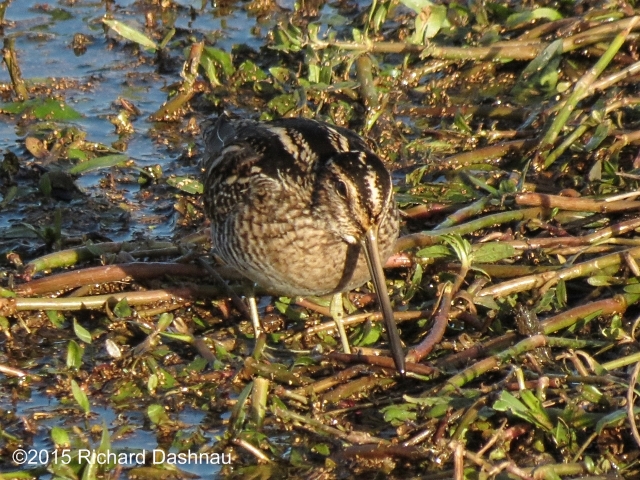
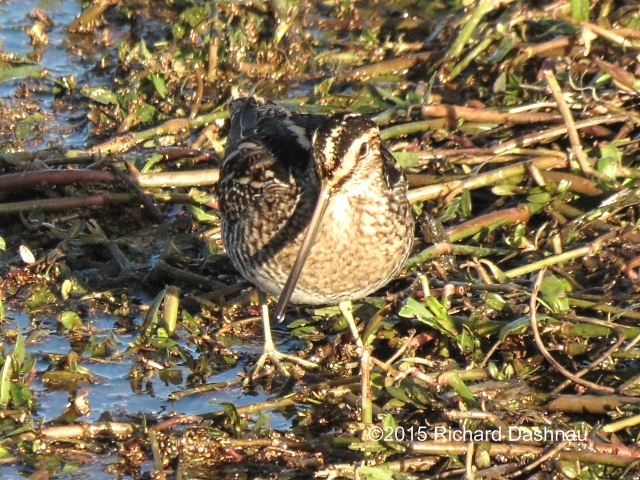
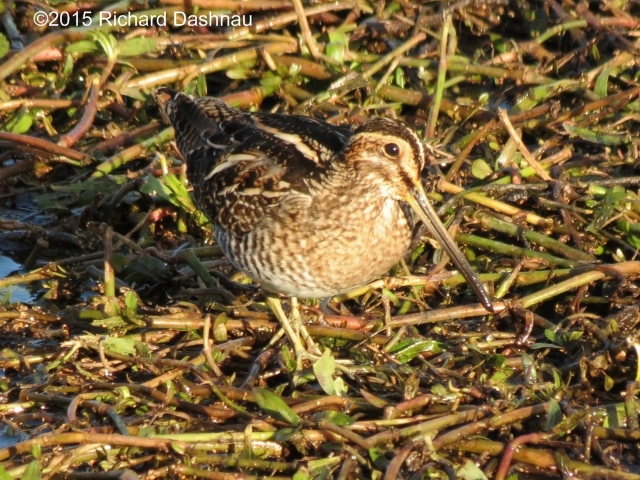
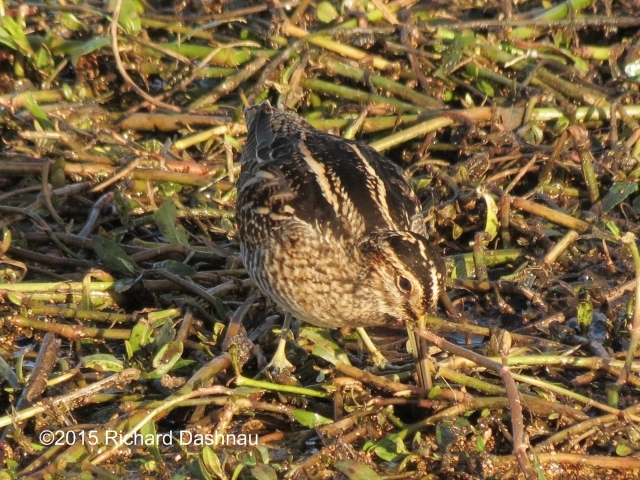
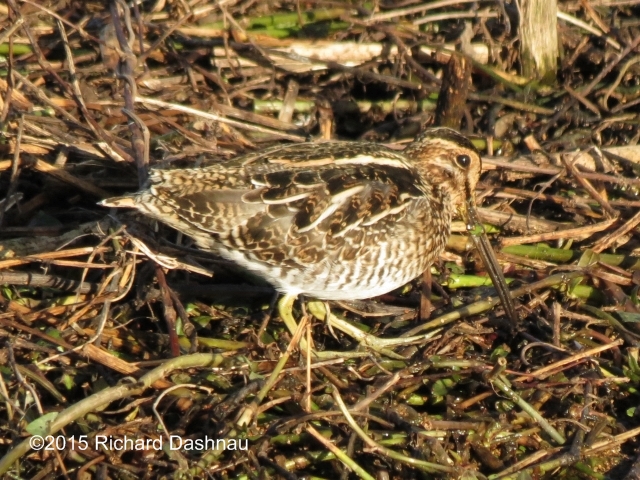
AMERICAN BITTERN 1---      --- AMERICAN BITTERN 2-------- AMERICAN BITTERN 3-     ---- AMERICAN BITTERN 4 ----AMERICAN BITTERN 5
The images above (bittern) show an American Bittern, which is usually a shy bird, and rarely seen. I think part of the reason for this is its amazing camouflage. I was taking pictures of this one, and trying to show it to some park visitors and they had a hard time seeing it. Click here(mpg 1,681 kb)  to see a short movie of this bird, and you'll see what I mean.

May 12, 2002  I watched a few of these Green Herons (sometimes called Greenback Heron) feeding today. Sometimes, one of these small birds will catch an insect, and drop it into the water. Then, the heron will watch, and when a fish comes up to investigate the insect, the heron grabs the fish. While I saw a few Green Herons fishing today, I didn't see any of them using bait.  I was able to get a short video clip of one of these herons spearfishing.  Click the links to download the flv video file(246 kb) or an mpg file(1,304 kb). While watching the clip, try not to blink, or you'll miss the long neck extension as the spearing is done. (GREEN HERON HUNTING, below)
-------------------------------------------------
   GREEN HERON HUNTING--                           --GREEN HERON FISHING WITH BAIT
May 18, 2002  Last week I talked about the Green Heron, and its habit of using live bait to catch fish. I wouldn't be surprised if some visitors to this site found that story hard to believe. This week, I was able to see some Herons doing it! (Not "it". Fishing with live bait. Jeez....) The image above, (GREEN HERON FISHING) shows a Green Heron in the act of placing its bait. This was a continuous process. As the bait would float or swim towards the lily pad, the heron would pick it up and place it back in the water.  Watch these two clips if you'd like to see this.  Look very carefully at the speck the bird is placing in the water. It is a bug of some kind, but this all happened about 20 yards away, and I had to use the video camera to bring it closer (which is why the image jerks around. Sorry.).  So, I couldn't tell exactly what it was.  Clip one (flv video 477kb) or (mpeg 1,843kb) shows a few repetitions of the bait placement. Clip two (flv video 559kb) or (mpeg 3,034kb) shows one more baiting, and then a lunge at food.  However, the fish got away.  One of these days, I'll get a clip of a successful stab at a baited fish.  When I do, it'll show up here.

June 16, 2002  It's time once again to see our friend the Green Heron. As I promised, I tried to get some video of a successful fishing trip. Here it is, with some more pictures. The Rickubiscam this week shows the heron with its catch.
----
   BAIT DRIFTS IN                GENTLY GRAB THE  BAIT       HERE' S A GOOD SPOT           TIME TO WAIT                      GOT ONE!
 As I've shown before, there is a repetition of bait, watch the drift, grab, bait.... This time, however, there was a "stab" and a successful one. Click on the following links to view the clips. Heron Snags It part 1 flv video (404kb)  or mpg ( 1,818kb)  Heron Snags It part 2 flv video (410kb) or mpg ( 1,753kb).  To see previous Green Heron pictures, go to the Critters of Brazos Bend page 1.

March 02, 2003
--------------------------
                 TICK                       GLOOP1                      GLOOP2
I was talking to some park visitors when we here this really odd sound.  Everyone got quiet, and someone asked "What the heck was that?" I heard it again, and I guessed that it was an American Bittern, but I'd never heard one before. However, Donna (she knows who she is) had described it to me, and she'd hit it right on the money. After a little search, I found it. The pictures above and below (starting with TICK, and through  GLOOP3) show frames from a movie clip that I was able to capture with the Olympus C-700.  The captions are how I would describe the sounds I heard him making. Gloop 1-3 are three stages of a single deep sound.   Of course, I'd only intended a quick trip, so didn't bring my video camera.  Click the following links for two flv video clips of the Bittern calling clip1(656 kb)  clip2(654 kb). He was about 30 yards away, and blends in with the grasses, so the resolution isn't that good. I've also included an .mpg (2,619 kb) file of the second clip that's a little clearer (but much larger!). One never knows what one will see at this park. The last image (AMERICAN BITTERN) is a little better photo I was able to get as he was walking.
-----------------------------------
              GLOOP 3                  AMERICAN BITTERN

March 30, 2003  Above is a  picture of the American Kestrel that we have at the park. Isn't it beautiful? This is a captive bird, obtained from a rehabilitator only after the correct permits had been applied for and granted (and this is a state organization!).  This Kestrel's wing was severely damaged some time (years) ago by contact with a power line, rendering the Kestrel unable to fly ever again. This is the only reason that this fine animal can be legally kept at all.  So, DON'T EVEN THINK ABOUT IT!
Then there was this American Bittern that I was watching out at the Creekfield trail. I watched as it hunted for a while and then, to my surprise, it waded to shore, about 12 feet from me (HERE HE COMES, below). Then, he (she?, I noticed that there were no dark markings around the throat, which I believe means it was a juvenile bird), crossed the trail. (See BEEP-BEEP!, and MADE IT, below.)  Just as he was in the middle of the trail, some park visitors came into view behind me. I believe that he stopped to try his "vanishing trick" (See, CAN YOU SEE ME NOW?, below) but he might have just been trying to get a better look at the approaching people.  He finally flew off when the visitors got closer.
------------------------
         HERE HE COMES                        BEEP-BEEP!                           MADE IT!                   CAN YOU SEE ME NOW?

April 19, 2003 Today, Earth Day was celebrated at the park. As part of my contribution to the effort, I was signed up to lead an "alligator hike" at 2:00 pm. I was able to get out to Elm Lake at about 11:30. As I was passing the last pier, I heard another headslap from near the same area that I filmed last weekend. I approached a pod of baby alligators (about 14 lined up on a log) and their mother in the water right at the trail intersection. And the rest of the alligator stuff today is in my alligator pages.

January 18, 2004  Okay, so we got a little cool weather today.  No big deal. Not when compared to the below-zero (F!) temperatures that have been reported in the Northeast US this week! So, the temperature stayed under 45 degrees, or at least it felt that way at Brazos Bend State Park. We'd gotten about 3 inches of rain recently, so water was high, and it was flowing nicely over the spillway between Pilant Lake and Pilant Slough. If the weather had been a bit warmer (perhaps mid-sixties with lots of sun), alligators would have been there, looking for fish being swept through the spillway. The alligators didn't show, but quite a few of our wading birds did.  The last image below (GREAT BLUE) is a nice close-up shot of a Great Blue Heron.  When I first saw this heron, it was perched on the rail of the Spillway Bridge (see TOLL, ONE FISH, below)
----------------------
    PAY TOLL--ONE FISH                        WATER'S FINE!                               GREAT BLUE
The person in the picture is quite a bit further down the trail, and is only that small in perspective. It's a Great Blue Heron, not a Humongous Blue Heron, after all. Then, it jumped into the water, and walked under the bridge and I used the opportunity to sneak up closer and catch it standing (see WATER'S FINE!, above).  It's always impressive to see these birds take flight from nearby. They are BIG.  See a bird of this size perched on the bridge handrail was an arresting sight by itself, but seeing it open its wings and flap from about thirty feet away can make you hold your breath for a second.  It just seems so odd to see a bird so large standing on anything but the ground.
Visitor attendance at the park was slow, and it was a pleasure to be outside at the silent park watching the wading birds fishing (a lot of them seemed to be eating crawfish).

May 15, 2004; I took this picture of the Purple Gallinule just because they have such brilliant colors (see Purple Gallinule, below).
-------------------------------
                                         PURPLE GALLINULE

4/30/2006--I've never seen so many snakes being eaten by birds as I have this spring.  The average water level at the park has been declining since last year. I don't know if the two events are related, but it's possible that the limited amount of aquatic hunting ground has concentrated the snakes (and all other aquatic creatures) into a smaller area, thus making them easier for the birds to find. I've seen snakes being eaten by American Bitterns, White Ibis, Little Blue Herons, and even a Grackle. Here are some pictures of a Great Blue Heron which I just caught a glimpse of as it was finishing off a snake. I can't really tell what kind of snake it was, but I'm pretty sure by the overall color and comparative size of the head that it is non-venomous. This short video clip (  HERON WMV 1.4 MB ) shows the heron apparently having a bit of trouble getting the meal to go down.
-------------------------
                    SUCCESSFUL HUNT                                                  BETTER CLOSEUP VIEW
5/07/2006 I've already mentioned that I've seen a number of snakes being eaten by birds this spring. Here, a Little Blue Heron ( egretta caerulea ) has caught a small snake. The snake appears to be  a Gulf Crayfish Snake ( regina rigida sinicola ).  My copy of Texas Snakes by Werler and Dixon (third printing) shows the snake on plate 118 and describes it on pages 244-246. I going mostly with the color of the belly scales for this identification.  The snake is non-venomous. Even in pictures, one can see the difficulty the heron has with prey of this type.
Imagine eating with chopsticks (some of you may do this regularly. I have.) Consider how difficult it can be to pick up just one soft noodle from a plate using the chopsticks. Now, animate that noodle, and imagine that it can bite, and might be venomous. Finally, imagine that the your eyes are on one end of the chopsticks and that they would therefore be at risk from that animated, possibly venomous, noodle. You may now have some idea of the complexity of the activity that this, and similar birds, have to perform time and again, for their entire lives.
----------
      A SUCCESSFUL HUNT            CLOSER LOOK AT THE MEAL        NOW, WHAT?                      A TANGLED SITUATION                MAYBE THIS WAY
While watching this kind of event, I wonder how much compression force the bird can generate with its beak. While the bird seems to be squeezing the snake
( sometimes on its head) the snake, in most cases, seems to be moving vigorously throughout all this. It seems that most of the mortal damage is inflicted by stabbing motions of the beak as it is rammed into the prey as it is dropped and repositioned. In most cases I've seen the snake (or other prey) appears to be still moving as it is swallowed. You can see a short video clip of the Little Blue Heron in action here (wmv 1.5 mb).
This happened on the North part of the 40-Acre Lake trail, on the North side of the trail (in Pilant Lake), about midway between the Observation Tower and Hoot's Hollow. In these pictures, you can see how low the water level is.
----------
     THE SNAKE'S BELLY               BY THE TIP OF THE TAIL        DORSAL VIEW OF THESNAKE               FINALLY GOT IT!          VIDEO CLIP WMV 1.5MB

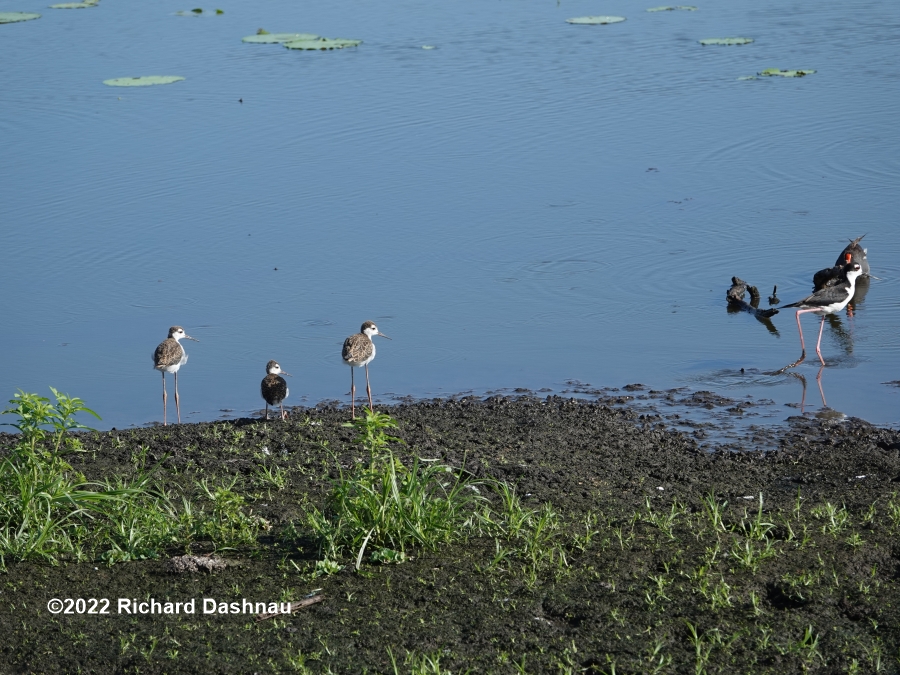
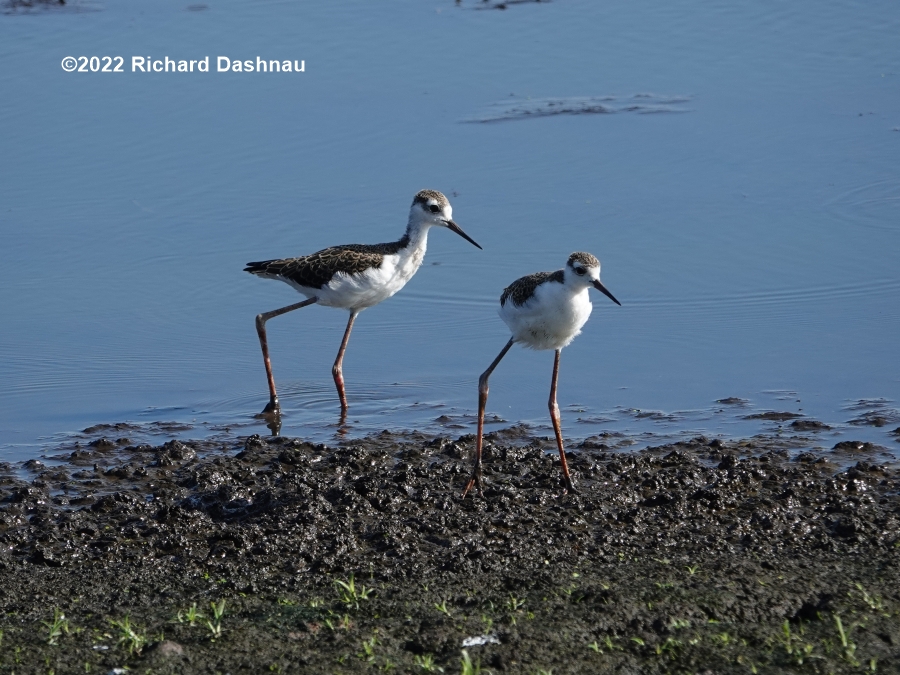
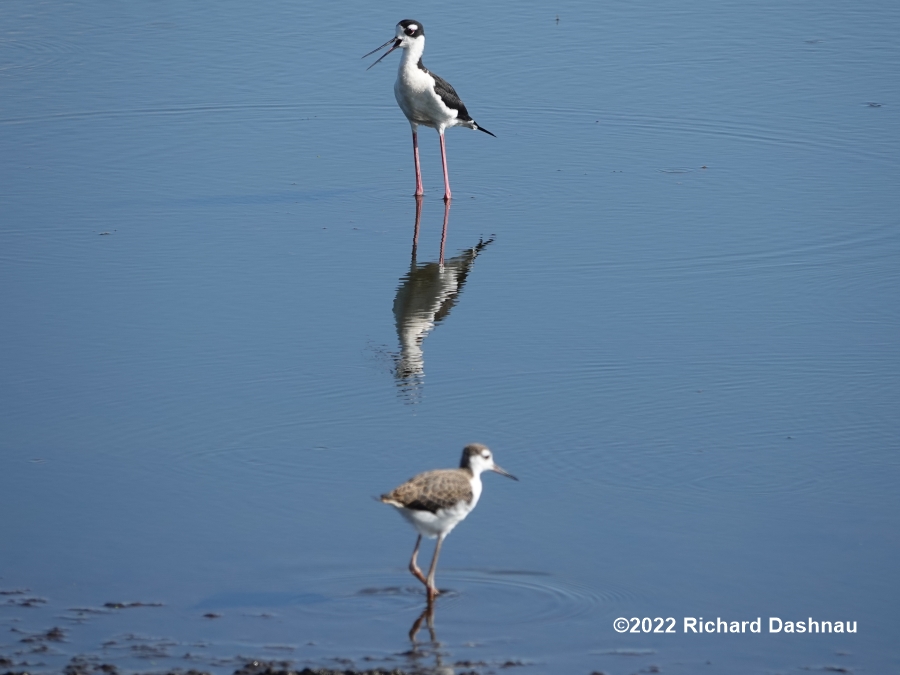
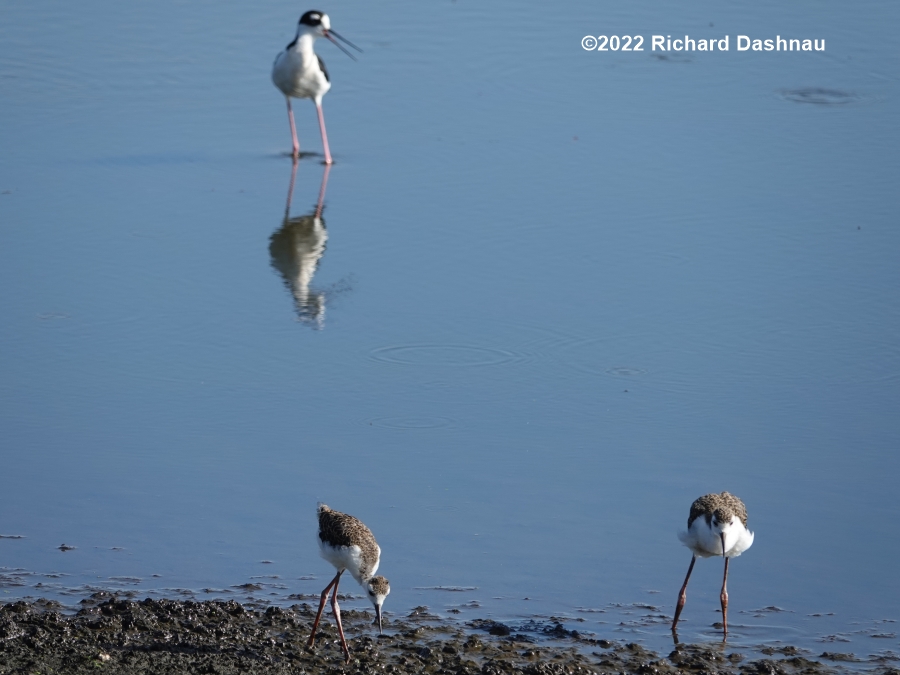
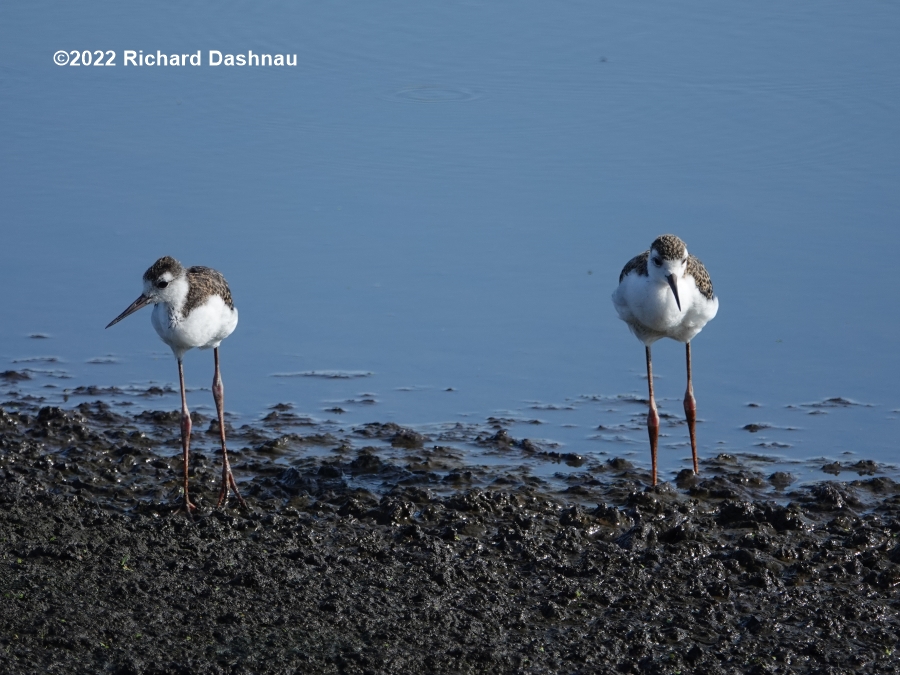
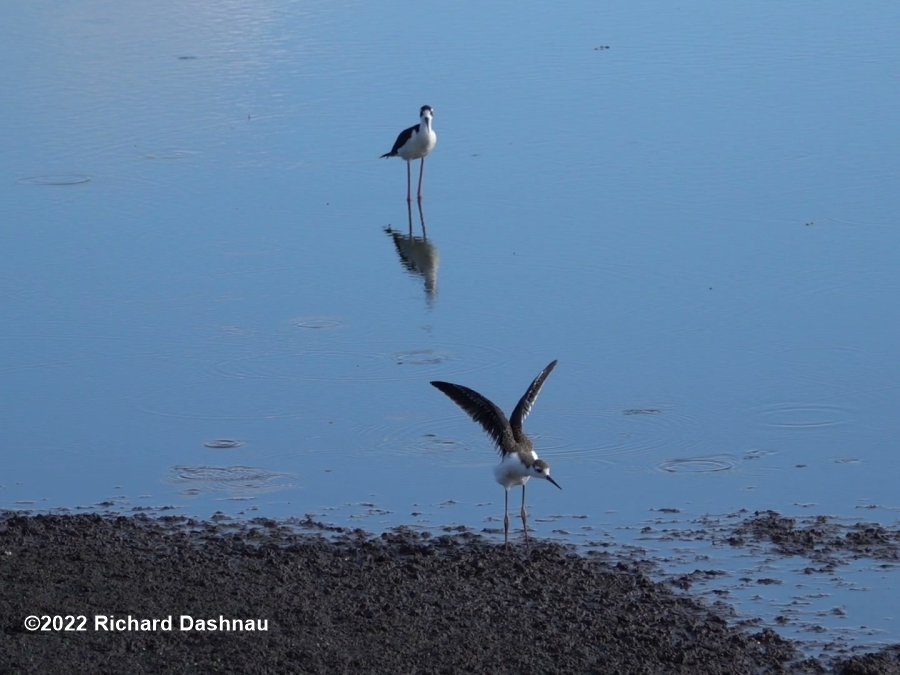
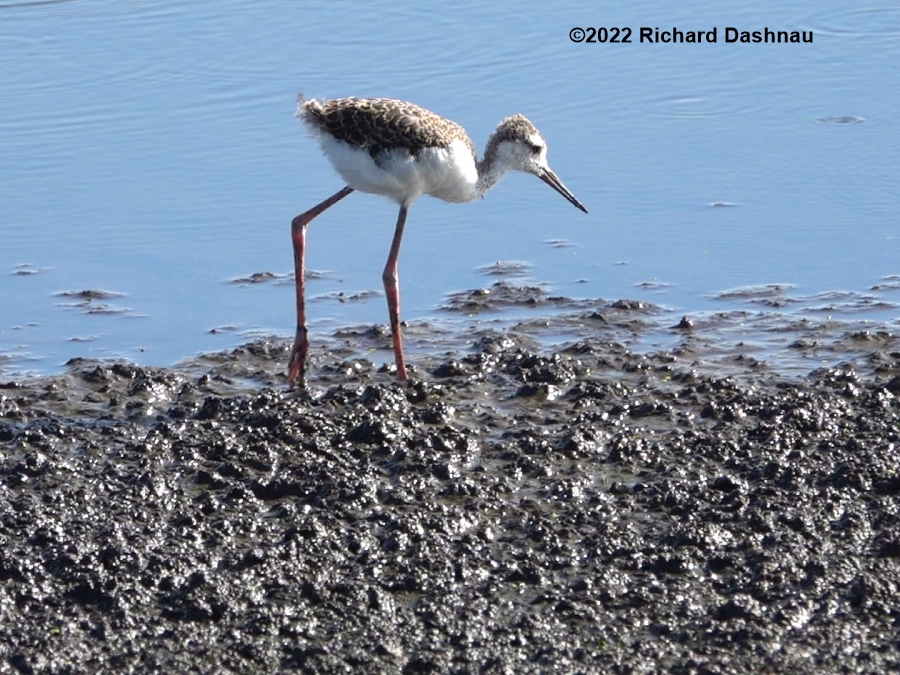
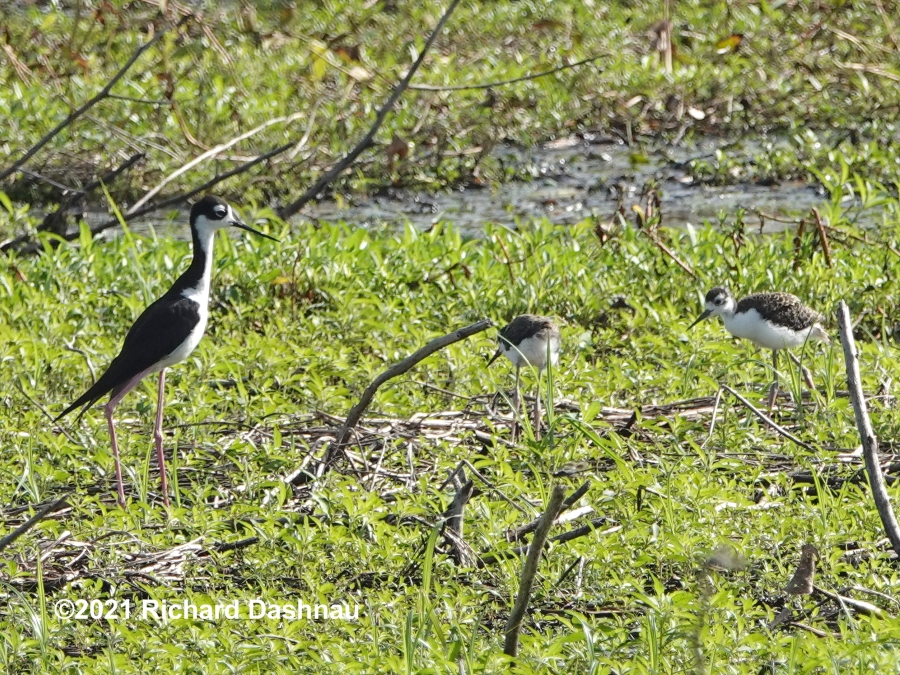
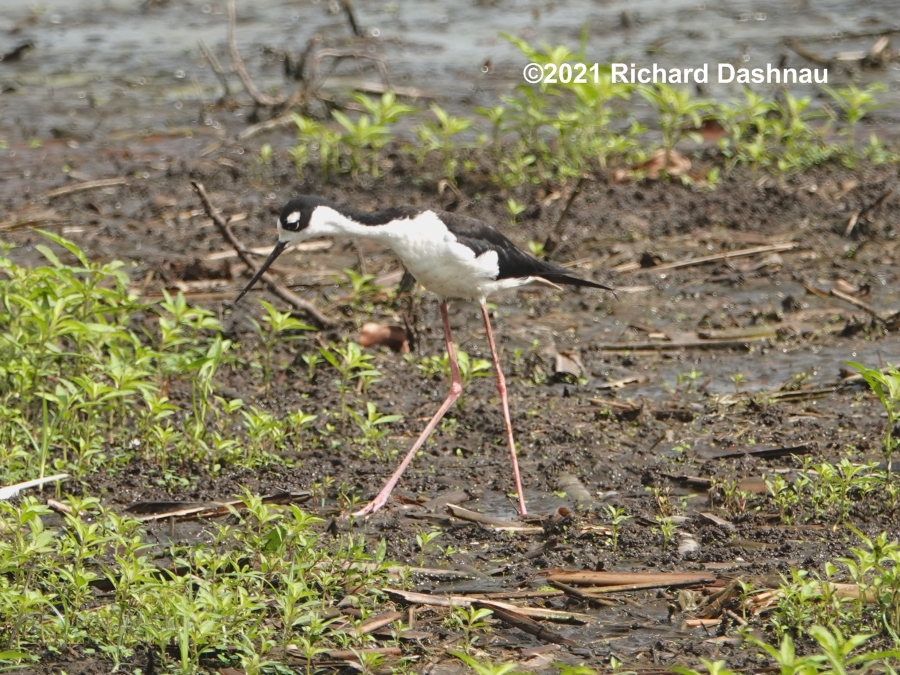
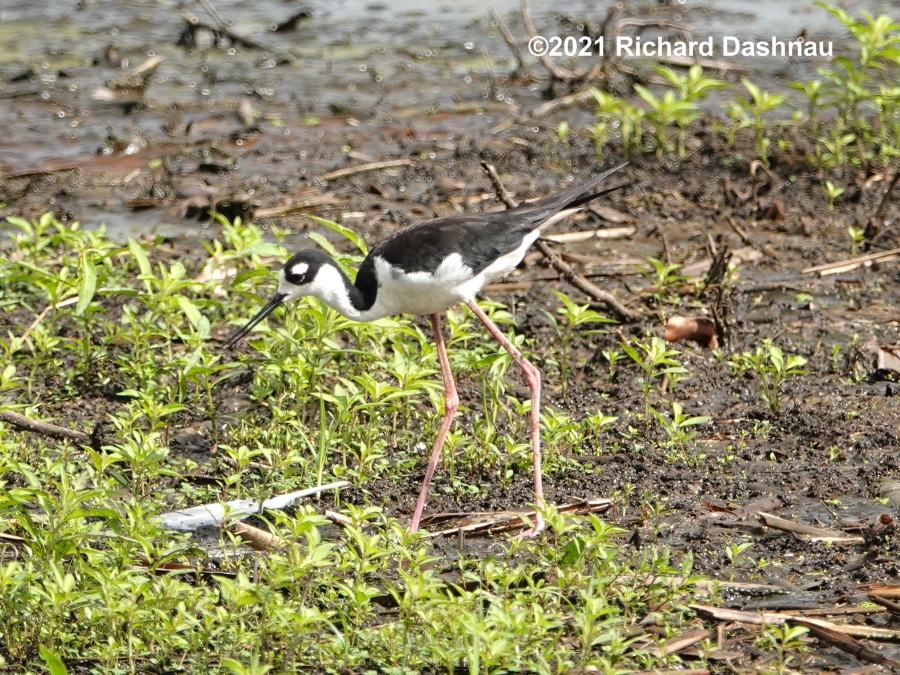
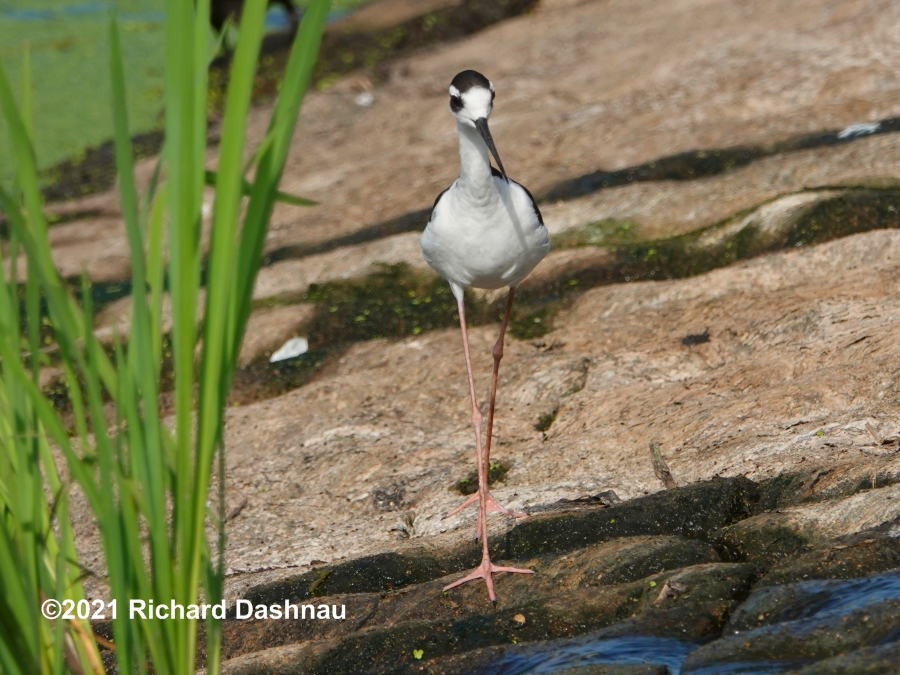
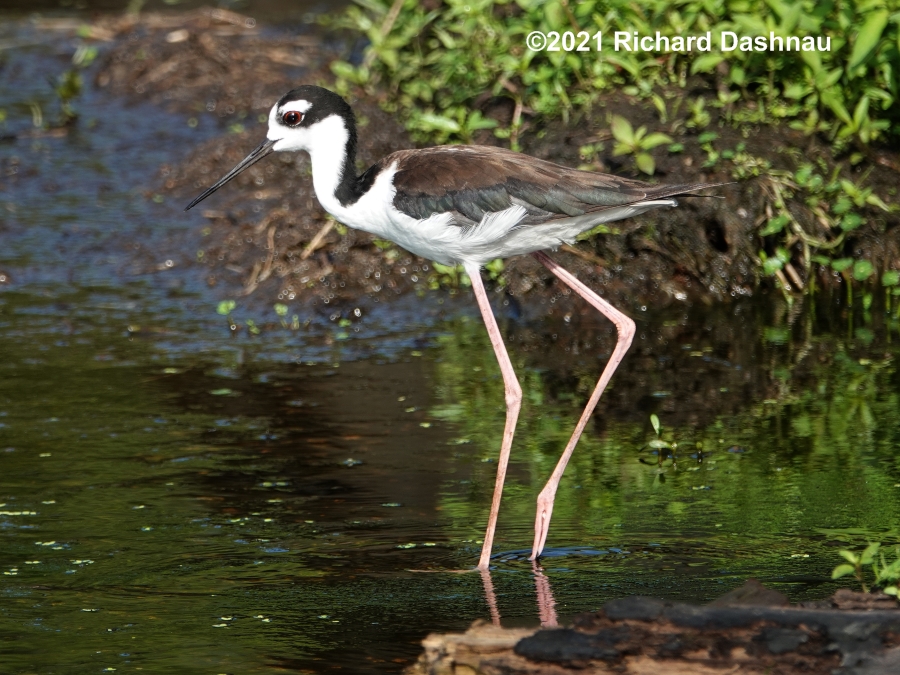
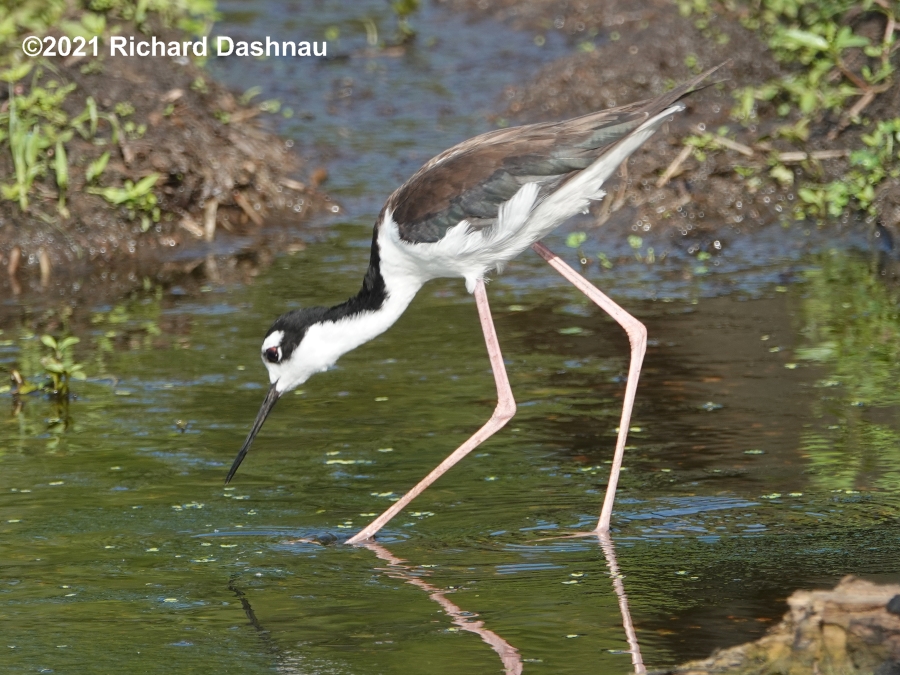
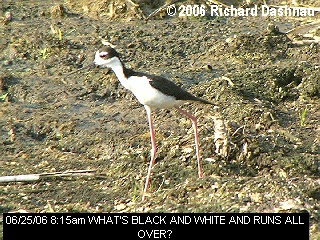
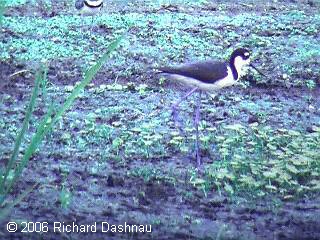
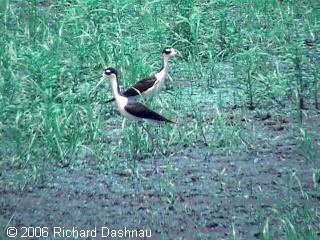
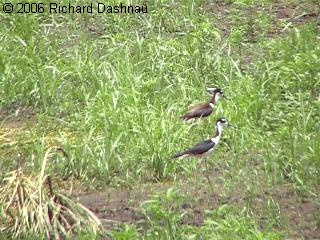
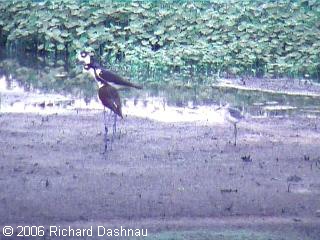
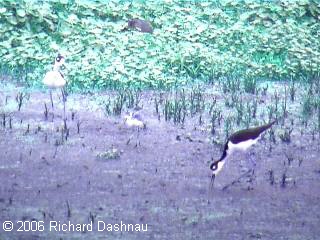
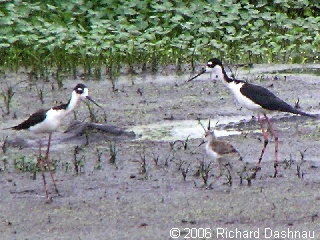
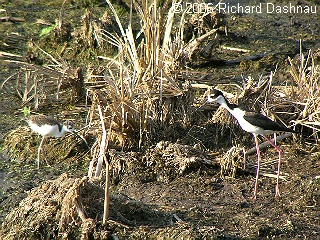
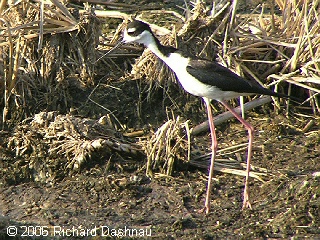
June 25, 2006--This is actually one of my last sightings of this striking bird. The first time I noticed one was a few weeks earlier, on 5/28/06. I was walking along the North side of the 40 Acre Lake trail when I saw this visually-arresting black-and-white bird. Something about the colors, or the way they are arranged pleased me, and I stopped immediately and just watched the bird. When I returned to the VC/NC, I described the bird to Beth, and she immediately identified it as a Black-Necked Stilt. The Black Necked Stilt (Himantopus mexicanus) is not common to Brazos Bend State park, but has started feeding there because the water level at the lakes has dropped so much.  Stilts eat water insects and even snails, according to The Encyclopedia of American Birds, by Michael Vanner.
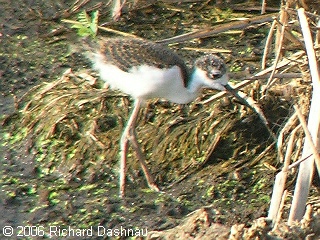
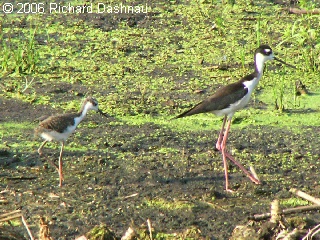
Since I liked them so much, I tried to take pictures when I could get close enough. They seemed rather shy. Eventually, there were young Stilts walking around.
Below, I have some pictures and links to video clips of these interesting-looking birds. Look how long their legs are, and watch that odd "sitting" position they attain by bending their legs and resting on the their shins.
-------
                                                               5/28/2006                                 6/04/2006                                 6/04/2006                          6/18/06 with alligator               6/18/06  past alligator
                                         5\28\06 clip 5800 kb wmv6\04\06 clip pt1 2800 kb wmv   6\04\06 clip pt2 3400 kb wmv    6\18\06 clip pt1 4400kb wmv    6\18\06 clip pt2 6200 kb wmv

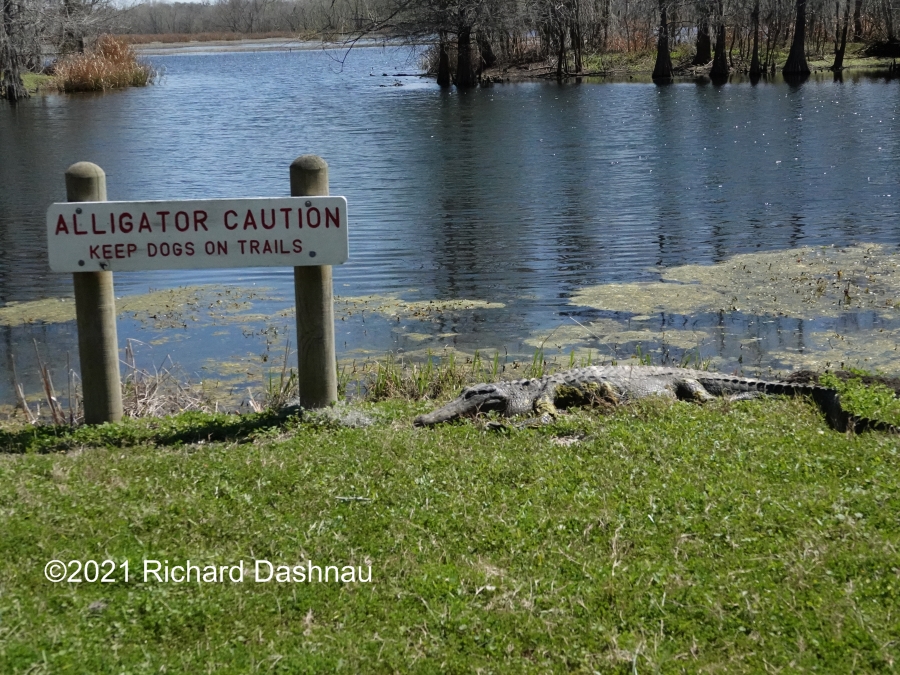
In the clips from 6/18/06 above, I noticed the alligator only after I'd been watching the Stilts through the camera for a while. The parent Stilts, however, appear to be very aware of the alligator.  The Stilts are very protective, and I like how the two parents walked--in the last clip--along with the young one between them.
Below, I have some pictures and more pictures from photographs (those above are frames from video clips) . The first one shows the two aduly Black-Necked Stilts with the young one, and the alligator behind them, taken on 6/18/06. The remaining 4 show the young Stilt with the parents walking around on what used to be the bottom of 40 Acre Lake.
-----------------------------
----------
   JUST KEEP GOING, YOUNG'UN         PARENT AND YOUNG               CLOSEUP OF YOUNG                      THE PARENT STILT             ADULT AND CHILD WALKING
Those Stilts were walking on mud that alligators were swimming over just a few months ago. The alligator with the Stilts above was forced to push its way through that muck. This must tire the alligators, plus it makes foraging difficult.

07/16/2006--From time to time, a park visitor will come up to me and ask about the "flamingos" that they've seen in the park. While larg, pink wading birds do visit the park occasionally, they aren't flamingos. They are Roseate Spoonbills (Ajaia ajaja). I've seen them from time to time, and there was even a group of them staying on the 40 Acre Lake island for a few weeks. But I've never been able to get close enough to watch them. Until today.
We had been favored with a little rain, and the corner of Pilant Lake near the Elm Lake water station had filled nicely. A few Spoonbills were foraging in the water, and to my great satisfaction, they allowed me to take some pictures and video.
A look at the Spoonbill's head will immediately tell how it got its common name. The end is flattened horizontally and rounded. The bird sweeps its bill from side-to-side in the water, catching the small creatures that it eats. Although the bill may look a little odd in air, its shape allows for efficient work in the water. According to The Encyclopedia of American Birds-by Michael Vanner, Roseate Spoonbills mate for life and lay two or three eggs per nesting.
The image directly below is cropped from a frame of the video of two of the Spoonbills together.
-------
The images below are cropped from larger photos I shot, and from frames pulled from the video clips I caught. Links to the video clips are below them.
-------
          STANDING TALL                    WALKING A LOG               WALKING A LOG, CLOSER               TWO OF THEM                 THE SPOON-SHAPED BILL              SPOON DIPPING

-----
      DRY OFF FOR A BIT               CLOSEUP OF THE FACE          THIS IS MY BETTER SIDE                   SWEEPING                        A LITTLE BLUE HERON                  FACE-TO-FACE
                                                                                                                                                SWEEPING 4000 kb wmvWITH LITTLE BLUE  2700 kb wmv  FACE TO FACE 2700 kb wmv
The first clip (SWEEPING) shows the sweeping motion of the bill. You can see that when it grabs something, the Spoonbill tosses it up and swallows it. The second clip (BLUE HERON) shows a Little Blue Heron passing, and then more Spoonbill sweeps seen from the rear. Keep in mind that all of these beautiful birds are free. That is, not in a zoo. The birds are in their own habitat and come and go as they like. And I'm lucky enough to see them.   Even with the dry conditions (and now heat over 90 degrees) Brazos Bend State Park is a joy to visit! The third clip (FACE-TO-FACE) shows a pair of the Spoonbills. There seems to be a moment when they look eye-to-eye, and the one on the right seems to signal with a slight opening of its bill.  While the Spoonbills, and other birds I've mentioned in these pages, can be sometimes be found easily if you know where to look elsewhere in Texas or the United States--almost ALL of the birds I've shown have been seen within a mile and a half radius around the observation tower! And they are ALL WILD!

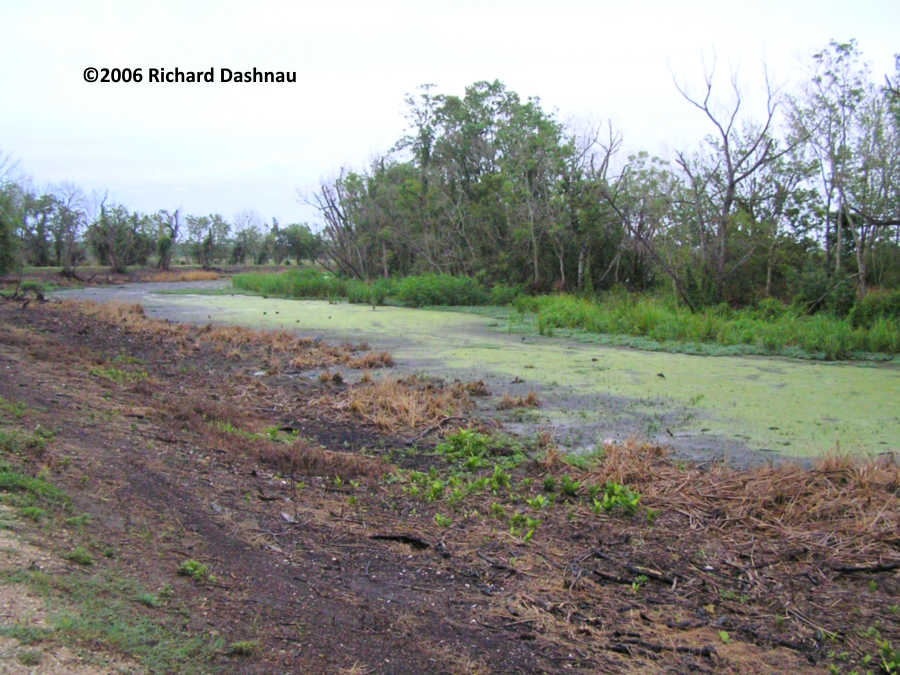
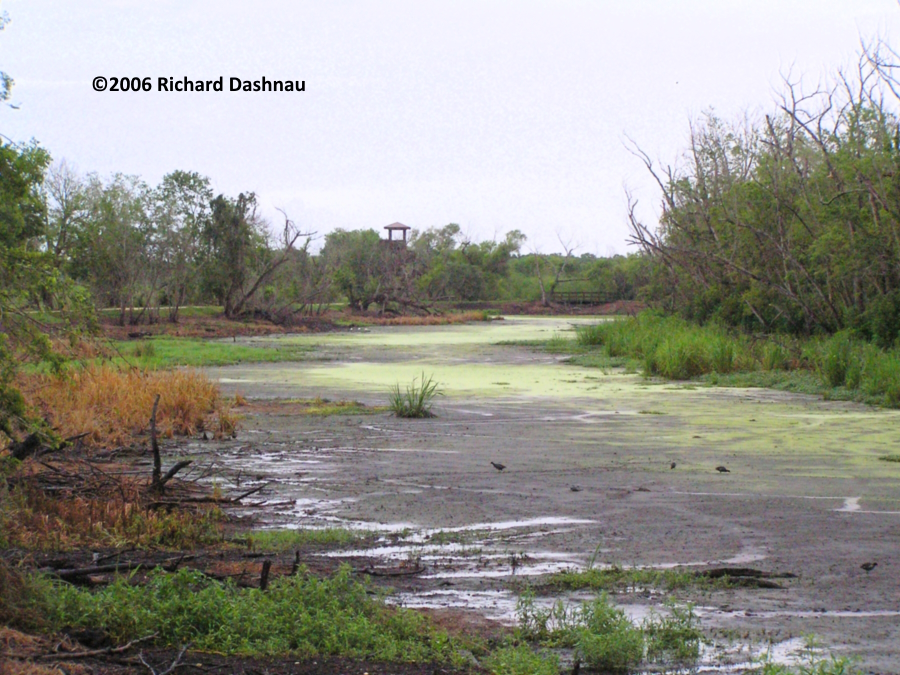
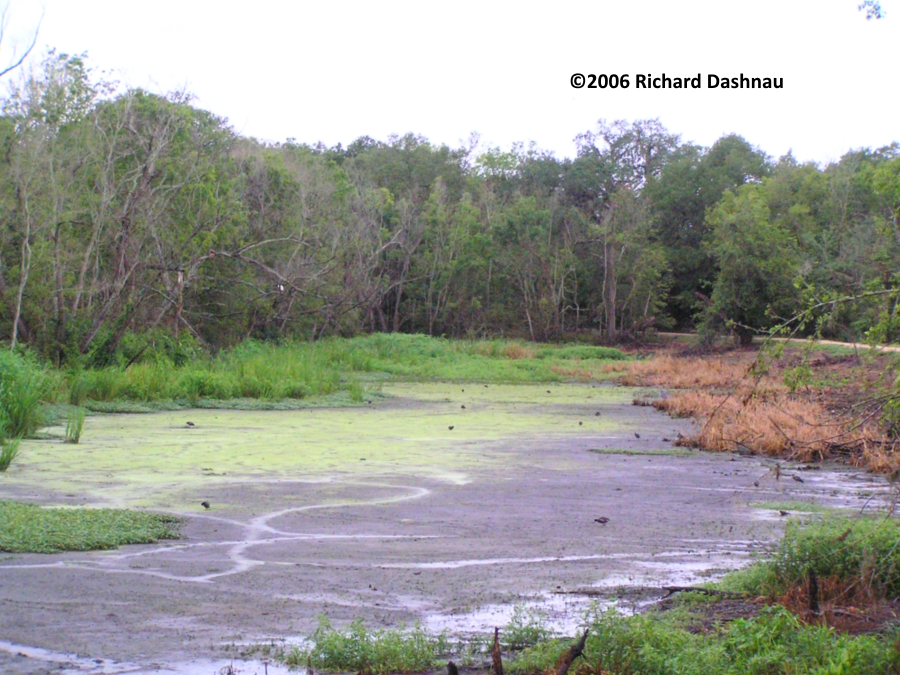
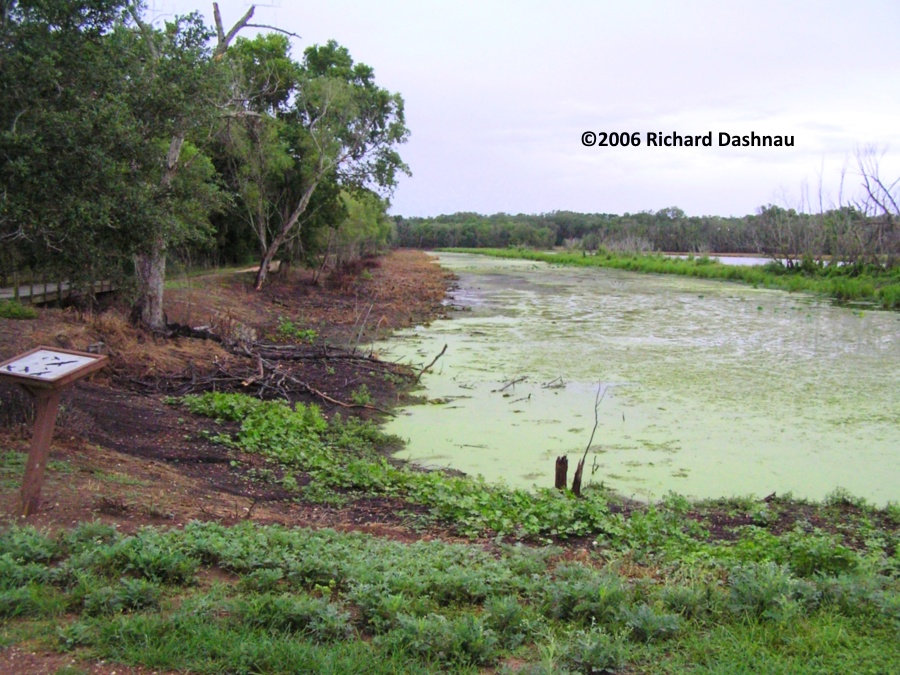
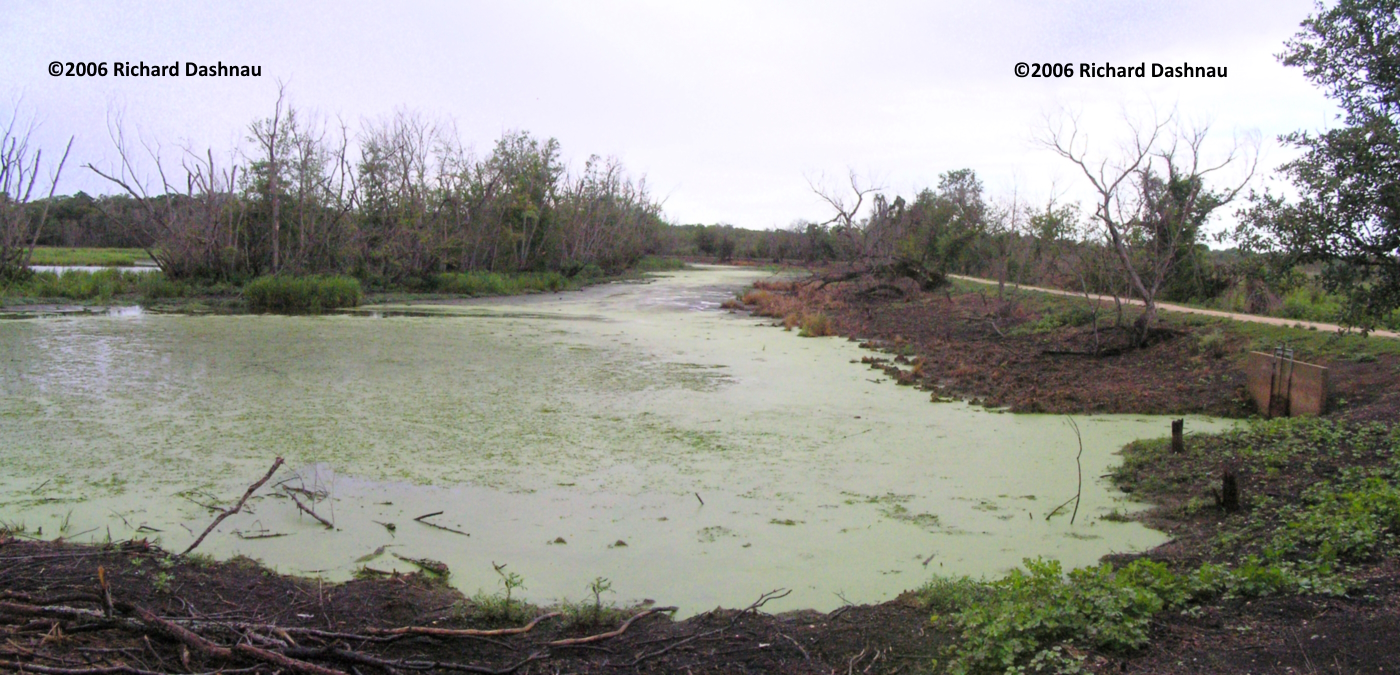
08/06/2006--BBSP finally got some rainfall about 4 weeks ago. There was enough water in Pilant Lake to allow some filling of 40 Acre Lake by opening the floodgate between them. When the water levels equalized, the gate was closed, and a diesel-fueled water pump was set up to continue filling the lake. The first image below (FILL THAT LAKE!) shows the pump in action.
The two images below show the improved appearance of the lake.  Compare them with the two images from 06/18/06 further down on this page.
----------
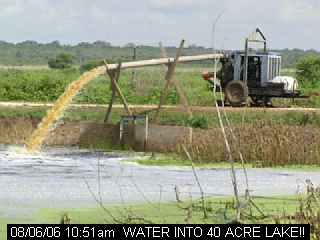
             FILL THAT LAKE!                       BETWEEN HOOT'S BENCH AND OBSERVATION TOWER                                 NEAR THE OBSERVATION TOWER
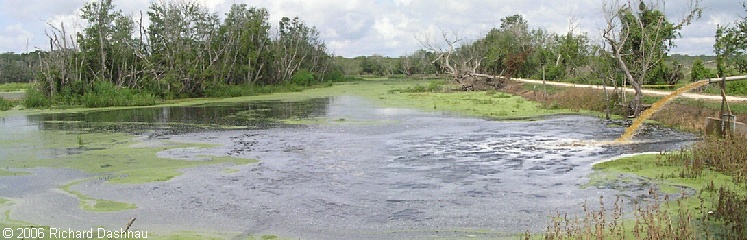
That's some improvement, right? This changed over 4 weekends.
Many of the animals that live in the lake were taking advantage of the water, and the food that was growing. In an odd turn of events, the primary water level rise (from opening the floodgate) caused many of the larger fish remaining in what was left of 40 Acre Lake to die. General opinion is that there was an oxygen depletion (perhaps caused by silting). Only the larger fish were affected, as there were many, many small fish remaining.
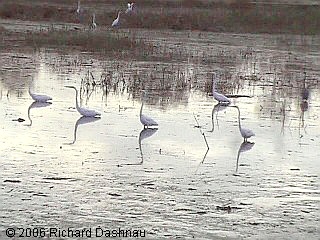
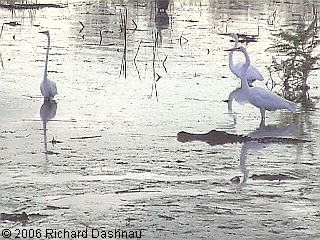
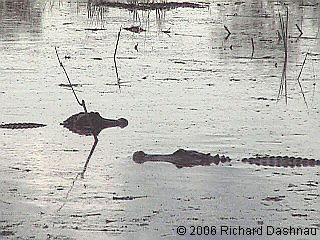
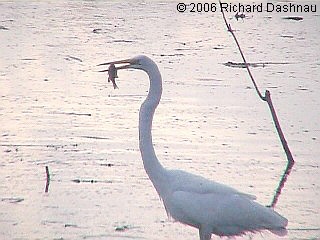
On the morning of August 6, I stood on the 40 Acre Lake fishing pier, and watched a group of Great Egrets catching fish. They were soon joined by a number of alligators. I thought it interesting that although an alligator occasionally swam towards an Egret, it didn't seem to be interested in catching the bird. Instead, the alligator seemed to be watching the area around the Egret--perhaps looking for fish the Egret had dropped, or for fish that it learned would be near a hunting bird. On the other hand, sometimes (less frequently than the first case) an Egret would go near an alligator, and they would both be facing the same spot in the water. Perhaps the Egret was watching for fish disturbed or distracted by the alligator's passage.  The series of images below are single frames from some
short video clips. The first  clip 4519 KB (OOPS...), starts with an Egret trying to un-spear a fish...which it drops. Then it seems to be looking straight at me (I was at least 20 yards away) like it's MY fault that it dropped breakfast. Then the camera pulls back and pans across to show the group of Egrets (and one Great Blue Heron). The splashing sound in the clip is from alligators pouncing.
---------------
    OOPS, AND SLOW PAN ACROSS       PARDON ME, EXCUSE ME              HEY!, CATCHING ANYTHING?             HOW A PRO DOES IT
  VIDEO CLIP 4519 KB                 VIDEO CLIP 14,621 KB                   VIDEO CLIP 4027 KB               VIDEO CLIP 9035 KB

The next clip 14,621 KB (PARDON ME...) shows a larger alligator as it swims through the group of Egrets. Notice how each Egret steps aside very delicately as the alligator approaches--except for one, which makes a short hop of a few feet. It landed in the path of the alligator though, so still has to step aside. By the end of the clip, the alligator has gone near two other alligators. One of these, then another, pounces, but without apparent success. The next clip 4027 KB (CATCHING ANYTHING?) is a closer view of two alligators passing. One does a sideways snatch after the passing, while the other one passes some Egrets.
The final Egret clip 9035 KB (HOW A PRO...) shows a successful catch and swallow. Notice how the Egret repositions the slippery fish before tossing it that final time and swallowing the fish.  I think the number of Egrets, and Alligators hunting; and the large number of fish are good indications that the lake will have a good population of fish before long.
Finally, there is  one more clip 4840 wmv . This is of a bullfrog calling, and the little "poot!" noise that Bullfrogs make sometimes after a bout of calling.
-------------------------
                                              HI  DIDDLE DIDDLE AMPHIBIAN BULL FIDDLE
                                                    VIDEO CLIP 4840 kb wmv
A large number of Bullfrogs can be heard in the clip. It is illegal to catch or molest any animal (with the exception of fish) at BBSP. Frogs cannot be legally caught IN ANY WAY at BBSP.  Although fishing is  allowed, State fishing regulations must be followed.
Leave the animals you see at BBSP alone, so that other visitors may enjoy seeing them (and also to avoid being ticketed and fined).

12/03/2006--As I hurried back to lead my hike, I saw a group of White Ibis in some trees, and this one posed for me. I just liked the picture, which you can see below.
------------------------------------------------------
------------------------NICE IBIS!--------------------------------------------------------NICE IBIS CLOSER!

11/30/2008 As a last experiment, I took some photos and video clips of some White Ibis foraging. I was able to shoot some video of a White Ibis taking off. I shot the video at 420 frames per second. When I reviewed that clip, I was amazed. The Ibis' wings unfolded and went straight UP to meet over the Ibis' back. Then with just ONE downward flap, the Ibis becomes airborn. The images below are some frames pulled from the clip. The clip can be seen here (wmv 4.0 mb).
--
  WINGS GO STRAIGHT UP!          WINGS PUSH DOWN                       IN THE AIR!

01/04/2009--  I was walking along 40 Acre Lake trail at BBSP when a large flying bird caught my attention. It was white, and I thought it was a Great Egret. But, something about it didn't seem right, so I looked at it through the binoculars. It was was a White Pelican! Pelicans hardly ever visit the park, and I watched as it flew out over Pilant Lake. I just assumed it was passing through. I climbed the Observation Tower to see what I could. It was pretty cold, and the breeze up at the top is pretty strong. My eyes teared profusely, making difficult to see in some directions. When I looked out over Pilant Lake, I found the Pelican again, and so I was able to observe it through my camera. The full optical zoom (20x) didn't help as much as I'd have liked, so I tried the digital zoom (100x), and it worked surprisingly well. Today's RICKUBISCAM (see RICKUBISCAM 01/04/09 below) is a frame capture from one of the video clips of the Pelican foraging in the lake. I was surpised at the leisurely dipping that the Pelican was doing. I found out (according to The Sibley Guide to Bird Life and Behavior) that this is common behavior for the White Pelican. The Brown Pelican feeds on saltwater prey, and dives onto potential food; while the White Pelican (the one I saw) prefers freshwater prey, and does this dipping behavior. The Pelican's beak with that large pouch (gular pouch) is used only to catch food--not to store it. The pouch is sensitive enough (I don't know the mechanism) so the Pelican can detect food even in darkness. The White Pelican can also have a wingspan of about 9 feet!  I wanted to try to catch some photos or videos of the Pelican taking off, but the cold finally made me turn out of the wind, but I at least shot some video footage of the Pelican foraging. An edited version of some of the clips can be seen  here (wmv 16.5 mb).
As I was looking the other way, some park visitors called up to me, and I turned in time to see the Pelican flying right towards the tower. I turned the camera around, and shot a couple bursts of photos. These are mostly blurred ( it's hard to focus on a flying bird). I did what I could with one of the images, and it at least shows this striking bird. (See Pelican Flyby below)
--------------------------------------
                                                          PELICAN FLYBY                                                              RICKUBISCAM 01/04/09

01/25/2009--  I was walking along 40 Acre Lake trail at BBSP when I spotted an American Bittern foraging amongst the plants. I watched it for a while. I hadn't seen a Bittern at the park for some time. Then, I shot a few pictures. Today's RICKUBISCAM is from one of them. I also shot some video of the Bittern stalking through the grass and grabbing food. I was able to get a good sequence of one of the beak thrusts, and subsequent swallowing. See (GULP!) below. To see the video, click  here (wmv 5.0 mb).   I've got a bit more material on Bitterns that I saw at the park on this page.
--
                          GULP!                                               RICKUBISCAM 01/25/09

If you'd like to know more about the park follow these links:

Brazos Bend State Park   The main page.

Brazos Bend State Park Volunteer's Page  The volunteer's main page.
 

           Go back to my home page, Welcome to rickubis.com
       Go back to the RICKUBISCAM page.
       Go back to the See the World page.