COWKILLERS; CICADA KILLERS; ANTS, WASPS
(and other
Hymenopterans) Polistes (paper wasps) have a separate page.
This
page was born 11/10/2006. Rickubis designed it.
(such as it
is.) Last update: 02/12/2022
Images
and contents on this page copyright ©2006-2022 Richard M. Dashnau
Go back to my home
page, Welcome
to rickubis.com
Go
back to the RICKUBISCAM
page.
06/06; 06/12 and 06/13/2021
(posted
6/25/21) While
going down the steps from my apartment, I noticed some quick
vibration near my feet. It
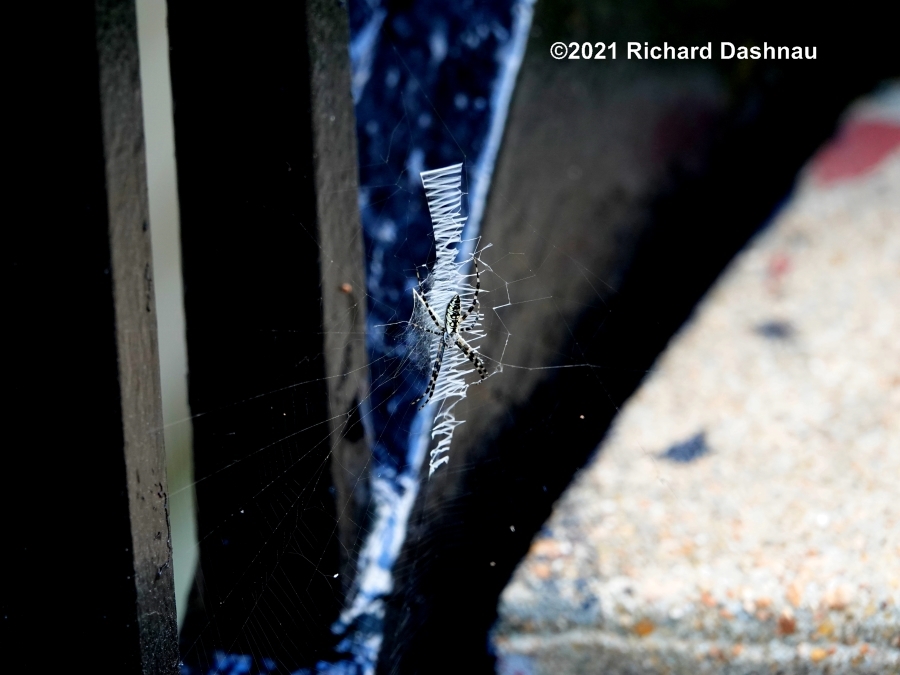
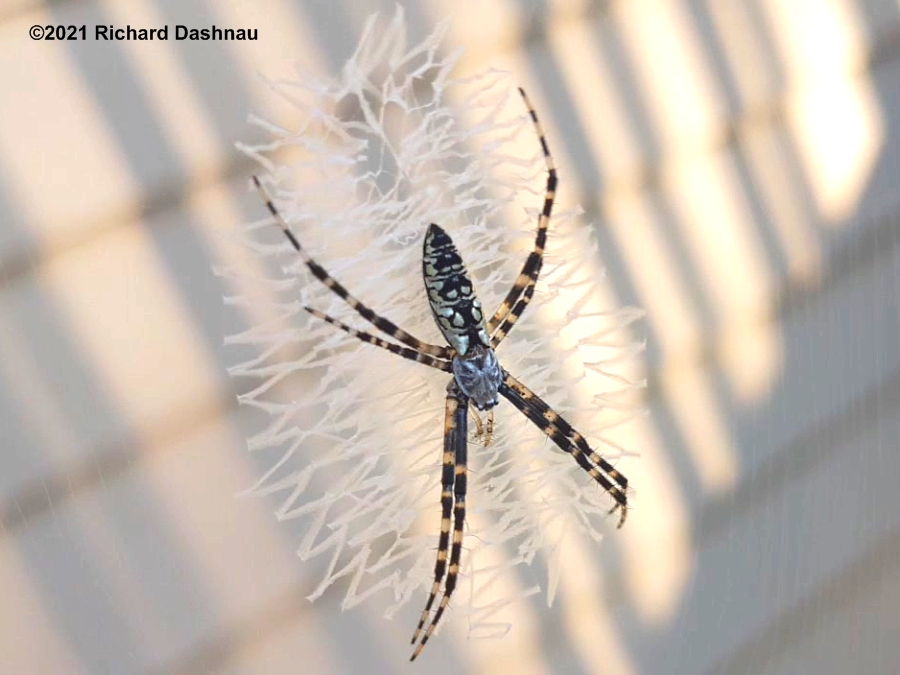
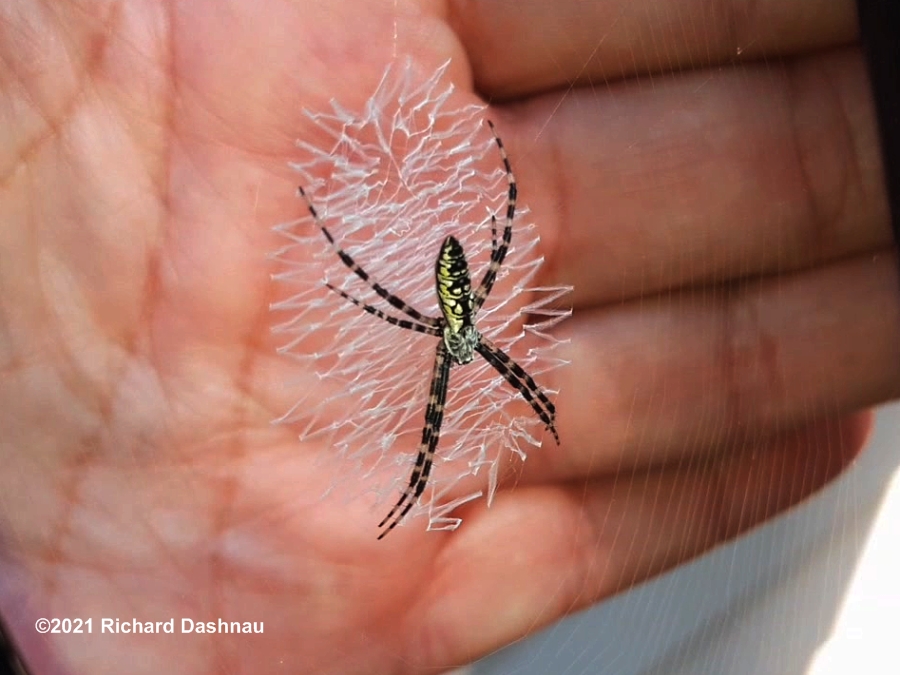
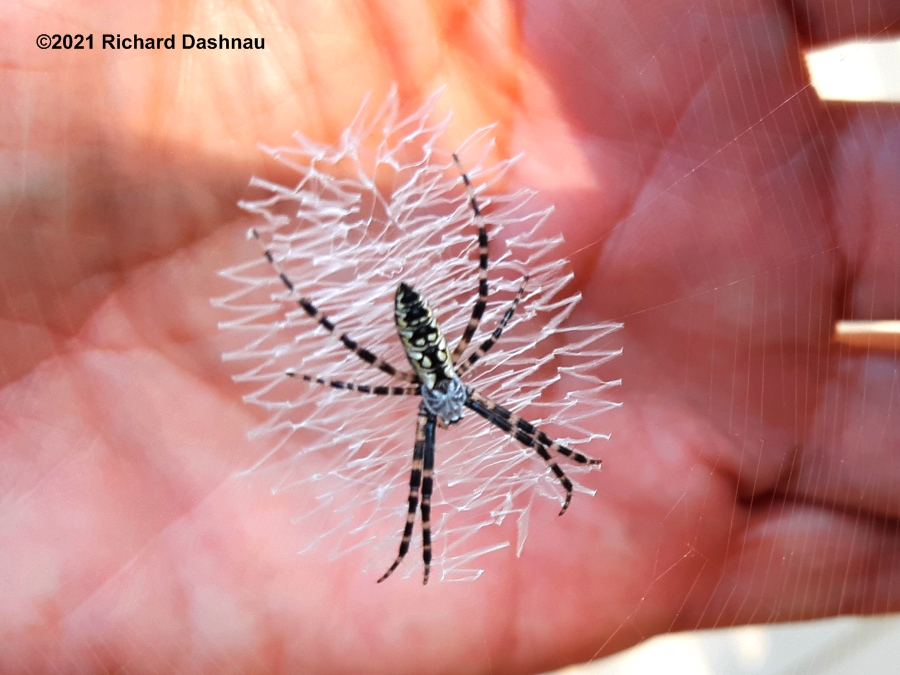
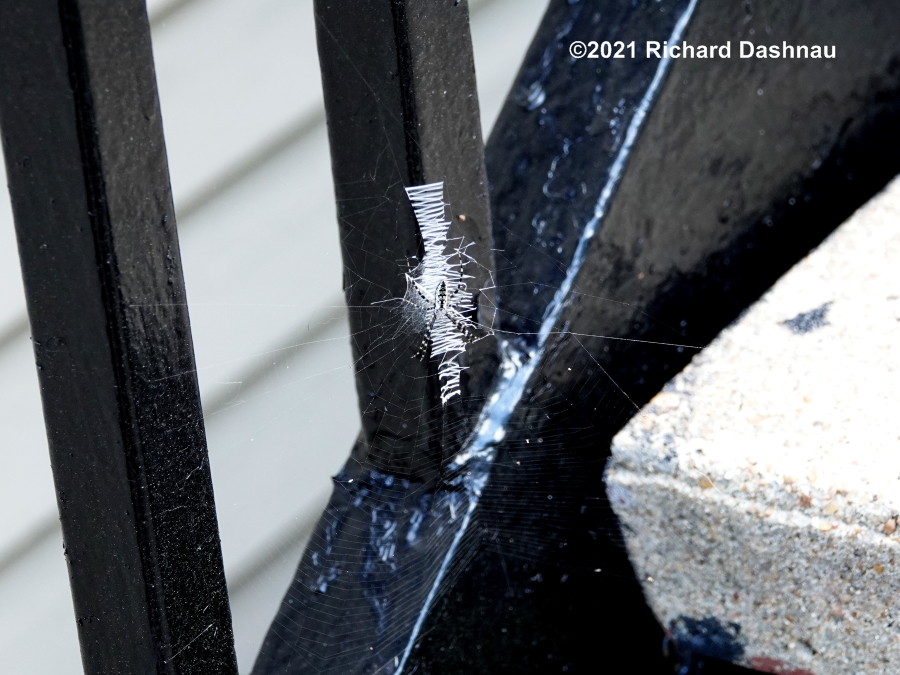
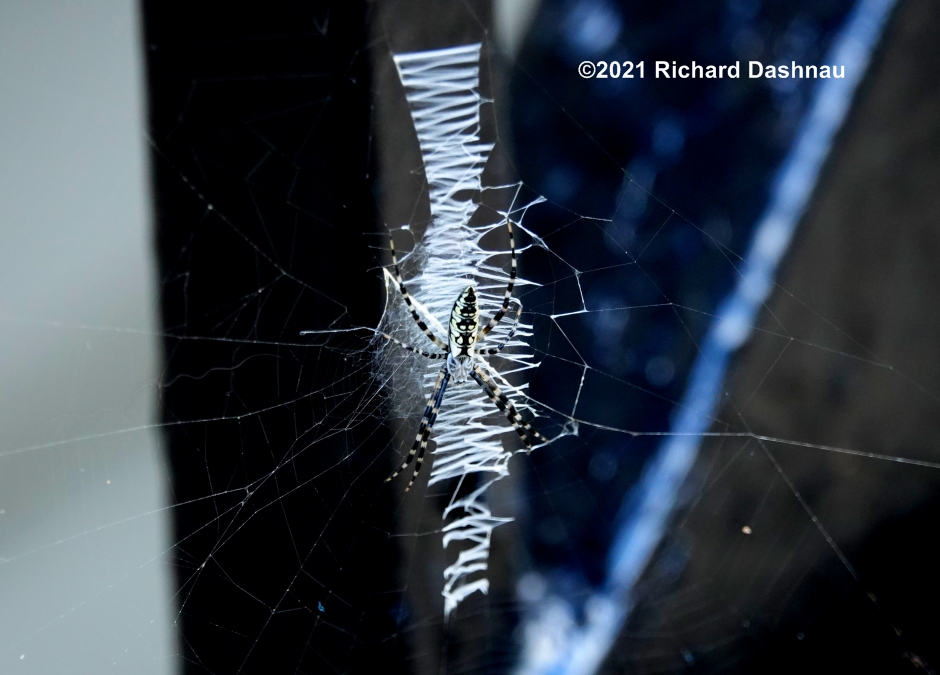
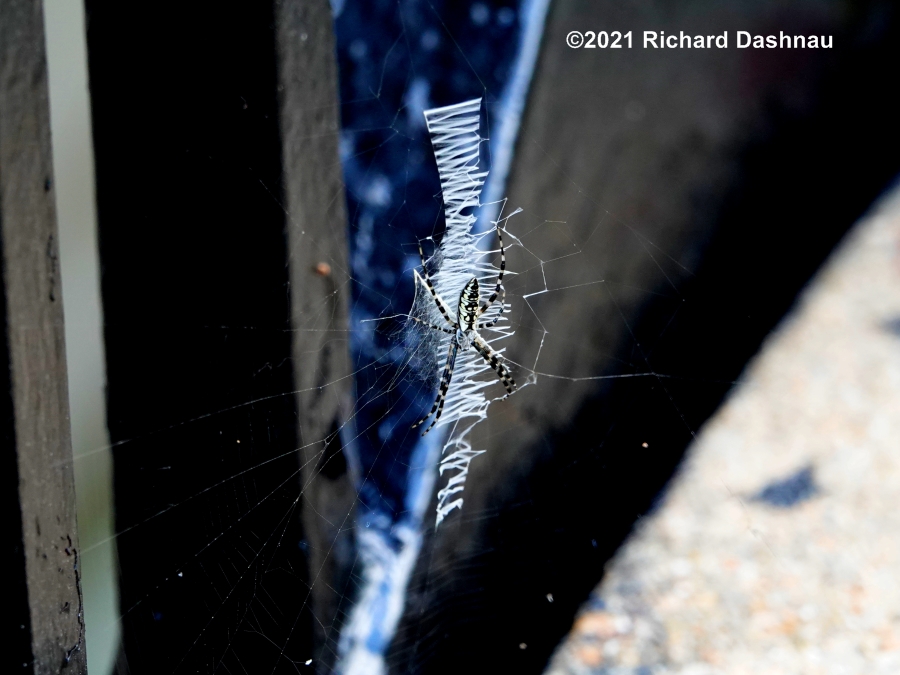
was a very young spider,
one of the
Argiope genus I think, and it was vibrating its web. Intimidating or confusing
potential predators are possible reasons for this behavior. The young spider was also
attached to
"mat" made of tightly zigzagged silk. This is
called a "stabilimentum",
and in this case may also serve to disguise the spider by hiding its outline. The
spider was near the same
spot the next day. It seemed to be a
bit larger. The
stabilimentum in its web sure was! The spider left and I
never saw it
again. I have video showing the young spider vibrating its
web to hide. Here's
an older
example of an adult shaking its web--quite a
difference. The stabilimentum
and
the vibration can help disguise the spider to hide it. But, from
what?
There may be an answer below. Most
of the images in this chapter are frame grab from various
video
clips that I filmed that day. I've edited the clips together into this video (mp4).
06/12/2021
06/12/2021
06/12/2021
06/13/2021
06/13/2021
06/13/2021
I
might have filmed a possible protagonist a few days before
(06/06/21)...miles away at Brazos Bend State Park. There, I
found
more Mud Dauber wasps at work. I've written about
them before further
down
this page. (07/29/2018, 07/04/2019, 09/14/2019). I saw two species
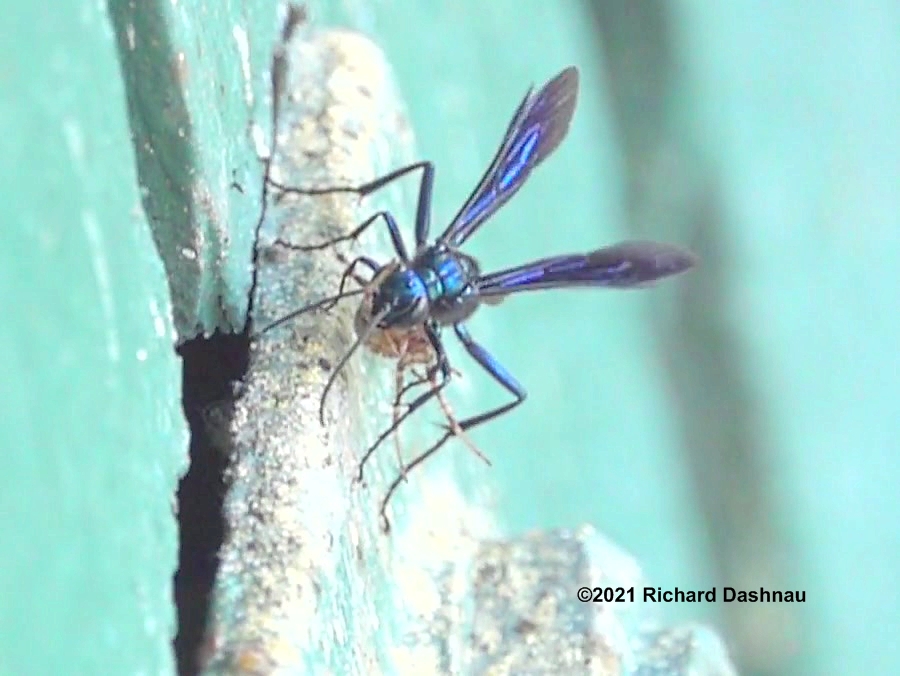
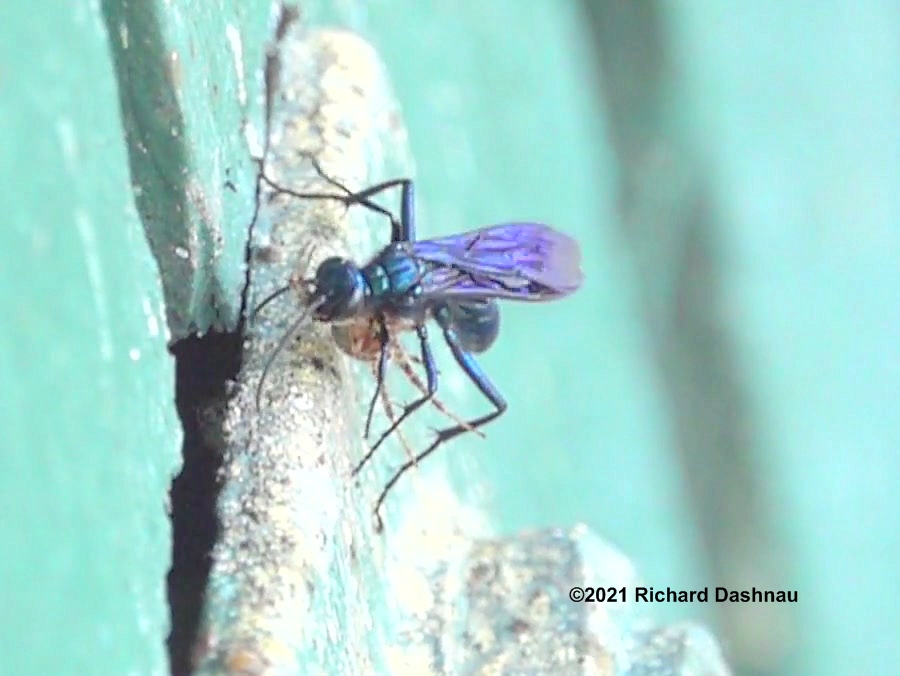
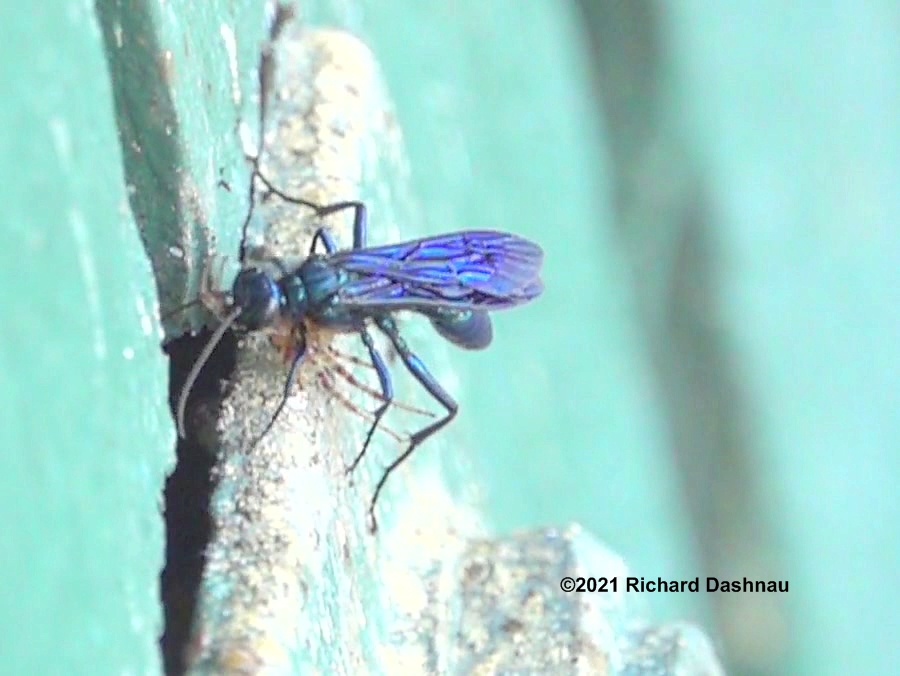
at at work . The black and yellow mud dauber (Sceliphron sp.),
and
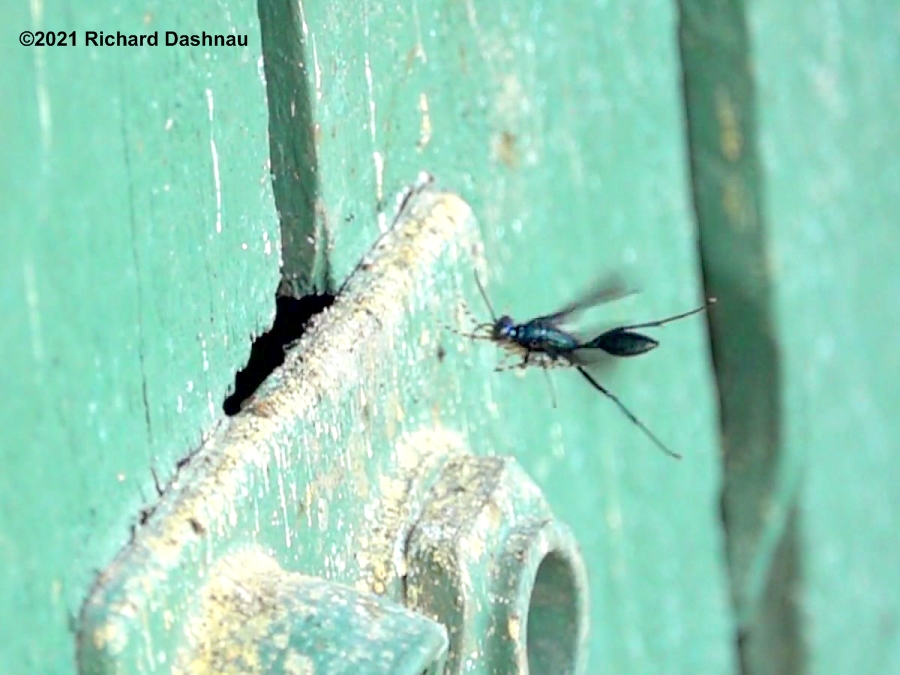
the blue mud dauber
(Chalybion sp.).
The
Chalybion is the subject in today's story. Previously,
I'd read that Chalybion
wasps hijack the mud nests
of the Sceliphron
wasps; and
that the Chalybion
may specialize in
collecting
black widows. They were described as going to sealed cells built by Chalybion.
They break open a cell,
pull out the spiders stored there, then fill
the cell up with their
preferred spiders, lay an egg on them, and reseal the cell. But
I've
recently found more information: First: The two species
Chalybion caeruleum and Chalybion californicum are
the
same
wasp. Then,
a few sources state that Chalybion
don't carry mud, but
*do* carry water, which they use to soften the mud on the nests
that they wish to hijack. There's a
suggestion to describe
them
as "water carrying" wasps rather than "mud daubers". I
saw this in: NOTES ON NESTING AND GREGARIOUS BEHAVIOR OF A
BLUE
NEST-RENTING
WASP, CHALYBION JAPONICUM (GRIBODO) WITH COMMENTS ON
COMMONLY USED
NAME
FOR CHALYBION SPECIES (HYMENOPTERA: SPHECIDAE)
by PHONG HUY
PHAM 2018; and this in: Sphecid wasps of the
World
Page (Bohart; Menke et.al. 1976) pp. 101,102.
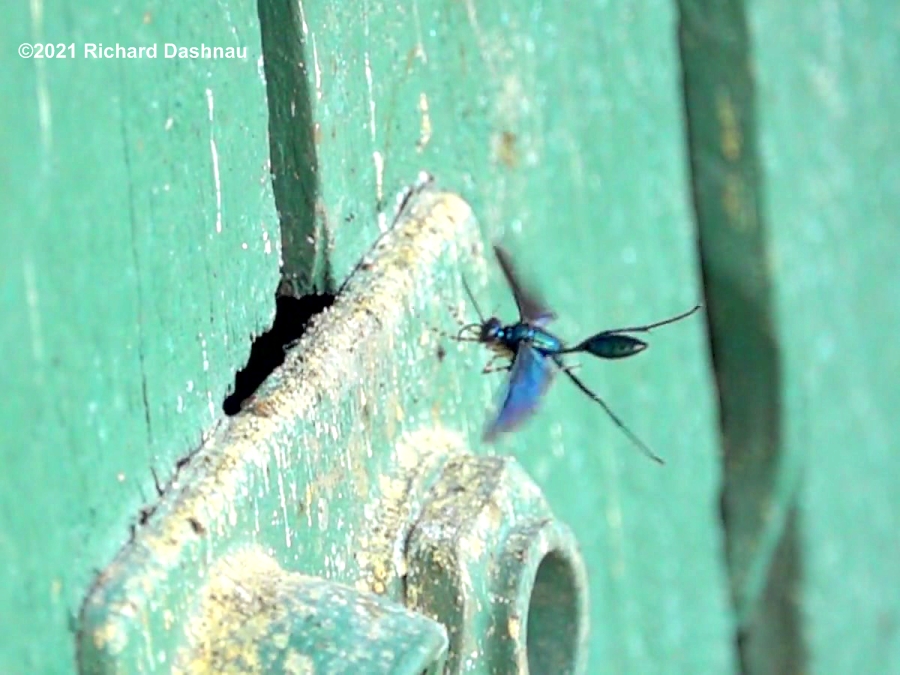
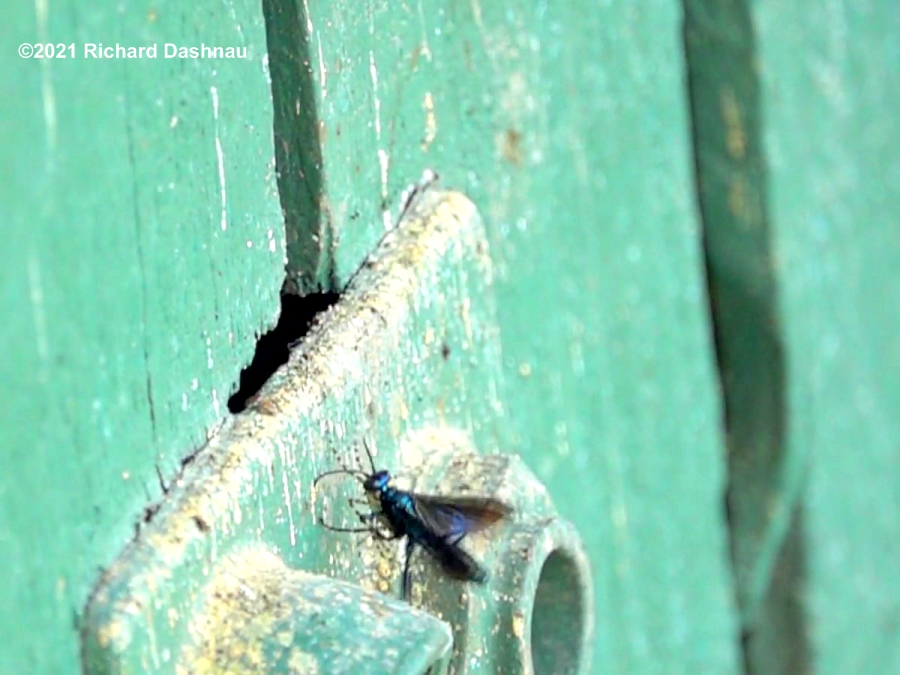
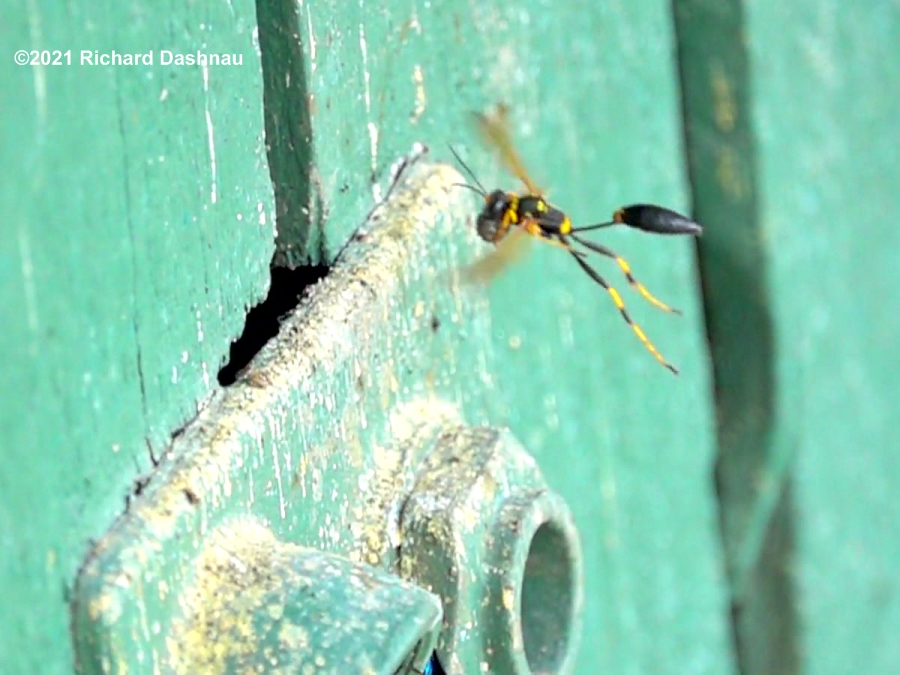
CHALYBION
WITH SPIDER APPEARED
CHALYBION STARTED TO LAND
CHALYBION
DROPPED DOWN TO HIDE
SCELIPHRON
FLEW IN WITH A MUD BALL
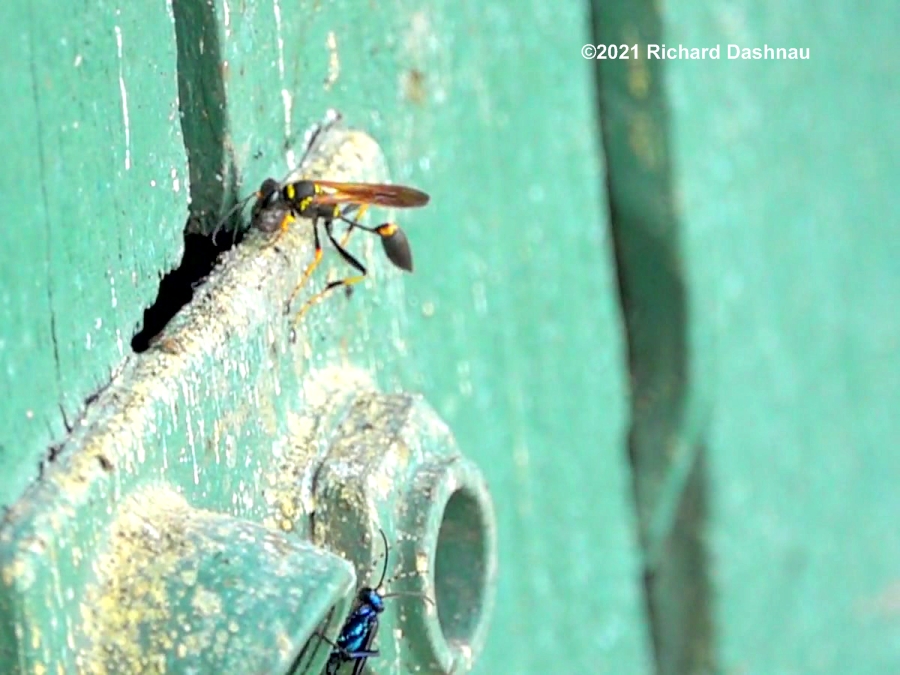
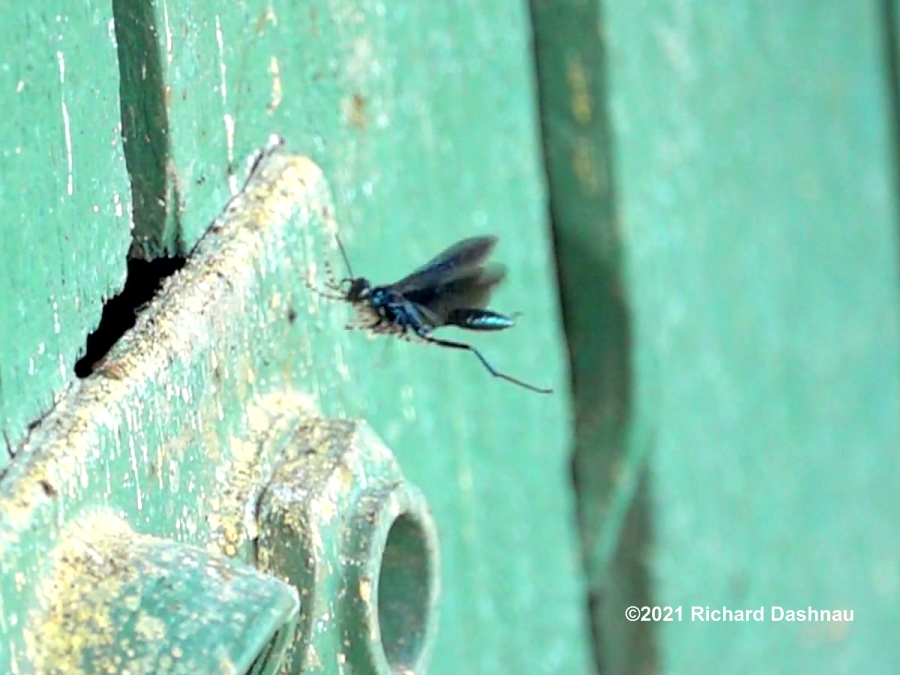
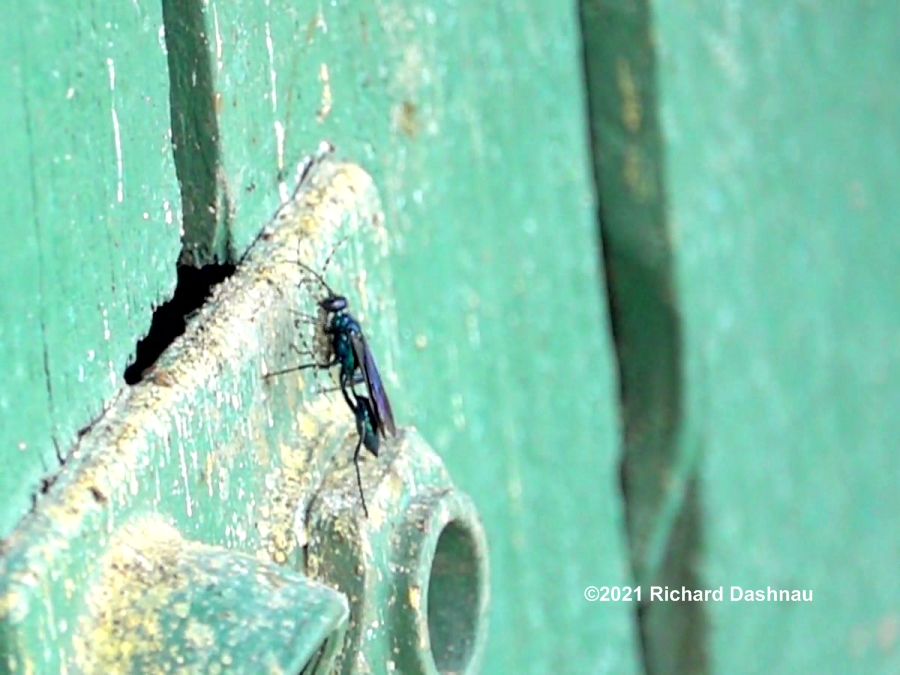
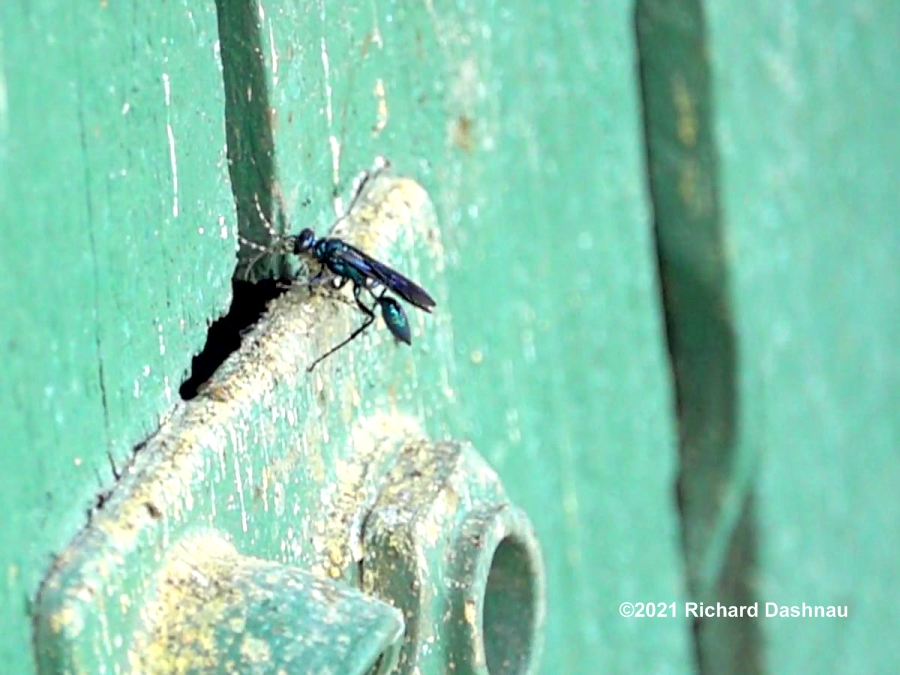
CHALYBION WATCHED THE
SCELIPHRON
CALL CLEAR! CHALYBION FLEW BACK
UP
CHALYBION
LANDED WITH THE SPIDER
CHALYBION
ENTERED WITH THE SPIDER
Finally,
these
studies: Seasonal and latitudinal variation in spider prey of
the mud dauber Chalybion californicum
(Hymenoptera:
Sphecidae) by Martin S Obin; James H
Hunt.
and
Specialists and generalists coexist within a population of
spider-hunting mud dauber wasps by Erin C. Powell and Lisa A. Taylor
say that these wasps take a
great variety of prey
--including a number of orb weavers-among them,
various Argiopes. In
fact, about 40
spider species are listed! Prey choices are driven by what's what's
available by habitat and
season. From
the
videos I've
filmed
over the last year of so, it seems that the Chalybion might be
stealing cells before the Sceliphron wasps have even finished their
nests! But I
can't tell, since they are all building inside the
walls.
While I was watching the wasps at the park, I tried to catch
video of them coming in with prey. I caught a few at high
framerate;
but it's still hard to identify the spiders because of how the
wasps carry
them.
But, at least one of them sure looks a lot like my Argiope
neighbor!
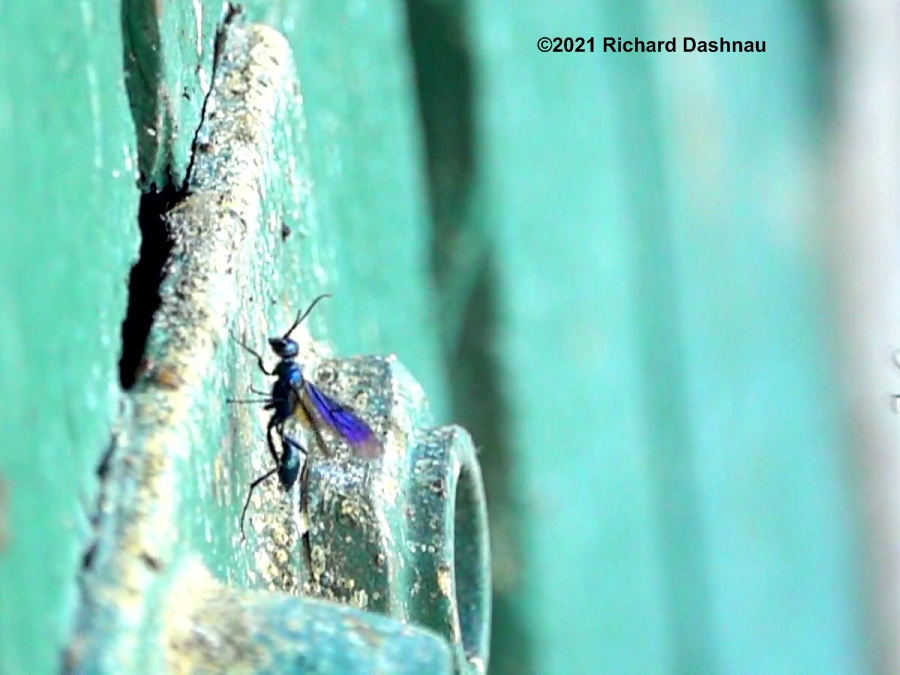
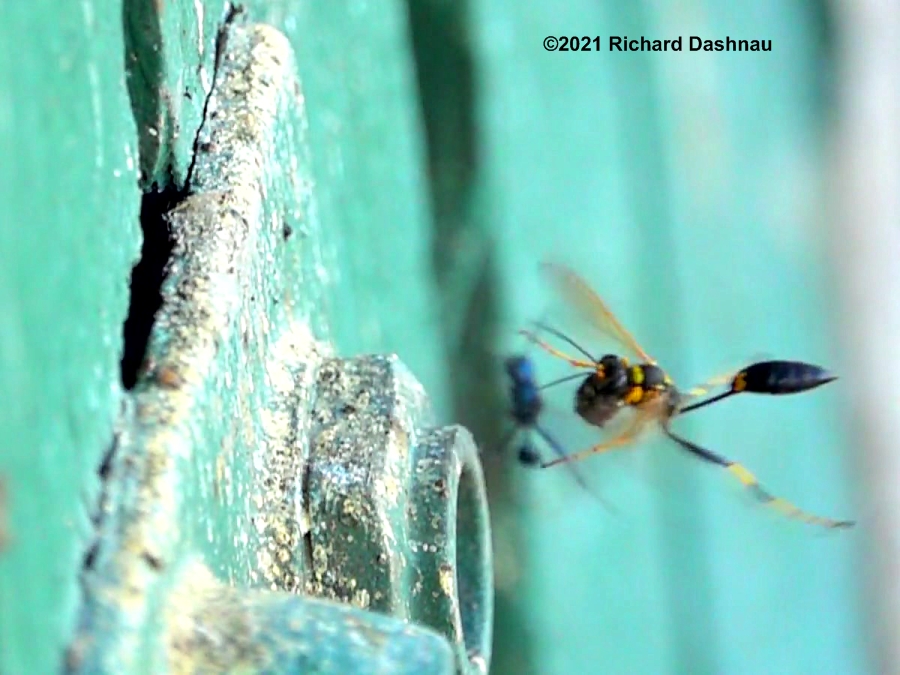
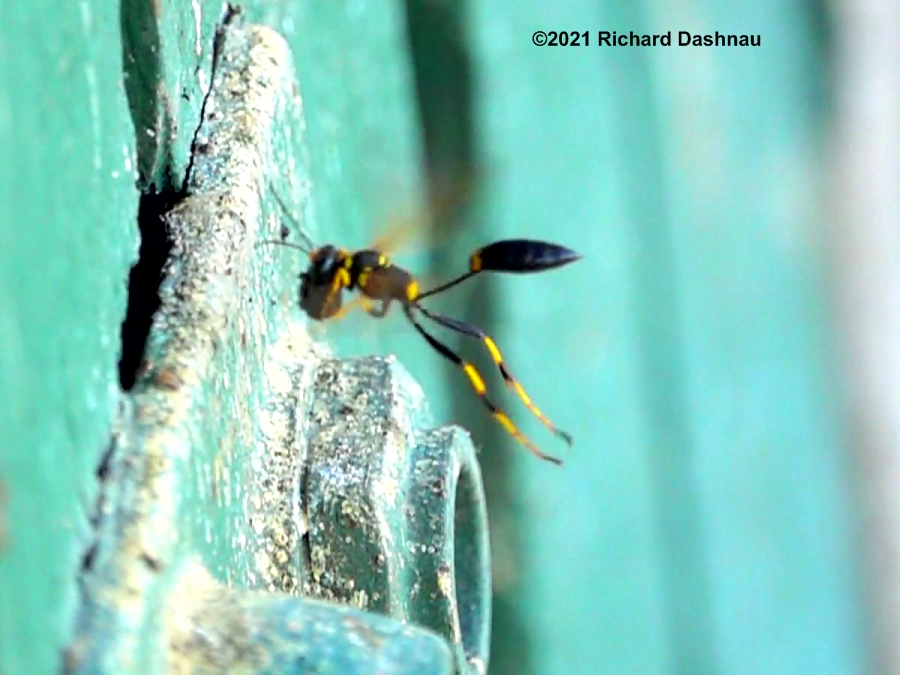
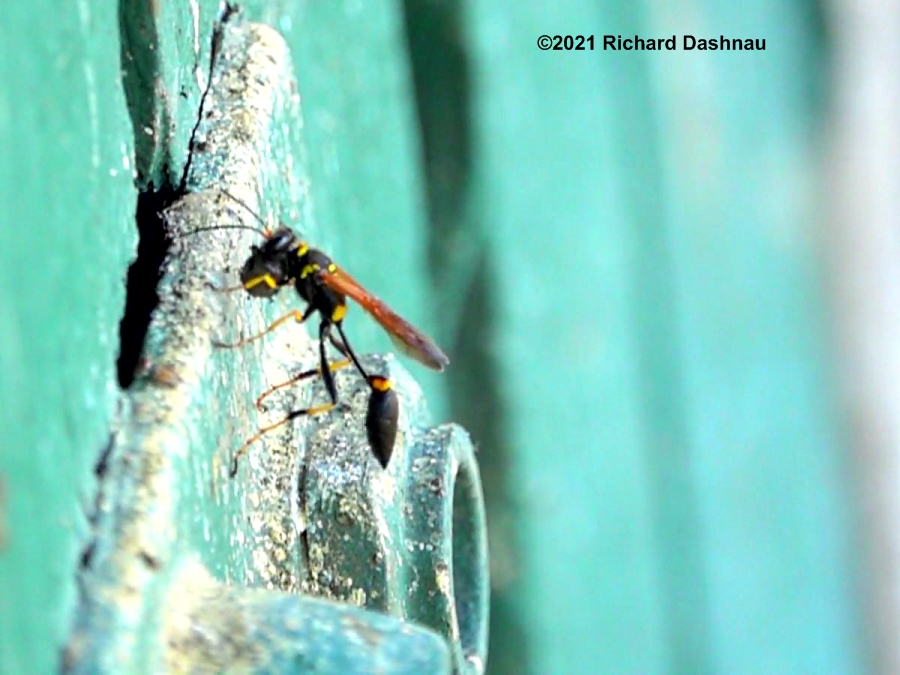
CHALYBION
DROPPED DOWN TO HIDE
SCELIPHRON
WITH MUDBALL
COMING THROUGH!
GRACEFUL FLIGHT
PRECISION
LANDING WITH MORE NEST
MATERIAL
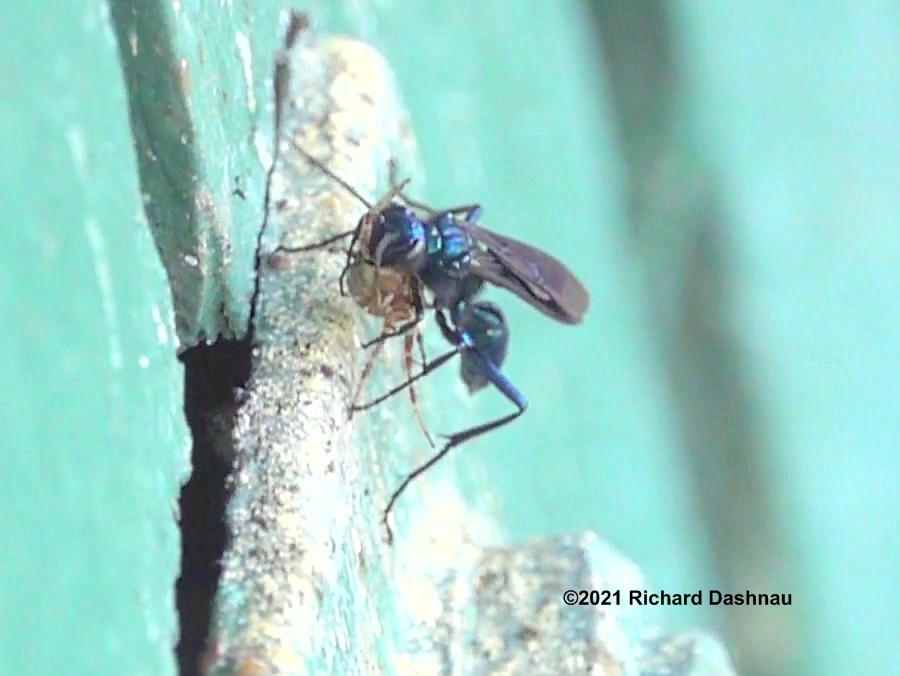
THIS
CHALYBION FLEW IN WITH A
BIGGER SPIDER
I
also caught a few clips of
the Chalybion flying in carrying
something else...something that didn't look like spiders, or part
of anything that had been alive. I was baffled, until I stumbled
across
this single sentence (in Bohart; Menke et.al. 1976):
"One
of the more
interesting aspects of
the nesting behavior of Chalybion s.s. is the fact that all of the
species listed above except califomicum seal their nests with
an inner layer of mud
and an outer layer of white material composed of
either lime from walls or uric acid obtained from animal feces. (also
page 102). I think that the wasps were carrying chunks of lime that day.
Most of the
images in this chapter are frame grabs from various video clips that I
filmed. I've edited the clips together into this
video (mp4).
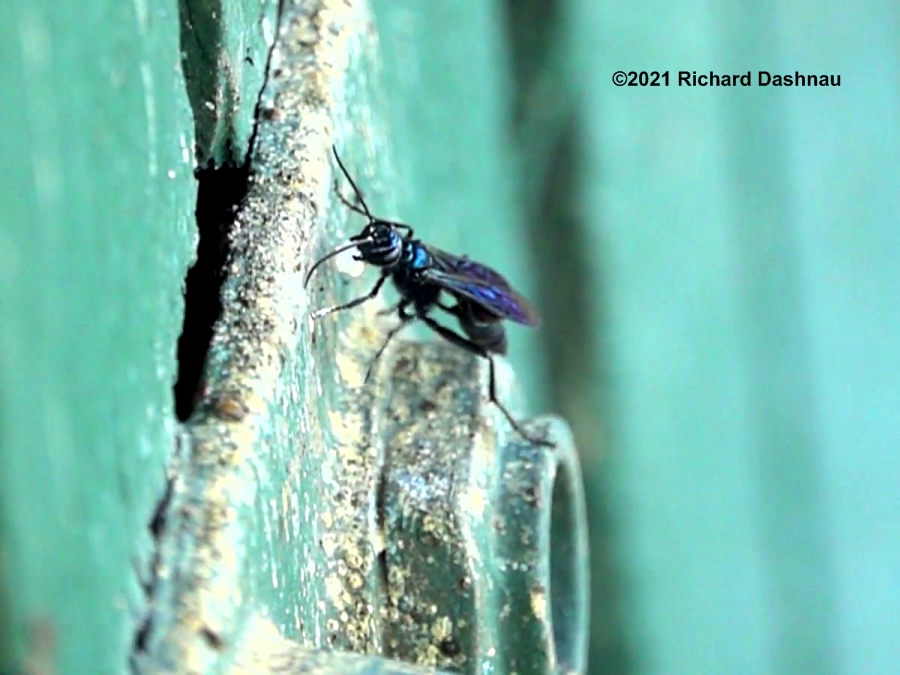
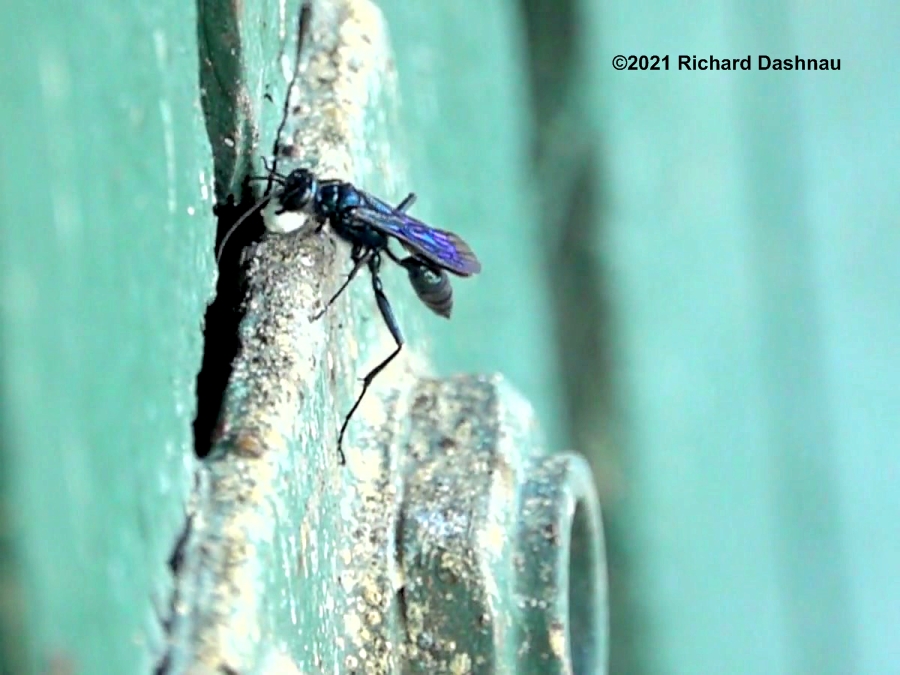
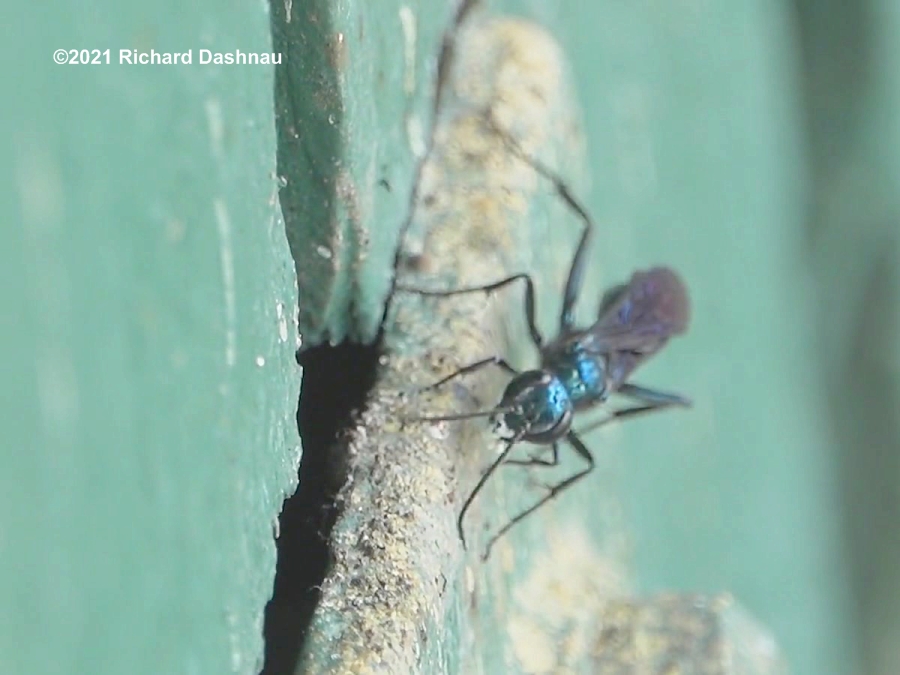
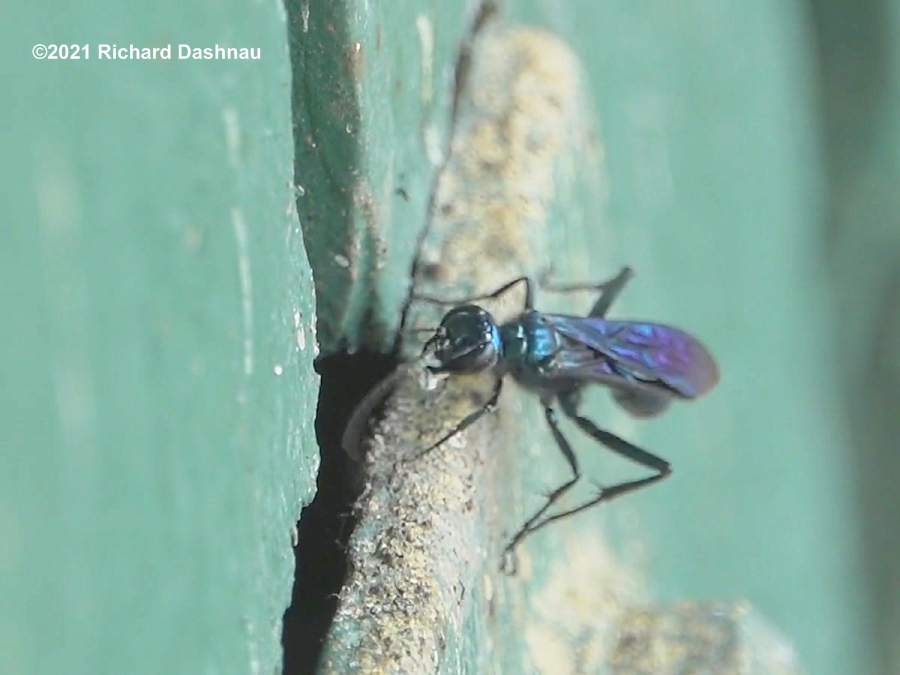
CHALYBION CARRYING A WHITE CHUNK
CHUNK OF LIME, PERHAPS?
DIFFERENT CHUNK. NO FEATURES VISIBLE
SO WAS
THIS CHUNK NESTING
MATERIAL?
09/29/2019
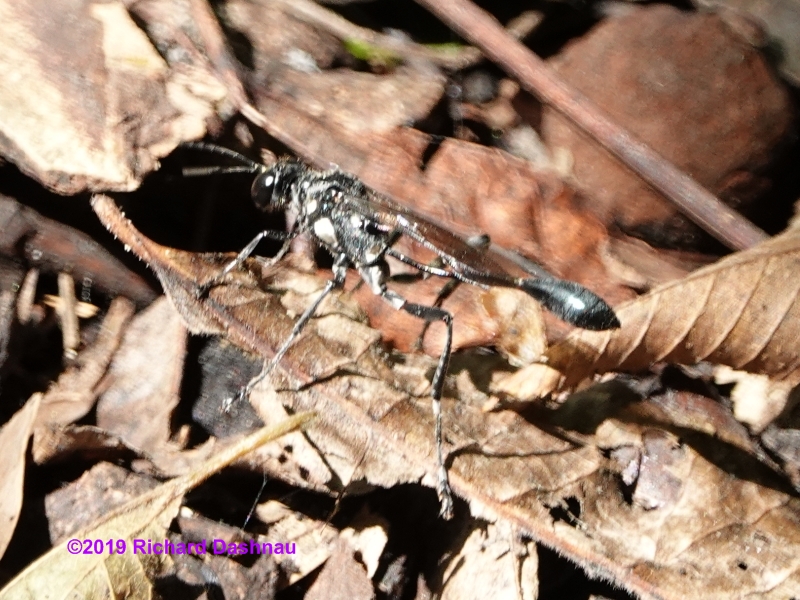
I noticed a wasp moving through the leaf litter near a trail
at Russ
Pitman Park. I watched it for a while, and took some pictures
and video
clips. The
wasp
seemed to be hunting,
and I thought that it was
hunting for insects of some kind to provision its
larvae.
After
just a few minutes, the wasp left and did
not
return. I
tried to
discover what kind of wasp it was, but I
couldn't find anything in my
insect field guides. Finally, I resorted to social media
for
an answer.
And I got one. Thanks
to
Dr. Sean McCann
(http://ibycter.com/sean-mccann-research-and-cv/ ),
I have found that
the wasp is one of the "thread-wasted wasps";
specifically;
Eremnophila
aureonotata.
I found most of the identification points that
help
identify this wasp, and some
information on its habits, on Bugguide.net
(link provided by
Dr.
McCann). One of the best characteristics
for I.D. is "silvery patches on the sides of the thorax".
The
images below show these.
This species uses caterpillars to
provision
its young. The female captures and paralyzes a
large
caterpillar, which it drags to a burrow. There, the wasp
will
leave the
caterpillar with one of the
wasp's eggs. Below
are
a few of the pictures, and here is one
video
clip
showing
the wasp working.
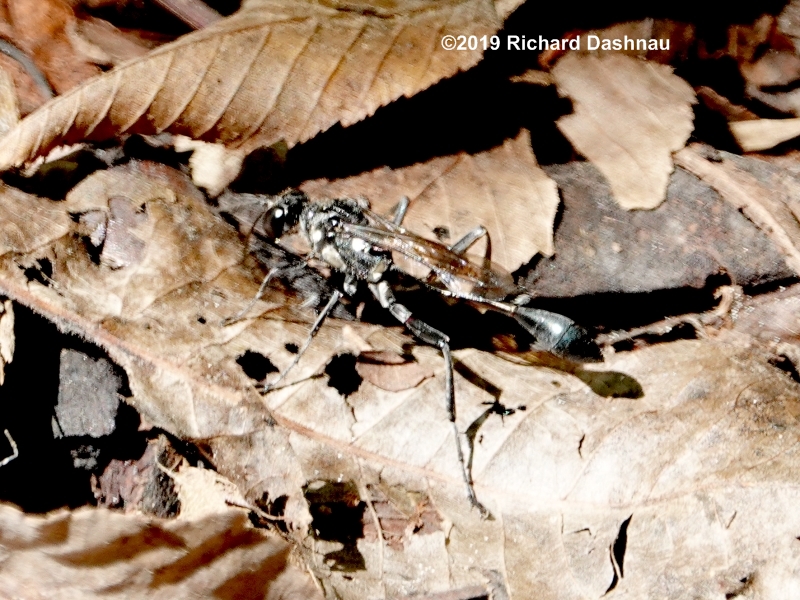
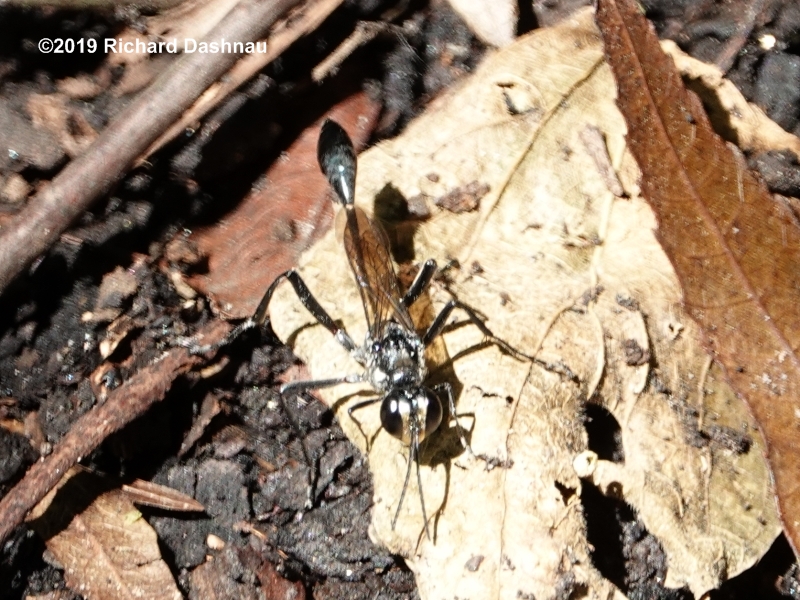
09/14/2019
I
was back at Scobee field (where I filmed the wasps), and I
looked down
at a drying puddle that was on my way to the building where
the wasps live. There, I noticed an
interesting effect in the
wet mud.
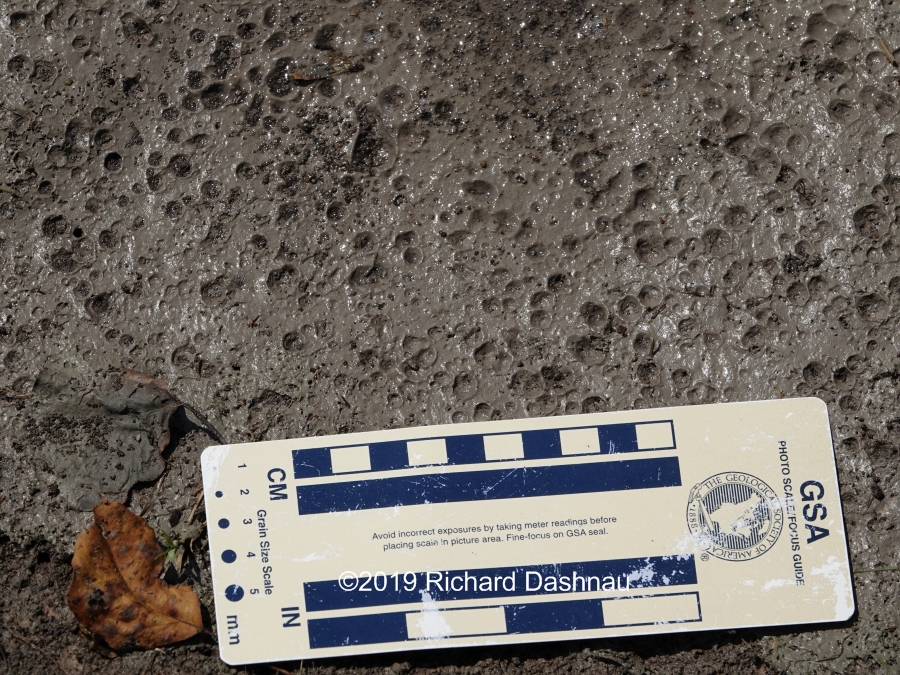
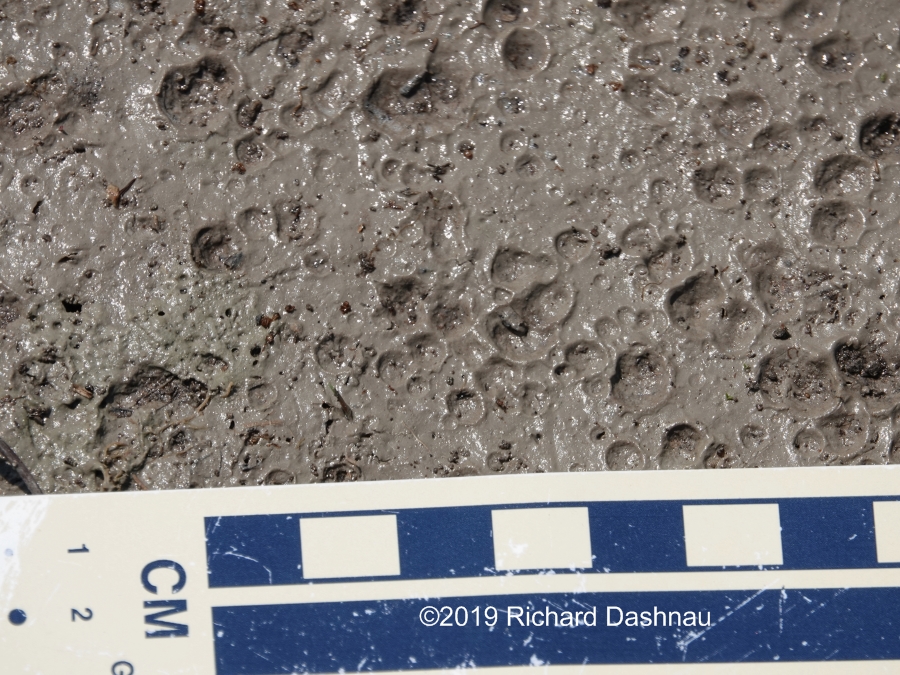
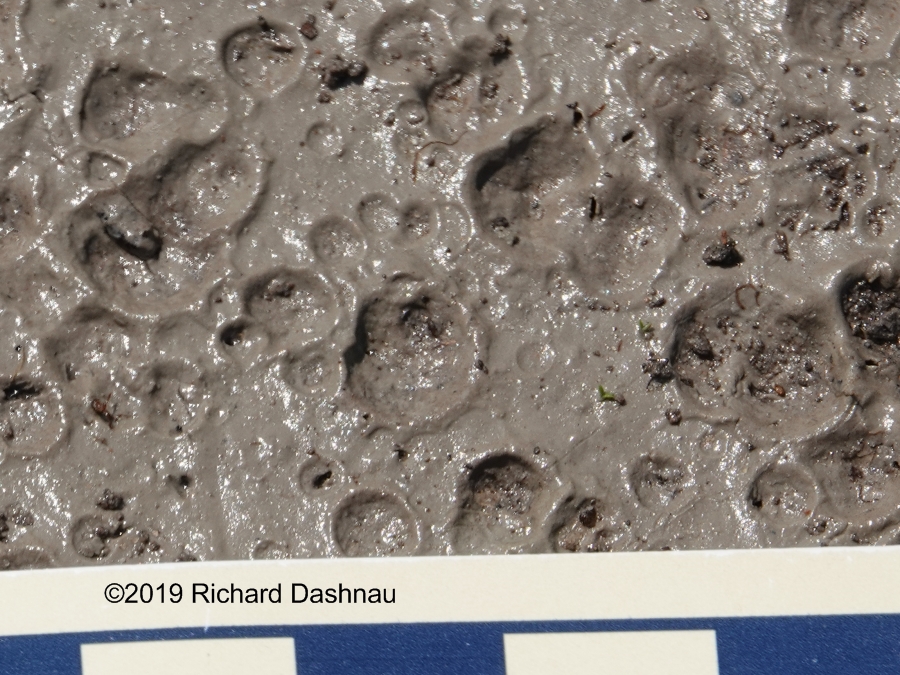
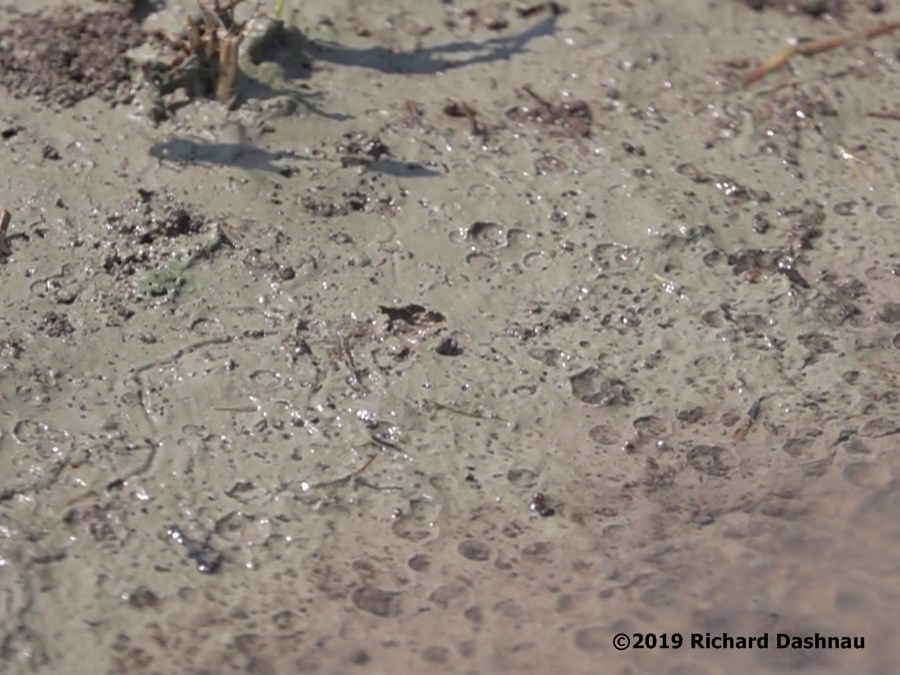
Taken out of context, a closeup of what I saw resembles the lunar
surface-a meterite ravaged field of craters. But of course
they were
not craters
caused by meteorites. There is a surface
effect caused by
raindrops
in dirt that appear as small craters. In fact, there are
fossils of these events. But, I didn't think that raindrops
caused
this, either. Some
of the
dimples are too small
to have been caused
by water droplets in that type of mud. So, what could have
made the
holes? In the series of
photos
below, I
expand the view of the
holes. The last image shows the range of
sizes and their amazing
quantity-hundreds? Thousands?
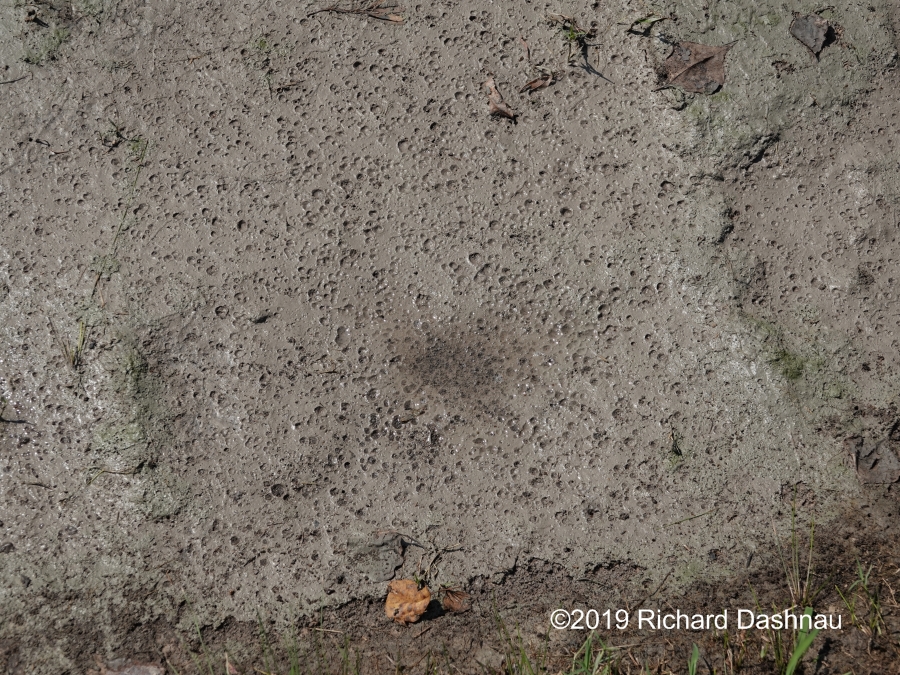
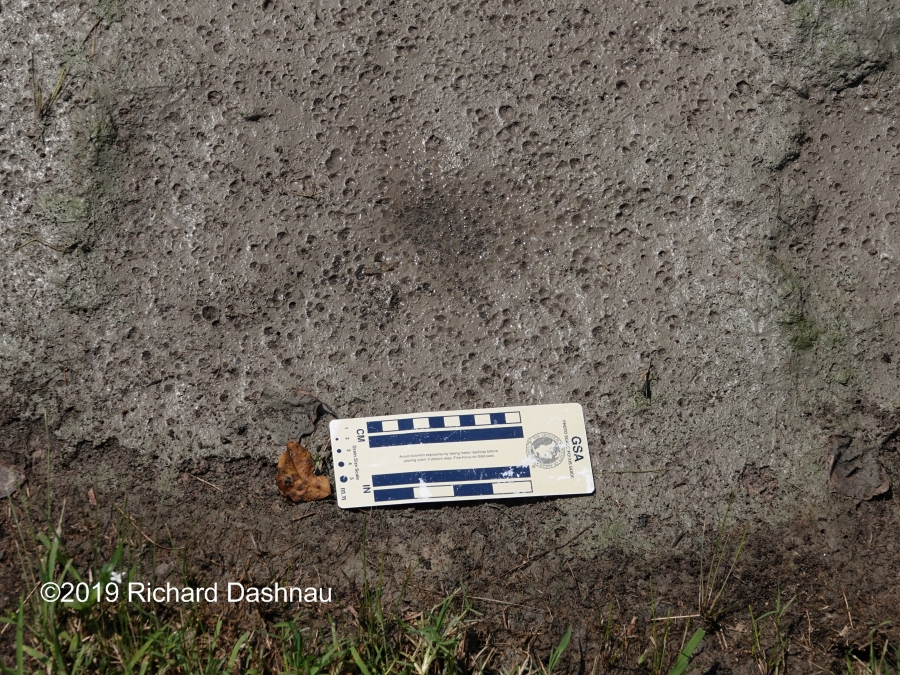
While
I was taking the pictures above, and examining the mud, I saw
a winged
visitor that gave me a hint at what might have dimpled the
mud.
I
decided to perform a quick experiment.
I considered that I
would not be altering anything that was there, and that all
the
elements I needed were already in place. I
replenished the water
in the puddle.-but not very much. I
retrieved about a half-gallon and slowly poured
it onto the edge of the depression so it would
flow to
the lowest parts.
I
didn't want to wash away any of the markings.
This produced
some wet spots, with just a fraction of an inch of water
in a few places, and these immediately began to
dry.
But, it was
enough time. Within a few minutes, visitors arrived at the
puddle.
My guess had been correct! I shot some photos and
some video clips
as the area became busy.
The
images below are
frame grabs of my culprits. In fact that clip is a pretty
good
demonstration of how the dimples were made.
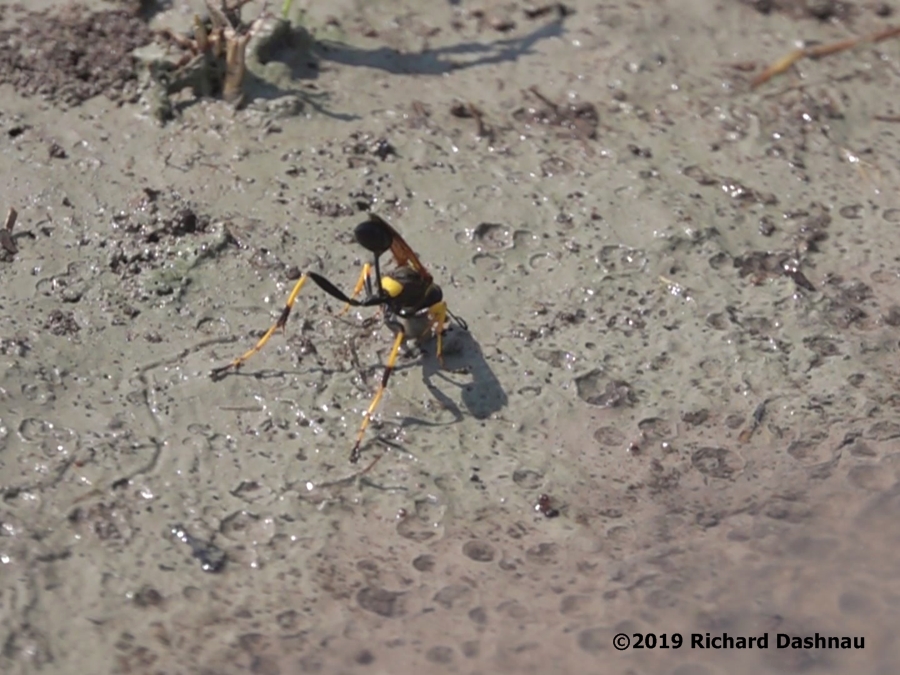
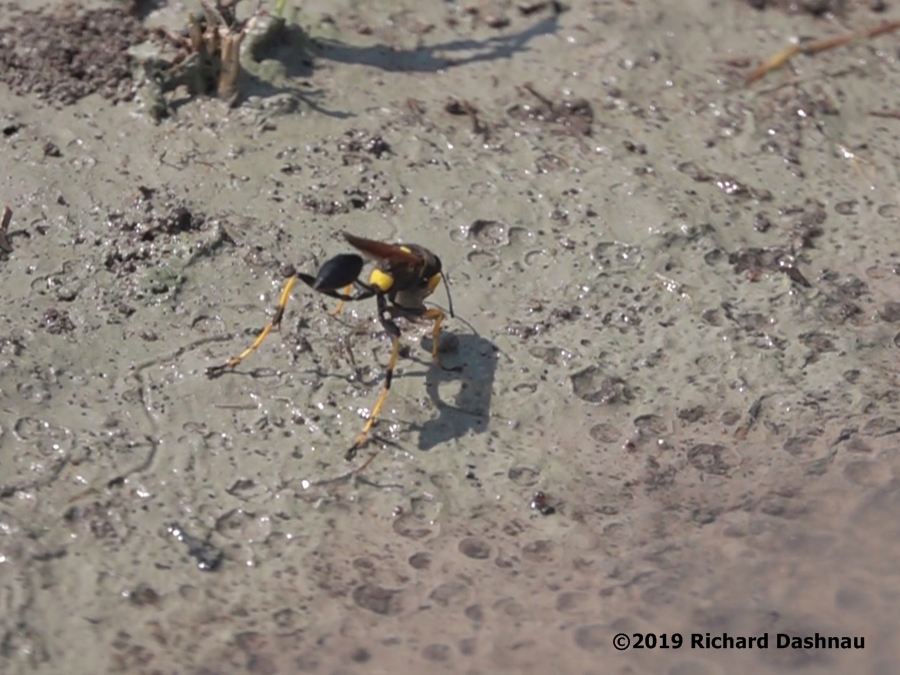
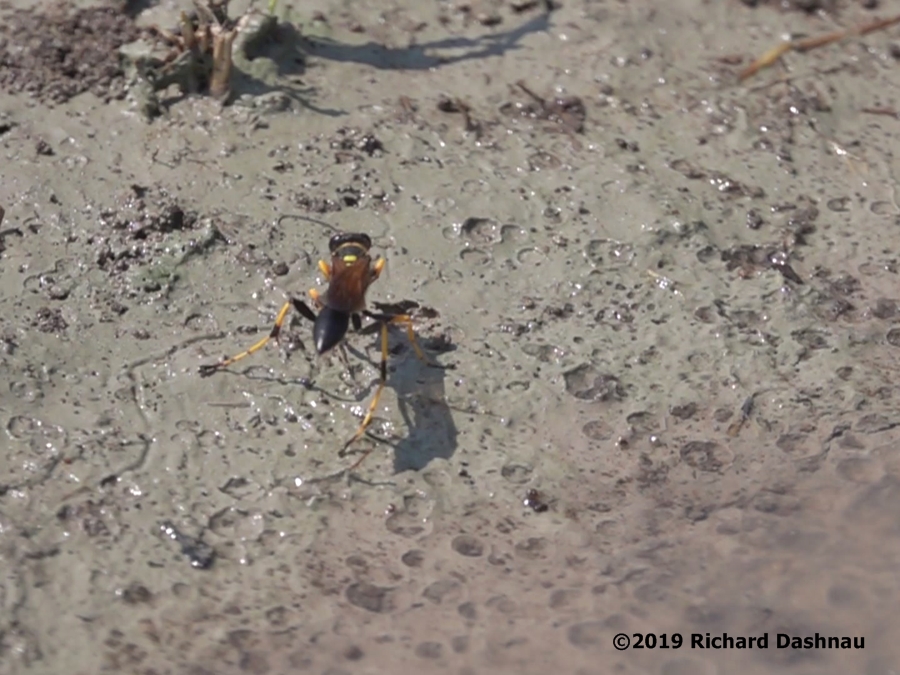
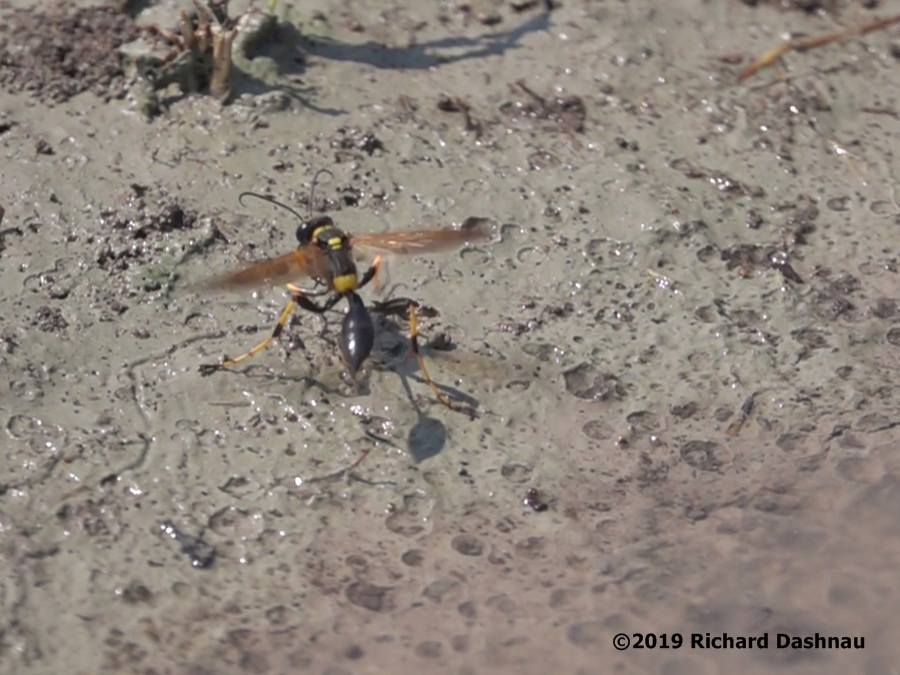
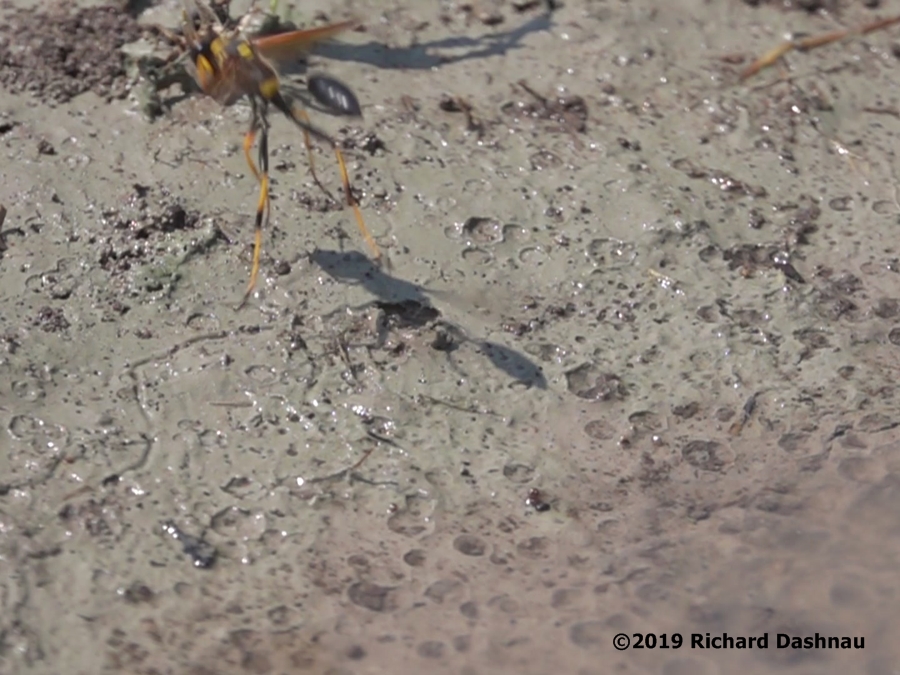
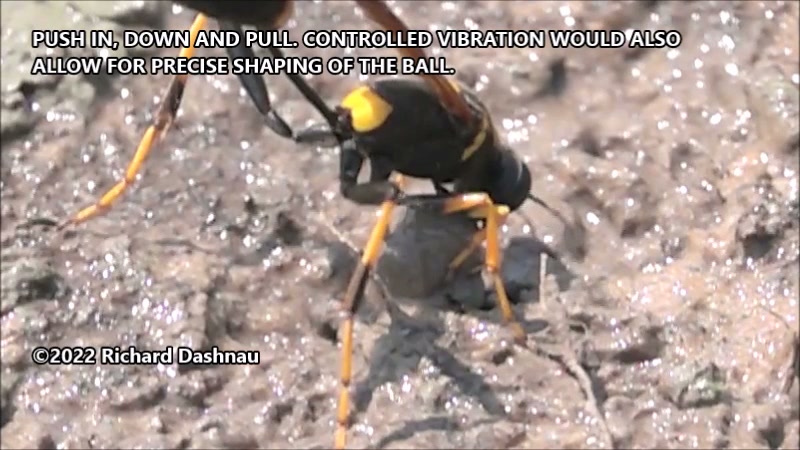
Yes, that is a Black and Yellow Mud Dauber (Sceliphron
caemantarium).
The last picture shows the hole it left in the mud. Notice that
there's
water right next to the
wasp. That's what I'd
put in. Soon, more Sceliphron
arrived and began
digging. Other wasps also appeared, but they only seemed to drink
at
the water's edge. Or-in the case of the polistes species
that
showed
up-ON the water. The wasps would land on
the surface of the water and
drift around a bit while drinking. I got
many video
clips, and I've edited some of them with some photos
into this wasp digging video . There's a
frame from the video
shown above. By the way, all this was happening about
30 paces from where I've filmed previous
video
clips of the various
species of wasps interacting.
The edited
video shows some closeup views
of how the mud-daubers dig the mud, and
make it into spherical packages to carry off. Quite
by accident,
I've collected some interesting views of mud dauber behavior.
I have filmed Sceliphron building their
nests (but not at this
park-the nests are hidden
under the siding of the bathroom
building.) I will have to
see if
I can use that and fill in another section of their behavior!
This
paragraph updated
2/12/2022--added new information about the "vibration" done
by the
digging wasps.In
the current version (from
2019) of the edited video, I comment on the
vibration
of the wasps' bodies while they are digging. In the time since
then,
I've wondered if that vibration was being done to soften the
mud, by a
sort of "vibration liquifaction" effect.
Just today,
02/12/22, I found a
study that at least refers to this vibration as a method to
modify the
viscosity of the mud. Study: "Investigating Physical and
Mechanical
Properties of
Nest Soils Used by Mud Dauber Wasps from a Geotechnical
Engineering
Perspective", by Joon S. Park, Noura S. Saleh, Hai Lin,
Hussein Alqrinawi & Nathan P. Lord
Link [ https://www.nature.com/articles/s41598-022-06162-2
]. Although I think the
effect is more like using vibrators while working concrete as described
here, while forming the
pellets,and while building the nest.
09/29/2019 Cowkillers
(the
females) move very quickly. It's difficult to get
pictures
or video clips of them because it is hard to keep them in
focus.
Today,
I
saw one running along at
trail at BBSP, so I decided to
try to "slow
it down" by shooting it with high-framerate video. The
resulting video
clips
still only had a few viewable sections. This image is a
frame
grab
from the clips. Check
the video here.

07/04/2019
-
07/05/19
Almost one year ago (7/29/18) I shot some video and pictures of
trafific around a hole in the siding of a building at Brazos
Bend
State Park. Specifically, there
were 3 species of wasps using that same opening for about
the same thing--nesting and
reproduction. This
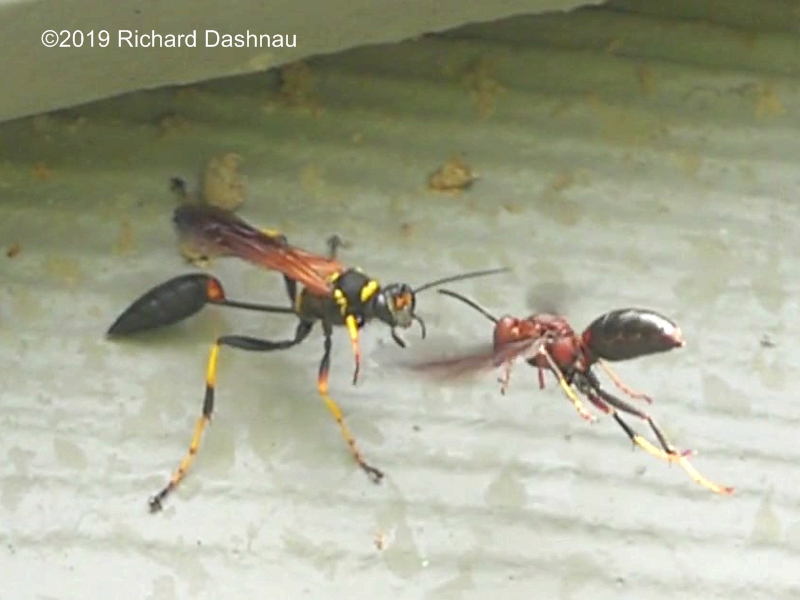
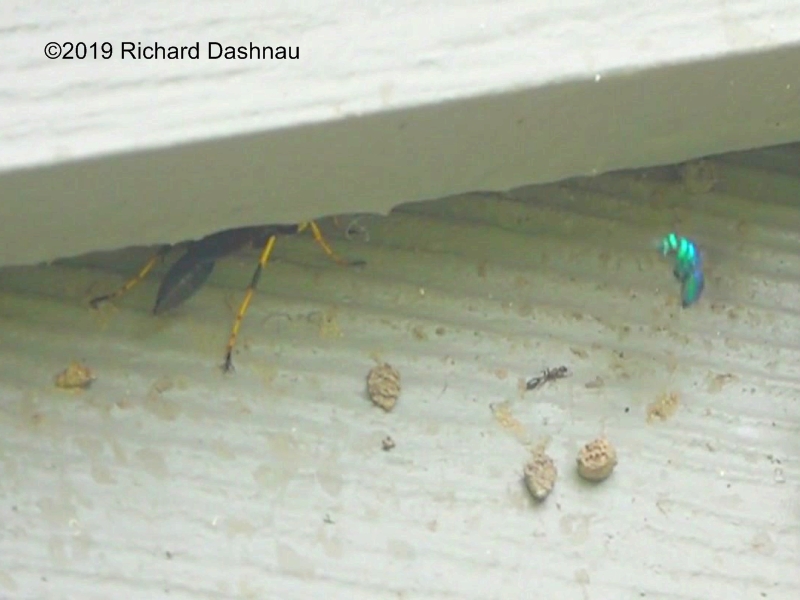
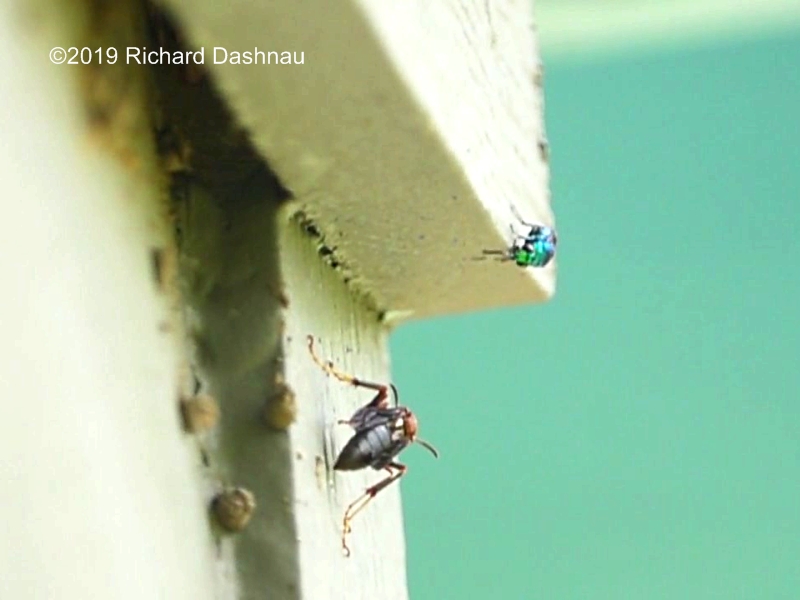
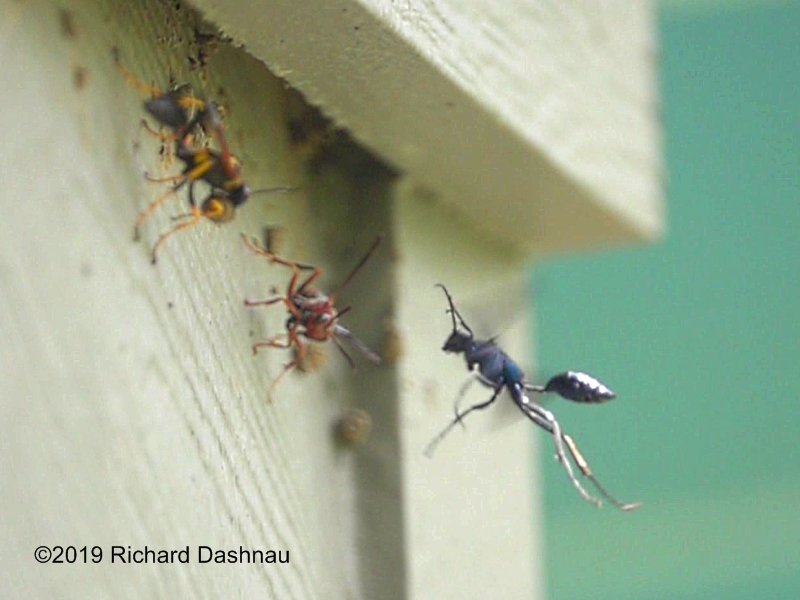
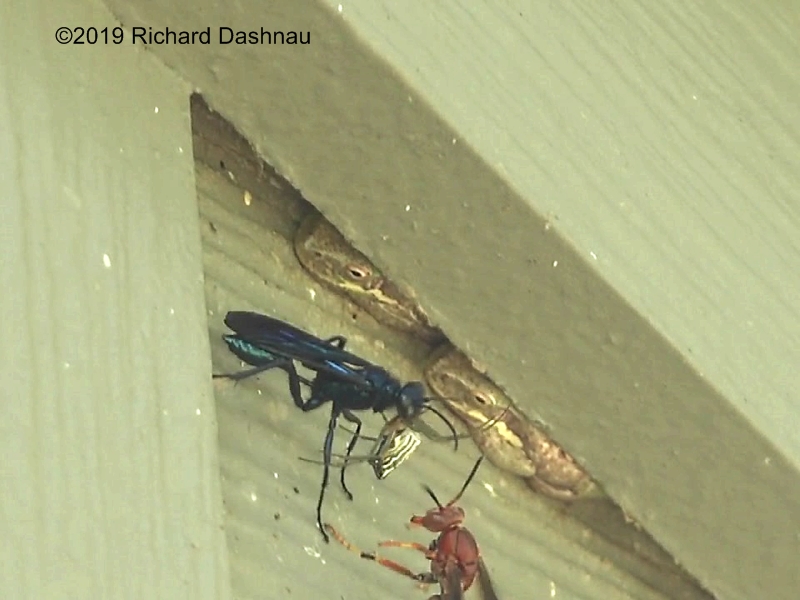
year, on July 4th and 5th, I was at Scobee Field, and I watched a
similar situation.
Various species of wasps were using a gap in the
siding of a building to shelter their nests. This time, there
was even more going on. FOUR species of wasps, an ant, and
even
tree frogs
were there! The species are:
black and yellow mud dauber (Sceliphron caemantarium)
blue mud dauber (Chalybion californicum)
cuckoo wasp (possibly Chrysis angolensis according to @RTC_Ento)
red paper wasp (Polistes carolina)
twig ant (possibly pseudomyrmex gracilis) (brief appearance)
squirrel tree frog (hyla squirella)
I
stayed around the area for a few hours and shot video (and a few
photos) whenever a wasp appeared. I left when the activity
slowed
down. But, I came back the next day and filmed
a bit more, but this
time I was at the other side of the building, under a different
piece
of siding. One both sides, I watched a number of interesting
behaviours between the species.
There was the same implied bad behavior
as before--The black and yellow seemed to be only carrying nest
material (mud). The blue often appeared while carrying a
spider.
There was
the occasional appearance of a cuckoo wasp, and I saw
one leaving the "nesting area". The blue may, or may not,
have
been stealing the nest cells of the black and yellow. The
cuckoo
wasp was probably sneaking in and "infecting" the nest cells of
either
mud dauber by placing its own eggs in the their brood cells to
feed on eggs or larva. But *now*, there
were also the red
wasps.
And they all seemed to be sharing the same opening in the siding
without a problem--until the red wasps started chasing the others
away.
That is, away from
the nests that they also had in there. The
red wasps were basically acting like jerks. The
images are frame grabs from the video I put
together.
Note that
the tree frogs seem to be just hiding from daylight as well as
they
could while the wasps moved around them. The video is
here.
It's a different view of one some of our neighbors.
07/29/2018 I
was at the 40 Acre Lake bathrooms when I noticed wasp traffic
near one
of the electrical outlets near the water fountain. I decided
to watch
for a while and see what
I
could
capture with
video.
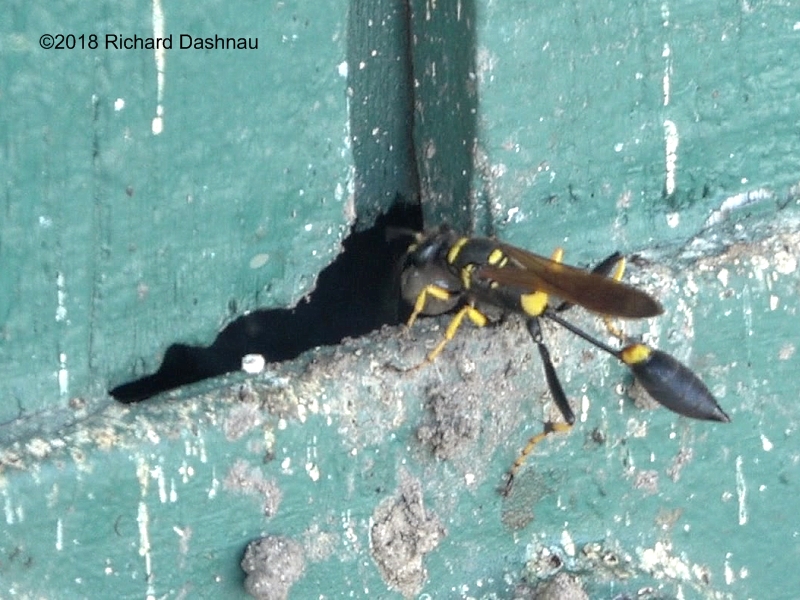
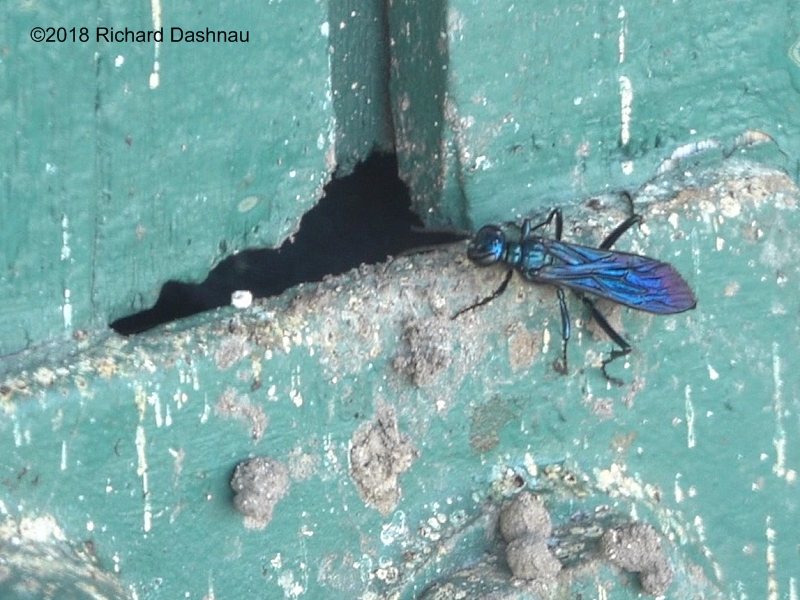
I captured, 3 species of wasps using the same
entrance. First, the black and yellow mud dauber
(Sceliphron
caemantarium) often builds exposed nests
on
many
types of surfaces. However, these seem to be building
nests inside the wall
of this building. I think that the hot summer has caused the
wasps to
do this. These wasps make clusters
of
cylindrical cells. They use mud as building material.
Once
one
cell is completed the wasp looks for prey, which is usually
some
species of spider. Different wasps have been observed
showing a
preference for different species of spider--but this could be
due to
what's available nearby. The wasp lays a single egg onto one
of the
first spiders put into the cell, fills
the
cell
with more paralyzed
spiders (which can be around 25 spiders!), then seals
the
top.
The egg hatches in 1-4 days, and all the spiders are consumed
in 1-3
weeks. If the nest was
provisioned
in
August, then the larva makes a
cocoon and the pupa forms during the next spring. The
adult
emerges in May or June, and lives for 3 to 6 weeks. The
video
clips
show wasps coming in
with
dollops of mud, and some of these
are visible stuck haphazardly around the outside of the
opening. I
didn't see any wasps fly in carrying prey. The image
below left is a
frame from the
video
and
shows
a black-and-yellow mud dauber.
Next,
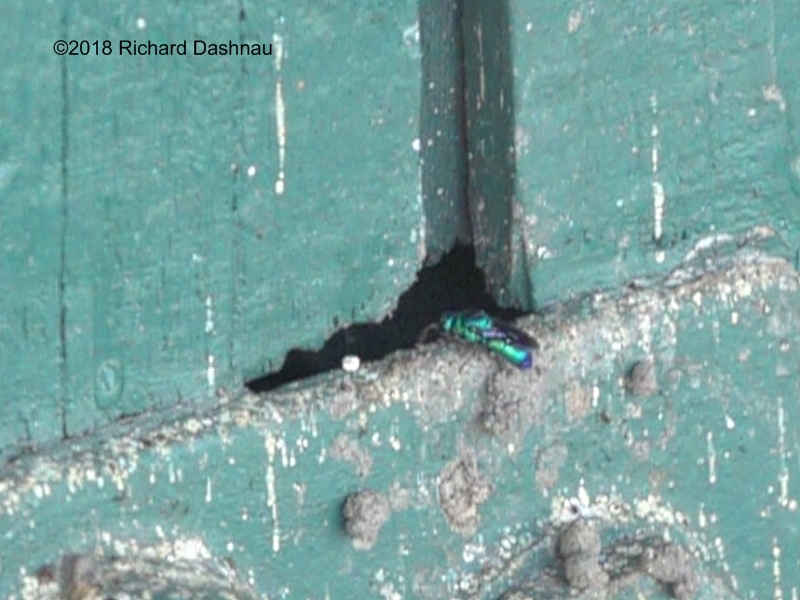
I saw blue mud daubers (Chalybion californicum) entering the
hole.
Information I first found online indicated that these wasps
often use
"abandoned" cells of the first wasp (black
and yellow mud
dauber). They provision the cells in a similar manner, but
prefer black
widow and brown widow spiders. A number of online sources
indicate that
blue mud daubers are a
good control for populations
of widow
spiders (Latrodectus sp.). I wasn't sure why the
blue mud
daubers are showing up here, since it looks like the black and
yellow
mud daubers seemed
to still be building their cells. Unless,
perhaps, there are older cells in there as well. The image above
center is a
frame from the
video and shows a blue mud dauber.
BUT....that
didn't make sense
to me, so further research online indicated that the blue mud
daubers steal
the cells of the black-and-yellow-as described here: "since
it has only recently
come to light-that Chalybion cyaneum is
not
a nest builder, but is a house breaker who with drops of water,
tears open the seal, empties the spiders belonging
to caementarium, refills
it with her own prey, lays
an egg and
then re-seals the
cell."
(source: The Spider Prey of the Mud Wasp, Sceliphron caementarium
((Araneae, Hymen.: Sphegidae)) By Phil Rau, Kirkwood.
Missouri. p. 268
of ENTOMOLOGICAL NEWS VOLUME XLVI, 1935) While the quote
references
"Chalybion cyaneum" searching online seems to show that it may be
the
same as
Chalybion californicum...so I'm going with that
description of
their thievery. Finally, a Cuckoo Wasp (Chrysis. spp.) made
a
brief appearance at the entrance. The image above right is a
frame from the video showing the cuckoo
wasp. I did not notice where it came from (if it had come
from inside
or not), and it didn't enter while I filmed it. If it *had* been
inside, then
some of those mud daubers may experience an unfortunate
surprise. Cuckoo Wasps are named so because they parasitize mud
dauber
wasps. They do this be sneaking in and
placing an egg inside a
provisioned nest cell. They are just one of many species of wasps
that parasitize mud daubers. Depending on the species of
parasite
an egg is placed inside
the nest cell of the host
wasp. The larva may then hatch, eat the provisions
*and* eat the host larva;
or it could wait until the host larva has eaten the
provisions-and just eat the host
larva. In any
case, it doesn't go well for the host wasp, the black and
yellow Sceliphron
caemantarium.
And, what at first seemed to be a convention of wasps, or a
wasp party may
have actually been something much more sinister.
11/06/2016 If
you've been walking outside among trees, you may have
sometimes noticed
an ant crawling on your arm or upper body. This has
occasionally
happened to me. I
wondered
how the ant managed to crawl all the
way up from the ground until I realized that the ants were
falling on
to me out of the trees. I'd never considered what kind of ants they
were until recently. I'd
describe
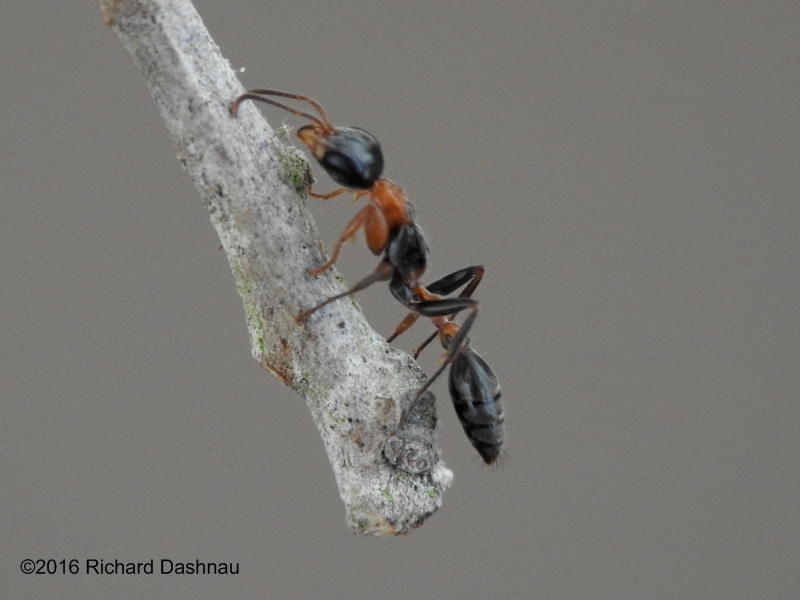
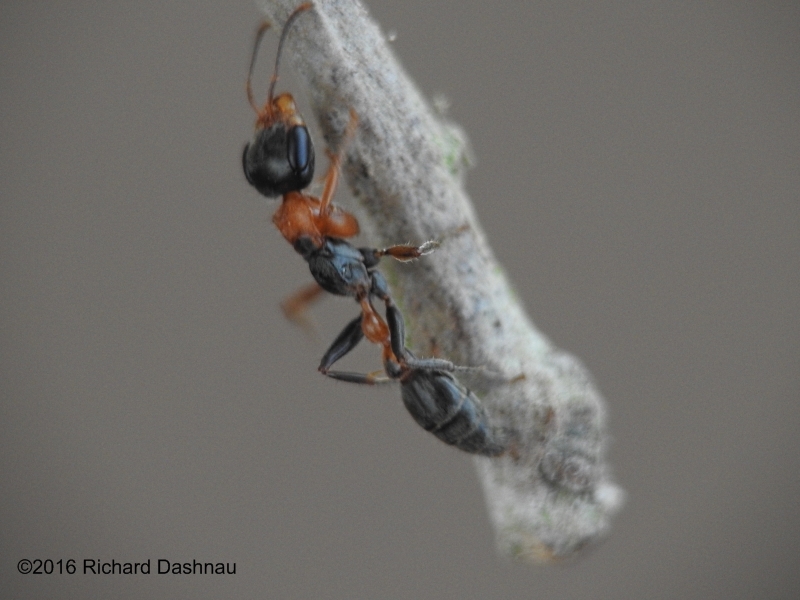
the ants as reddish-brown and black, but long and thin
when compared with fire ants or carpenter ants. In various
literature
they are described as
"wasp like". They
are
called Mexican Twig
Ants, Elongate Twig Ants, or Graceful Twig Ants
(pseudomyrmex gracilis
or pseudomyrmex mexicalus). I found an article online:
Elongate
Twig Ant, Mexican Twig Ant (suggested common names),
Pseudomyrmex
gracilis (Fabricius) (Insecta: Hymenoptera: Formicidae:
Pseudomyrmecinae) by
Patricia
L. Toth
(link: https://edis.ifas.ufl.edu/pdffiles/IN/IN75200.pdf)
According
to this article, these Twig Ants have a painful sting (I've
also
learned this through personal experience), but are usually
only
encountered in small numbers. It is a solitary
ant--it
forms small
colonies. It feeds on live insects, fungus spores, and
can tend aphids
for honeydew. These ants are originally from Mexico. As the name
suggests, Twig Ants
nest in hollow twigs, but can use other small
cavities as well. Once I learned about this ant, I started
trying to
photograph one. I've
tried
several times (they move quickly), and
was
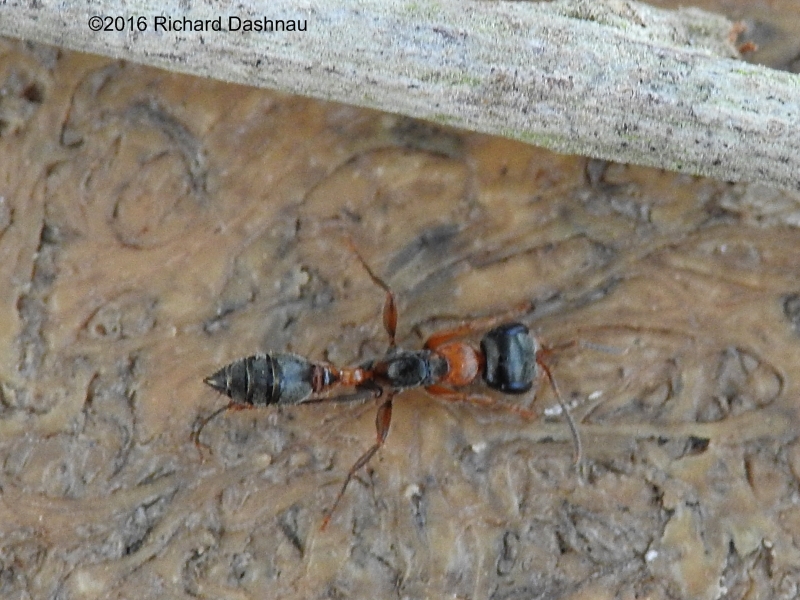
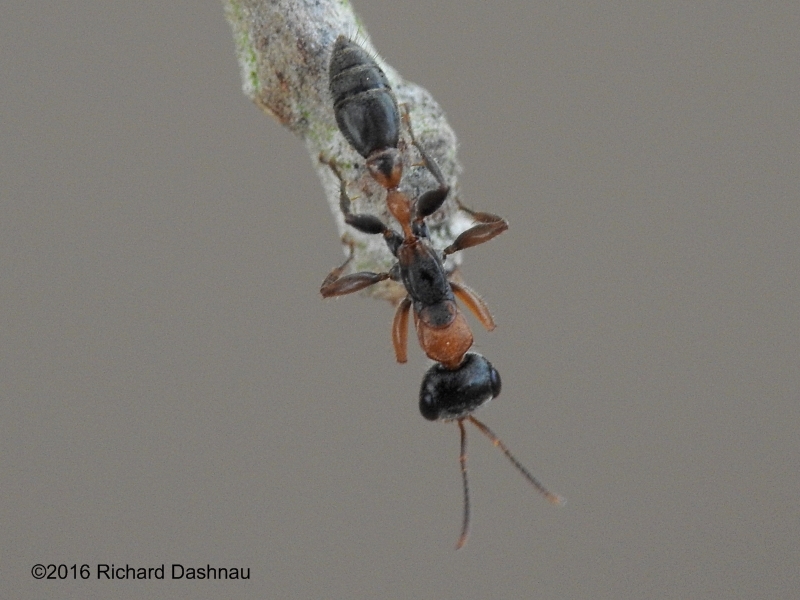
finally able to capture video of a twig ant on one of the
benches
at BBSP. I filmed the video at 120 fps to slow the ant's
movements. The
"wasp-like"
shape of the ant can be seen,
as well as
the long, oval eyes. Near the end of the video it's possible
to see the
ant cleaning its antennae. I also took a few photos,
shown below. The
video
clip is linked here.
I
read another article on the feeding habits of these ants:
THE
FEEDING HABITS OF PSEUDOMYRMINE AND OTHER ANTS.
W.
M. WHEELER ANDI. W. BAILEY.
link:
https://www.jstor.org/stable/1005485
In
that study, they determined that it was possible to get an
idea of what
ants eat by looking at their pellets. What pellets?
Ants
clean
themselves, other ants and their nest. They also
can only ingest liquids, but get those liquids by
processing various prey items, such
as insects. When ants clean themselves, they
use
their tongue. Ants have a tongue that they can
extend between their
mandibles for a short distance. I found this for a very
detailed study on the function of an ant's tongue:
How
Do Ants Stick Out Their Tongues? by
Jürgen
Paul, Flavio Roces, and Bert Hölldobler link:
https://www.researchgate.net/publication/11170720
According
to that study, the tongue is apparently extended "passively"
by various
elastic structures that are loaded when the tongue is
retracted. The
tongue is held in place by
other
passive structures that allow the
tongue to extend when those structures are moved out of the
way. This
means that the tongue is not extended by pressure from the
ant's body
fluid, or
hemolymph. Hard materials, and various "gunk" that
ants clean off their antennae, etc. are deposited in a
cavity
that opens just below their esophagus. This is called an
"infra
buccal
pocket", and
as
material gets compacted into the pocket; it
is eventually expelled as a pellet. This pellet can be
examined to
determine the nature of the materials within--and some
idea of what the
ant eats can
be
found. This surprised me, since owl pellets
(which are formed a bit differently) can be used to determine
what an
owl has eaten! So, at the end of my
video clip, the ant
cleans
its antennae, and
I
believe I can see the ant's tongue also!
The ant is pulling its antennae though comb-like structures on
its front legs called "strigils". After
it combs the dirt off its
antennae, the ant uses its tongue to
clean
off the strigils. This material is stored in the
infra buccal cavity. Eventually it will expelled as a very, very
small pellet.
10/16/2016
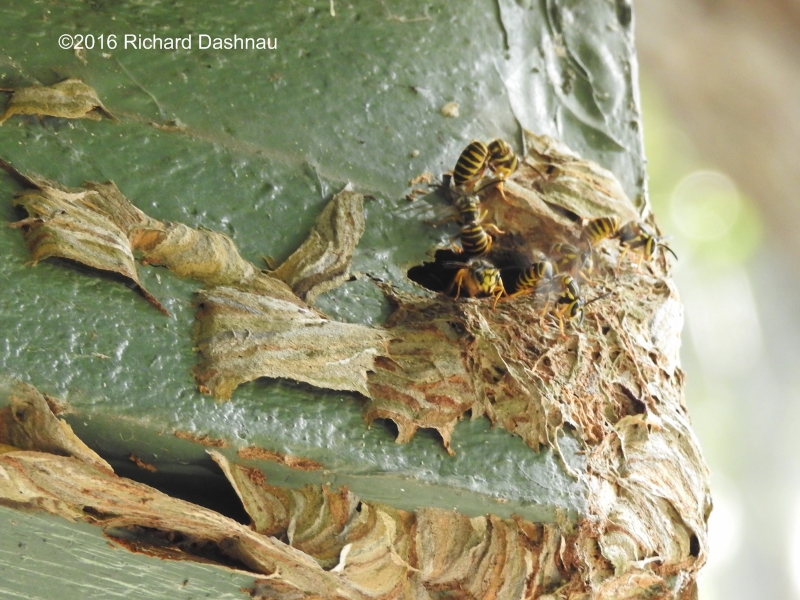
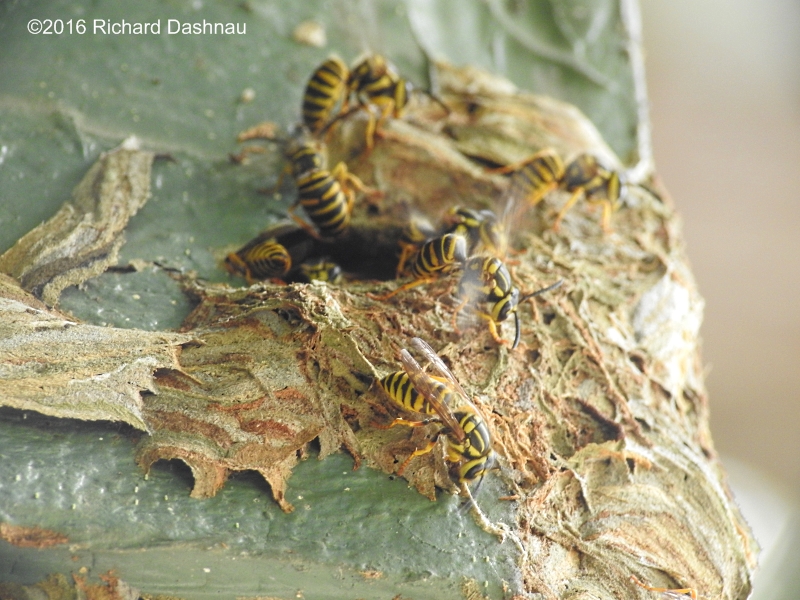
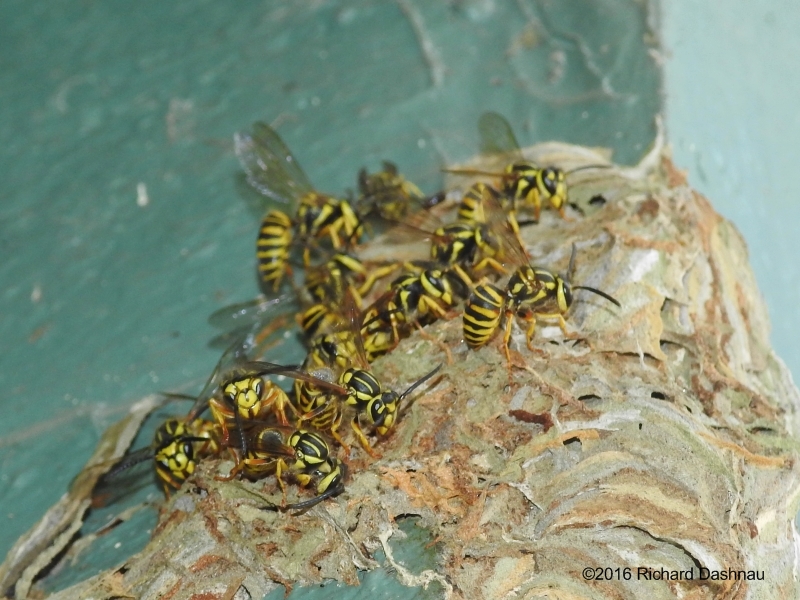
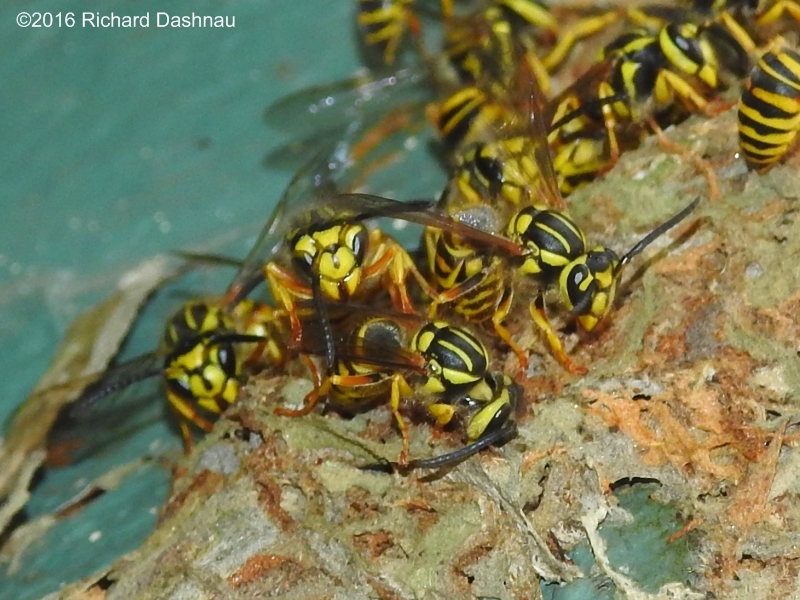
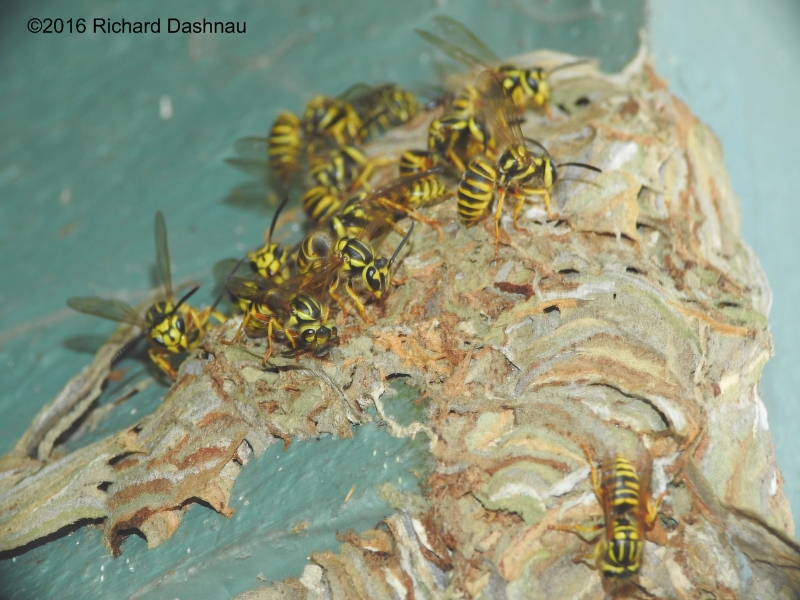
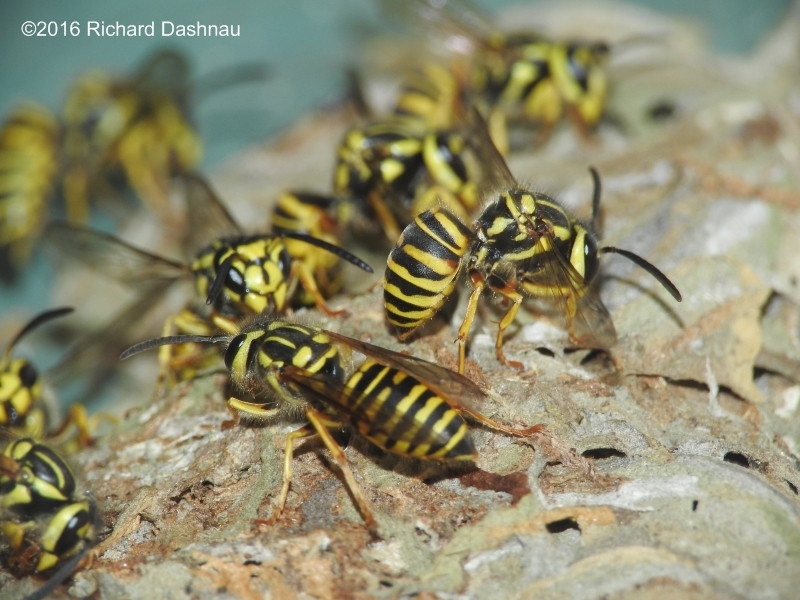
For a brief time,
there was a rather unique opportunity at the Nature Center. Yellowjackets had built a
nest on the edge of the building, right in front of the main entrance.
The entrance
to the nest was only about 7 feet high. The
yellowjackets were quite
docile, fortunately-especially considering the number of people walking by just
below their nest.
I didn't get a
chance to look
closely at them until about 3pm, and the sun had already
moved to a point that
caused most of the area to be shaded. I took a few pictures and then a
few video clips.
When I tried to take some closer shots, I realized that I was
moving a camera (with an occasional flash) just a few feet from
the
entrance of
the nest ...so I stopped
taking pictures. I decided not to press my
luck. Like some other "social"
hymenopterans, if one of the workers is goaded into a defensive
sting--then along with
the sting
two sets of
pheromones (scent markers) can be released.
One is an "alarm" scent,
which alerts other
workers and brings them out into defensive mode. The other is a "marker", which points
the
alerted workers towards a TARGET to attack. This is mentioned in a
study I read some time
ago:
"Developing a paired-target apparatus for quantitative testing of nest defense
behavior by vespine wasps in response to con- or heterospecific
nest defense
pheromones", by Sean
McCann, Onour Moeri, Sebastian Ibarra Jimenez, Catherine Scott, Gerhard
Gries (link: http://jhr.pensoft.net/lib/ajax_srv/generate_pdf.php?document_id=6585&readonly_preview=1)
So, I
was only able to get a few interesting macro photos, and video
clips, and so
I've put them together
into a short video. The images shown here are the few good ones I
captured.
The
video that I put together
from the clips is right
here.
I
wanted to identify these yellowjackets. My insect books
didn't really
have a clear description that I could use, so I looked
online, and
found some good studies. The one that helped
most is:
"The
Yellowjackets of America North of Mexico" from the
Department of
Agriculture (1980). Link: https://naldc.nal.usda.gov/download/CAT82762500/PDF
The
information that follows came from that source.
The
term "Yellowjacket" probably originated in America. It
actually refers
to just two genera. "True Hornets" are related to
yellowjackets, but
are larger, and usually live in the Old World,
although one species
(The European Hornet, Vespa crabro) has been
introduced into
eastern North America around 1850. This guide had a
very good
identification key, and I was
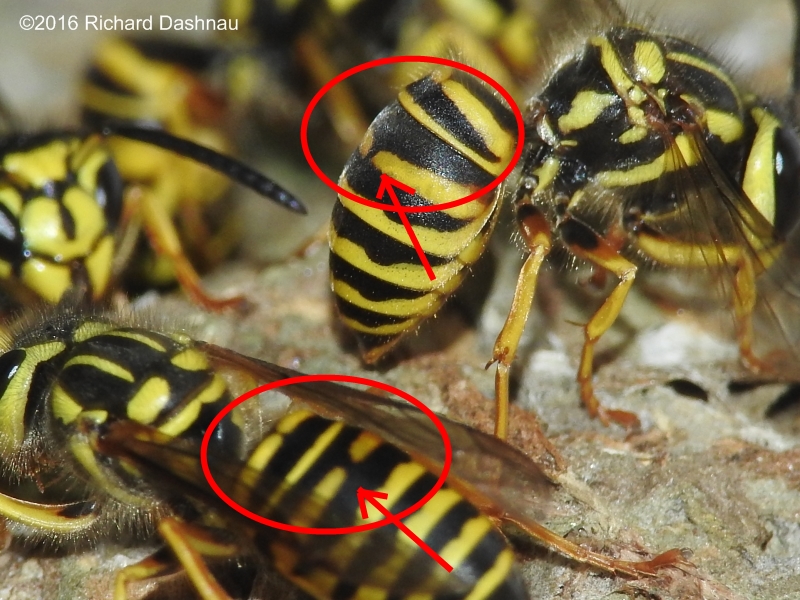
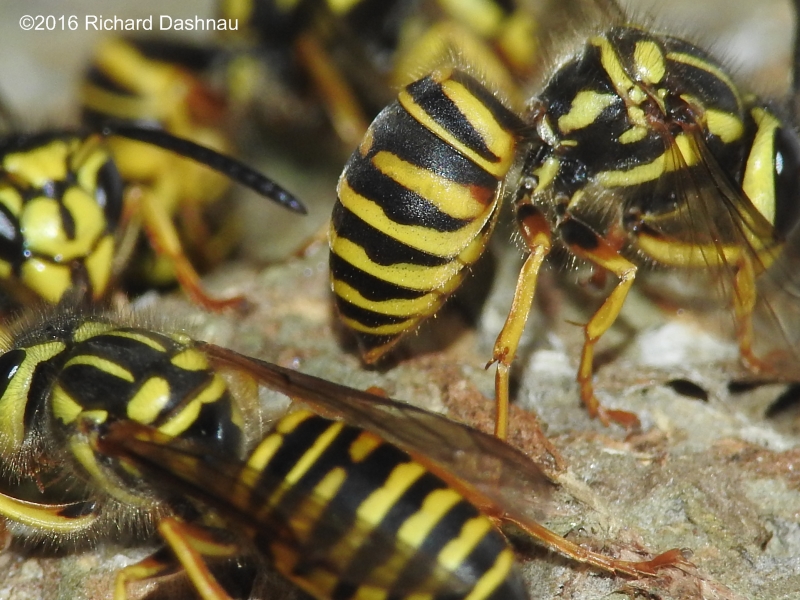
able to identify the yellowjackets as
Southern Yellowjackets (Vespula squamosa) by the line in the
center
of the second abdominal segment that joins two dark
bands.
Near the end
of a season, workers start pulling larvae from
the
combs an feed them to other larvae, or discard them. During
this time
(late summer or autumn) workers of some types of
yellowjackets
are
more likely to sting, even if they are away from the
nest.
Yellowjackets don't store honey. They feed their larvae meat
(usually
pulped arthropods--the correct term is "malaxated")
and possibly nectar and
honeydew. The adults can feed on juices produced while they
chew and
pulp (malaxate) meat for use in the nest. They can also eat
nectar and
larval secretions.
This
species of yellow jacket sometimes "usurp" colonies of another
species
of yellow jacket ( such as v. maculifrons, Eastern Yellowjacket).
V.
squamosa is considered a "facultative
social parasite" of other species
of Vespula. That is, they "can" parasitize other nests but it
isn't a requirement for their survival. V. squamosa *can* build
their
own nests. Otherwise, a
V. squamosa queen "usurps" the nest of the
original "host" queen. Then she assumes complete control of
the
host colony. The host workers then take care of the first brood of
the
new queen (v. squamosa) and eventually only the new queen's
workers
inhabit the colony. About 20 percent of colonies in one study
showed no
traces of the original colony--but in
the rest, host workers have
remained, or the nest shows evidence of the earlier construction
by the
host species. The usurped host nest can show "smaller, tan cells"
that
contrast
with the large grey cells of the original owners.
So it's sometimes possible to determine the history of a v.
Squamosa
colony by looking at the construction of the nest. Considering
that
this nest appeared rather suddenly in this high-traffic area, it's
probably not a "usurped" nest. There
may be some out there who feel that yellowjackets are just a
nuisance
and
should be eliminated, but many sources consider them beneficial
insects because of the number of potentially destructive insects
(such
as caterpillars, grasshoppers) that they abduct,
malaxate, and feed
to their larvae. It is true that if large amounts of food are left
exposed to rot (quantities of protein like meat, or sugars
like fruit),
then large numbers of yellowjackets
can appear to take advantage of the
windfall. But, it's usually *people* who leave those piles of
food.
Note:
8/1/2020 While watching the video during remastering, I
noticed that many
of the yellowjackets were fanning the nest.
While
I thought at first that this was for cooling, or for
ventilation--I
wonder now if they are fanning the newly-deposited wood pulp
being
used
as nest material. Would this be a way to "cure" it, or dry
it out
so it solifies quickly? I'll try to find out.
June
16
and June 27,
2010.
I'm going to tell you a true story about a young mother. She
needed to
feed her babies, but didn't have resources at hand to feed them.
So,
she
went
out cruising. She went here. She went there. Around her,
there were
the sounds of unattached lovers calling for each other. She
decided to
approach one of these callers; perhaps to
help her with her problem. So
she picked one, got close, and suddenly stabbed it. She
immobilized the
young lover and she brought it back to her home and to her
offspring.
By
then,
she'd gone beyond acceptable human behavior. But her actions
then
went from apparently violent to openly horrific. She dragged the
lover
into a dark room...
...and
left one of her offspring with it...
...and
then, she locked the room.
She
left her young one to eat the immobilized
lover--while the lover
still alive--or else the baby would starve to death.
I'm
speaking, of course, about a Cicada Killer Wasp. Of course
they
don't follow acceptable human behavior. They aren't human. The
females
dig tunnels and and then chambers in
loose sand or dirt. Then they
patrol,
looking for Cicadas--which are buzzing out their mating calls. I
have read
that the wasps will sometimes attack standing Cicadas, or take
them as
they fly. Then they sting a Cicada, which paralyzes it, and carry
it
back
to burrows that the wasps have dug. There, they will place the
paralyzed
Cicada in a chamber, place an egg on it,
and then wall off the chamber.
The egg hatches, and the hatched larva eats the Cicada--which has
been
kept "fresh" because it's paralyzed and still alive.
I've also found another study
of Cicada Killers that can be downloaded
in .pdf format. This is the link: Life
History
and Habits of the Cicada Killer in Ohio .
Some
of y'all might remember that I posted some slow-motion video clips
of
these
amazing insects flying around last year. That material can be seen
on
this
page below. This year, they
hatched in the same garden, and this time
I decided to try to catch some as they flew back to their burrows
with
prey
for their young. It's not easy, since they return from any
direction
and
are really fast--they just appear and hit the burrow. I got
two clips,
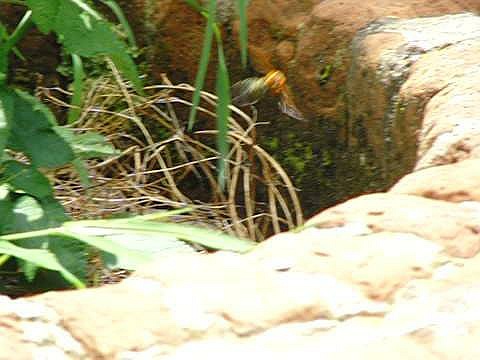
one just usable, and one pretty good. Today's RICKUBISCAM is a
cropped
frame capture from the newer video clip.
The links appear below the
images.
------ ---------
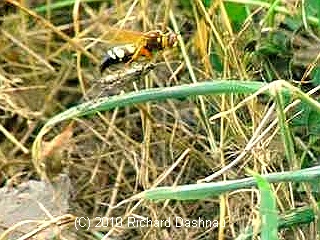 -----------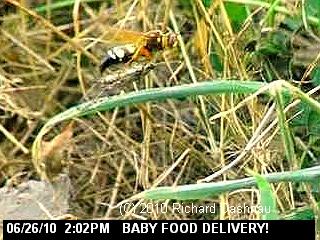
A QUICK DROP IN
HOVERING
AROUND A BIT
Cicada
Killer with Cicada clip one (wmv. 4.8 mb)
Cicada
Killer
with Cicada clip two (wmv. 10 mb)
We've
gotten
quite a bit of rain in the weeks after I shot the video clips,
and
I haven't seen any more Cicada Killer activity at the cistern
(where
I've
been filming these) for a while.
05/31/2009-06/21/2009-
In a garden near the Visitor Center at BBSP, there is a large,
dirt-filled,
brick cistern in the ground. Sometime around the end of May this
year,
a group of
large yellow and black wasps began to fly around the garden
and in and out of the cistern. They were Cicada Killer wasps, and
most
of the wasps patrolling around the garden were
males. The
males hatch
a bit earlier (up to 2 weeks earlier) than the females, so they
pick
perching spots and then leave those spots for short flying
patrols. They look
for
females,
and also will fly after each other. It can be pretty busy, and
we had a number of park visitors coming in alarmed about the
"wasps'
nest"
in the garden. What a great intrepretive
opportunity--expecially since
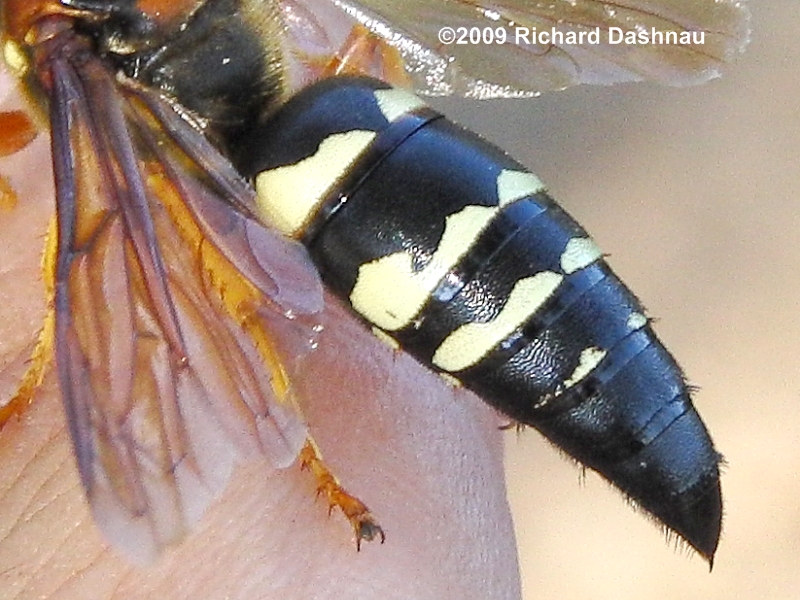
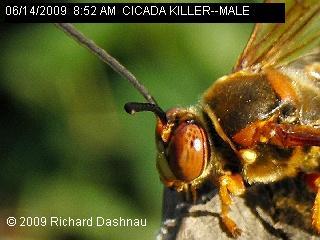
the wasps posed almost no threat at all. The males have a sharp
protrustion
at the end of their abdomen. This is NOT a stinger, but just a
false
one.
Only
the females can sting, and they usually sting Cicadas to
paralyze
them so they can be carried back to the burrows. A female can be
pushed
until it stings, but they are not aggressive.
Besides lacking
this
false stinger ( the females' operative one retracts), females can
be identified
by large "spurs" or paddles on their rear legs.
Since
all this activity was going on,
and the males would repetitively land,
fly, and land again, I was able to take some interesting
pictures
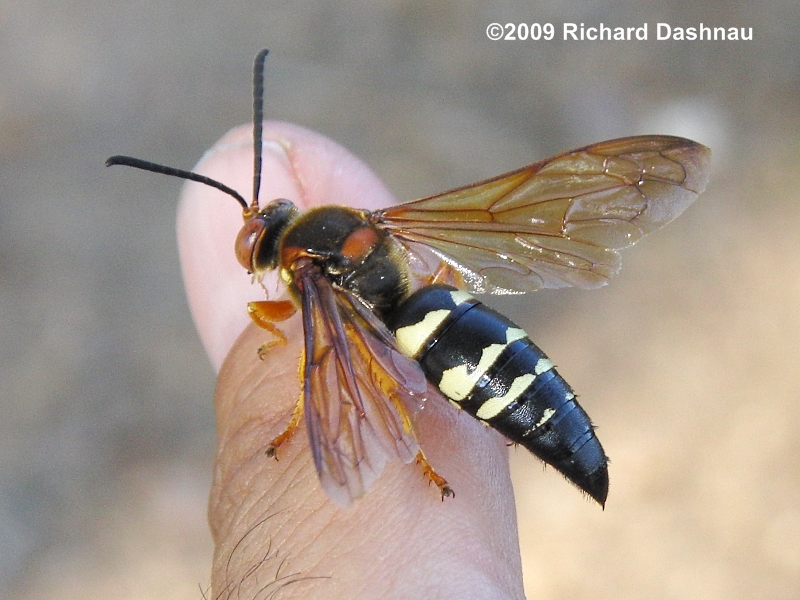
of these large wasps. I approached one of the males as it
perched
on a post.
When it took off to chase another male, I put my
hand
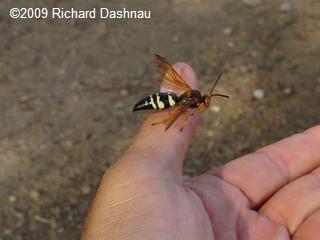
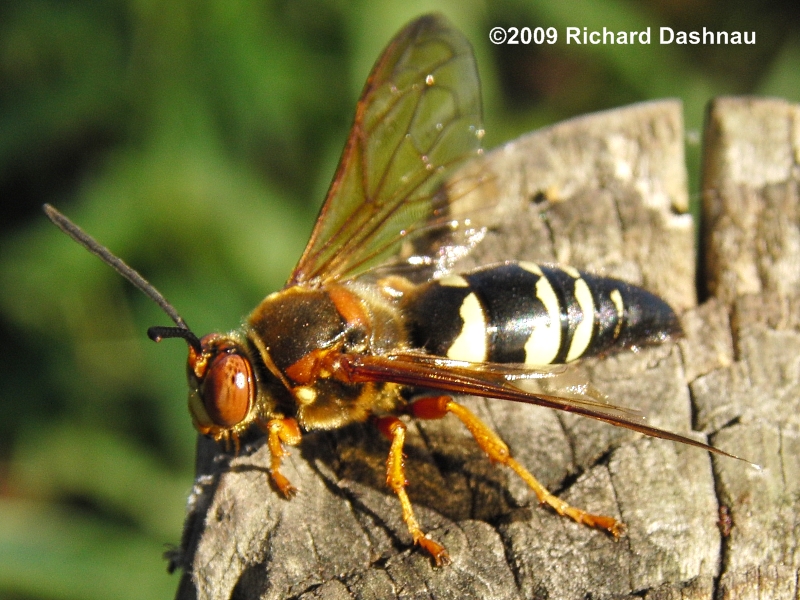
on the post, and it perched on my hand. Today's RICKUBISCAM shot is
a
picture
of the wasp on the post. Note:
Most of the
information I got about these wasps came from a web page (my insect
guides
didn't have much). That very excellent online source is: Prof.
Chuck
Holliday's Cicada Killer Page.
If you really
want to learn
about these wasps, visit his pages.
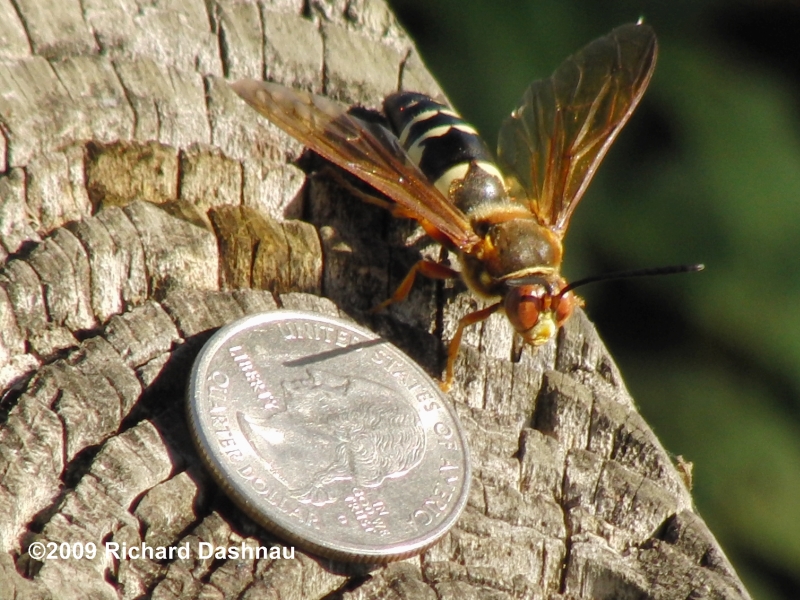 -
-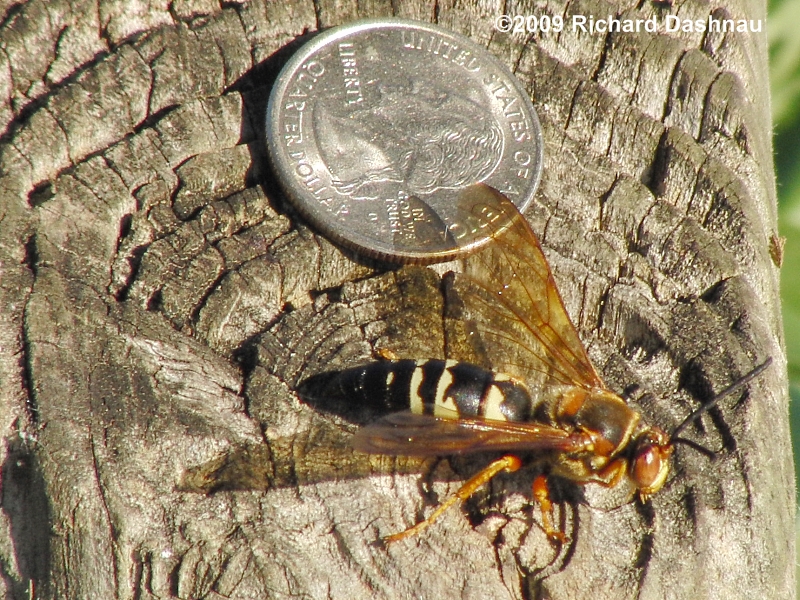 -
-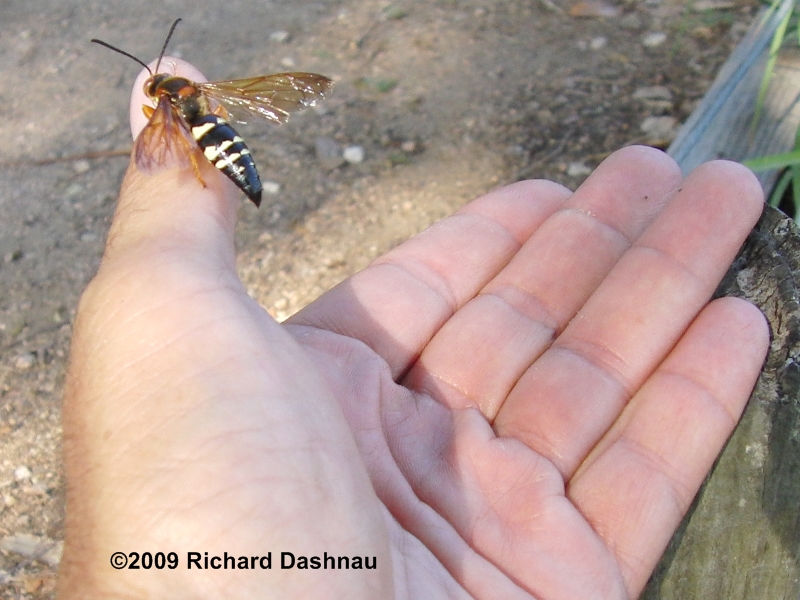 -
-
MALE
CICADA KILLER WITH QUARTER
MALE CICADA KILLER WITH QUARTER
CICADA KILLER PERCHED ON MY HAND
-
ON
MY HAND FROM VIDEO CLIP
Cicada
Killer on my hand (slomo at end) mp4
 -
- -
- --
--
ON
MY HAND CLOSER --
--
--
CLOSER CROP
ON THE POST FROM ANOTHER
ANGLE
OLD RICKUBISCAM SHOT
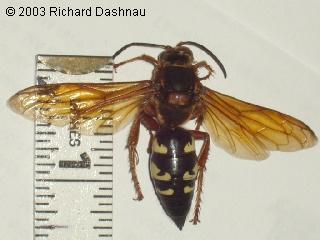
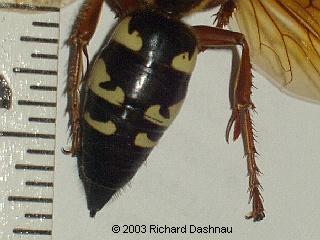
Directly
below are some pictures I shot in 2003, showing a dead female Cicada
killer.
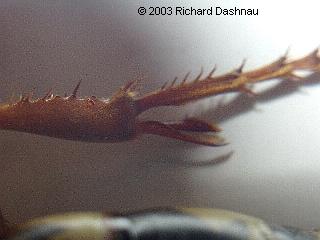
A co-worker brought it in to ask if I could identify it. These 3
pictures
show the broad spurs
(or paddles) that the female Cicada Killer has on
her last pair of legs. It is supposed that they help her
dig.
The female will dig a burrow, then dig branching burrows. She will
then
fly off
and return with a Cicada for the burrows. She will lay a
single
egg on a paralyzed Cicada. The egg will hatch and the larva will
feed on
the Cicada (kept "fresh" because it's still alive and
not dead and
rotting)
until it cocoon . It overwinters in this form,and then pupates and
then
hatches in the spring. The adults don't eat meat (preferring
sweet plant juices), and don't live
long (2 weeks for males, and 4 weeks for
females).
 -
- -
-
PRETTY BIG WASP!----
--
THE SPURS ARE
VISIBLE
ONE OF THE SPURS ON A REAR LEG
Finally,
the 3 images below are frame grabs from some short video clips put
together
from footage of the wasps flying. I tried to catch females returning
with
Cicadas, but there were at
least 3 burrows in the cistern, and I
couldn't
be sure where an incoming wasp would land. When a female did
return,
she was landed and inside before I could bring the camera on her.
I
couldn't
catch any of the midair collisions between males either. Remember,
even
though these wasps seem to be in a group--they are not acting
cooperatively.
They all are attracted
to a preferred nesting site (and may have
hatched
there). In
my
videos,
the subjects might move a bit out of frame, and a bit
out
of focus for two reasons. Even though capture was at
210 and 420 fps;
and
playback at 30 fps (about 1/7th or 1/14th that of realtime)--I shot
in
realtime. Those wasps are fast, and I had to try to keep them in
frame
as they flew. Slowed down,
it looks like it might be easy.
HA! Also,
once I'm shooting at that speed, focus is locked. If something moves
to
far in or out of my focus depth, then it blurs. Enough excuses. I
can watch
these over and over again. The wasps look beautiful at this
speed. Very
mechanical, too.
----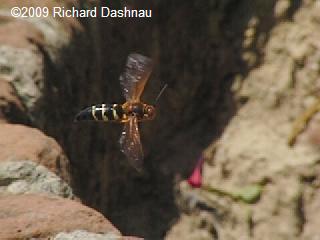 ---
---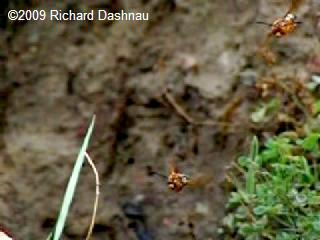 ---
---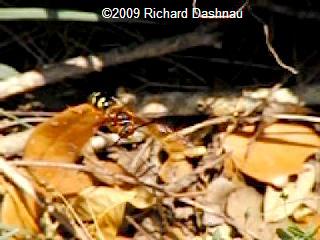
Cicada
Killer
at 210 fps wmv 7.6mb
Cicada
Killers
at 420 fps pt1 wmv 19.8mb
Cicada
Killers
at 420 fps pt2 wmv 9.0mb
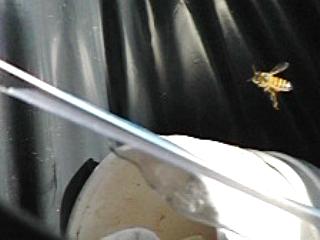
12/07/2008- I
had gotten a camera that could capture high framerate video, and I
was
shooting video of all kinds of things. I found some honeybees
foraging in a trash can, and I shot
a couple video clips. I
was still experimenting, so I shot one
video at 210 fps and one video
at 420 fps. I was surprised by the lack of "grace" shown by
the
bees as they flew. At times
it looked like they were
dangling at random on a string.
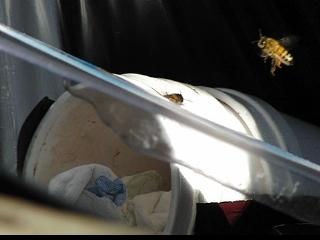 -
-
honeybees
210fps
wmv 2.6mb
honeybees
420
wmv 2.8mb
10/11/2006
(8/14/06; 8/10/06; 8/14/05)--I
was
talking
to some Visitors to BBSP last Sunday. It turned out that they
had
recently
moved from Colorado, and I had the opportunity to point
out some of our
local arthropods. As I did, I realized that I hadn't shown one
of our more
brightly-colored insects. It also has a nickname that might
alarm some.
So, here it is. I filmed some
of this material in August of 2006, and
some
in August of 2005. This could indicate that they are more active
at this
time, but perhaps not. At first
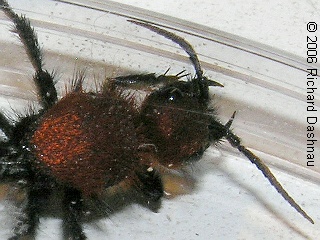
glance, the insect in this image looks like
an ant--a large, hairy ant. But actually, this insect is a
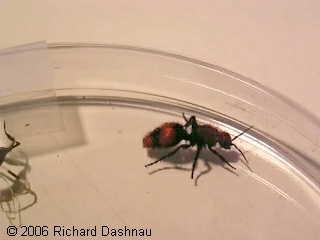
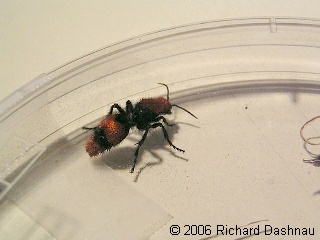
wingless,solitary wasp. It's sometimes called a Red Velvet Ant (dasymutilla
occidentalis).
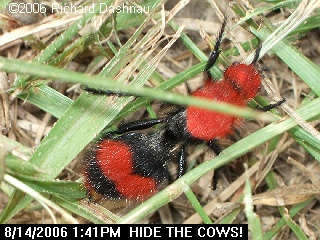
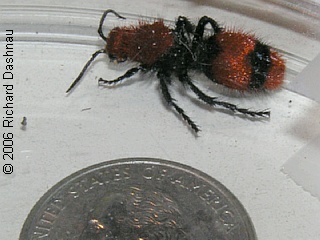
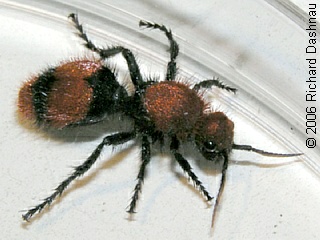
It is also known as a "Cowkiller". The first image below (ONE) shows
the
insect near a quarter. The next two clips show
other views of the ant (TWO,
THREE) inside a petri dish. I wasn't
going to let it sting ME. The last
two images below (FOUR, FIVE) are frames from short video clips.
These
images were shot inside, and the artificial lighting gives a
"darker"
cast
to the
red colors, and shows a slight iridescent sheen on the wasp.
These
were taken in 2005. There are two links below images FOUR and FIVE
to the
clips.
 --
-- --
-- --
--
ONE
TWO
THREE
FOUR
- -
-
FIVE
COWKILLER
IN DISH PT.
1 1.08MB COWKILLER
IN
DISH PT. 2 1.5MB
According
to A Field Guide to Common Texas Insects by Drees and Jackman (C)
1998
(pp. 282-283) This wingless form is the female. The males are
marked
differently,
have wings, and
don't sting (this is usually the case, since the stinger on
many insects is a modified form of the ovipositor-a hollow
structure
used for laying eggs by many insects. Some use the ovipositor
to drill
into wood, or dirt, or other insects before laying eggs. This
means
that
only females would have the ovipositor, and therefore, a stinger.)
The
females dig to the nesting chambers of
ground-nesting bees. They eat a
hole through the cocoon where they deposit an egg on the host
larva.
After
hatching, the Cowkiller grub eats the host larva before finally
developing
into
an adult. The female ant fights ferociously and has a
painful
sting.
The name "Cowkiller" refers to the fact that this sting is very
painful.
So painful that it was said to be able to kill a cow.
This is only
figurative.
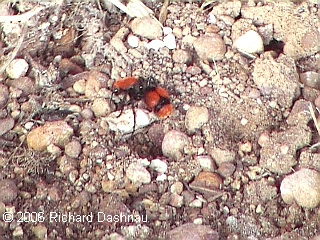
This
year, I found a Cowkiller wandering through the grass while I was
exercising
at Memorial Park. Today's RICKUBISCAM is one of the few usable
images I
could get at that time. When
this wasp breaks cover, or is disturbed,
it
can run VERY fast, and is hard to capture. A few days later,
I found
another one working in the loose dirt under the Observation Tower
at
40-Acre
Lake. Compared to the bright sunlight outside, it was a bit
difficult
to see in the shade under the deck. I shot some video
anyway.
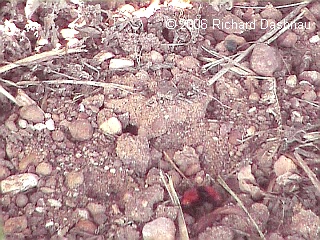
The images below are frames from the video clips. The
first clip (image
SIX, below) shows the dasymutilla apparently
foraging, and then
burrowing. Since it is under cover, and I haven't disturbed it,
the
Cowkiller is moving relatively slowly. The
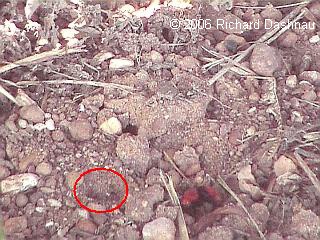
next clip (image SEVEN, EIGHT, below)
shows some more movement. Look at image EIGHT and you'll see a red
circle.
This shows an Antlion pit. In the second clip, it appears that the
Antlion
is either excavating its pit after the Cowkiller has collapsed it,
or else
it is trying to trap the Cowkiller (which seems quite optomistic
to ME).
I noticed
a number of other wasps
digging in the area, and they appeared to be
making
nests. It may be possible that this dasymutilla occidentalis
was
looking for some of these finished nests to use.
 --
-- --
--
SIX
SEVEN
EIGHT
COWKILLER
BURROWING
6.2MB
COWKILLER
PASSES ANTLION 4.6MB
------
Go
back to my home page, Welcome
to
rickubis.com
Go
back to the RICKUBISCAM
page.
Go
back to the See
the World
page.