CRITTERS
AT BRAZOS BEND STATE PARK (AND ELSEWHERE)--TURTLES
This
page was born 08/10/2005. Rickubis designed it.
(such as it
is.) Last update: 02/11/2023
Images
and contents on this page copyright ©2002--2023
Richard M. Dashnau
Go back to my home page, Welcome
to rickubis.com
Go
back to the RICKUBISCAM
page.
----------------------------------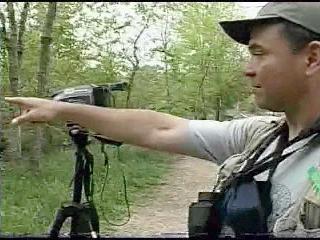
That's
me on the Elm Lake Trail at BBSP. As I've gotten more pictures of
turtles
at the park (and elsewhere), I've gathered enough to start putting them
on a separate page.
Here they are!
In
October of 2006, I attended a training seminar sponsored by the NAI
(National Association for Interpretation) to become a Certified
Interpretive Guide (CIG). As our final
project, we had to give a
10-minute presentation. I
chose Snapping Turtles as my subject. I was given a copy of the
performance I gave on 10/27/2006, and I've edited the
video. You
can see it by following this link
(mp4 format) .
Update 02/25/2023 - During
a few "Pondlife Programs" outside near 40 Acre Lake this year, we
caught a few baby Musk Turtles. During one of the programs,
we
caught three!
Considering that we were still in winter, and
had experienced some cold weather, I was surprised to see so many, and
wondered if we caught this
many, how many others might be
out
there? Musk Turtles, aka "Stinkpots", or Sternotherus odoratus have
some unique and interesting features (actually, that's true of almost
all wildlife inside BBSP, but I'm on
Stinkpots today.) Because of
the recent encounters, I did a bit of research to clarify my knowledge
of these critters. By the way, the glands that produce the smell are
called
"Rathke’s glands".
First-- some information about
their smelly nickname--From "Stink of Stinkpot Turtle Identified :
ω-Phenylalkanoic Acids" by T. Eisner et. al. 1977:
"Sternotherus has
four glands, morphologically identical, opening lateroventrally near
the edge of the carapace, in front and behind the plastral
bridges" (Based
on their image, viewed
from the bottom,
with turtle's nose pointing up (12 oclock), the glands are at 9, 11, 1
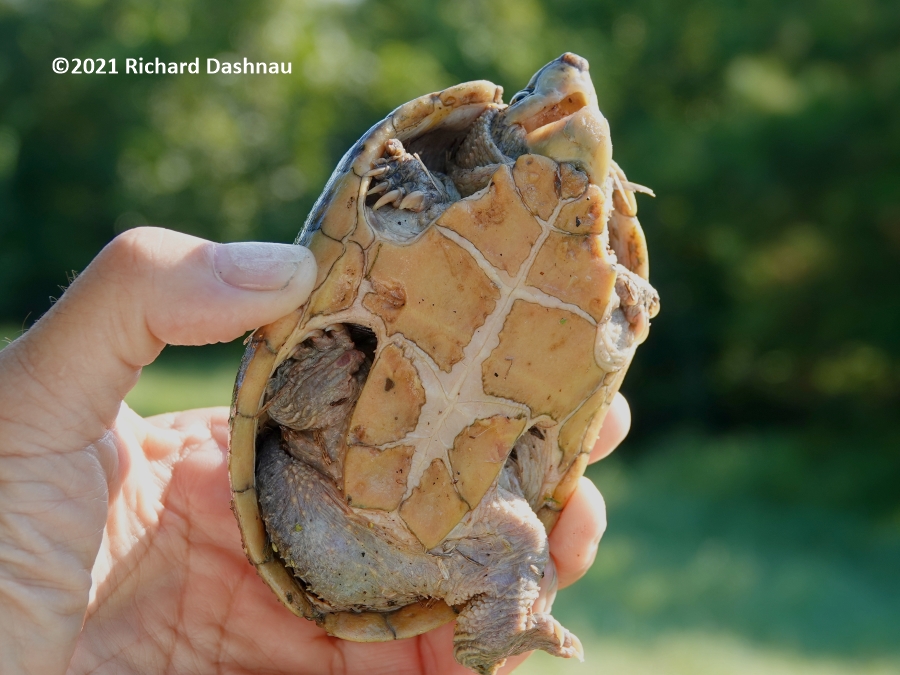
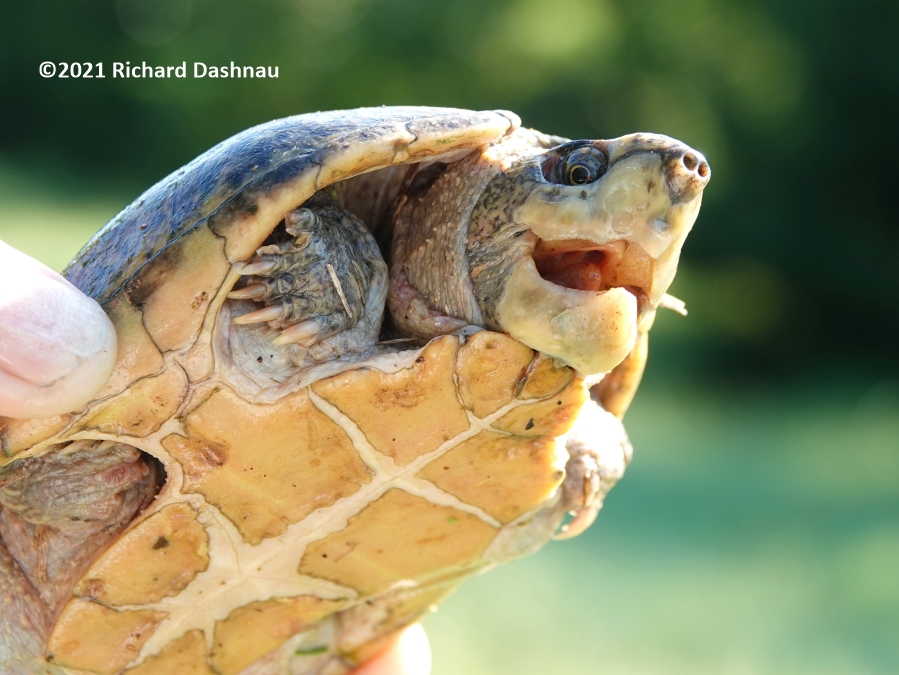
and 3 O'clock positions.) " I think at least a
few are visible (the front one, anyway) in these photos
I shot in August 2021 at Fiorenza Park. (see below on this
page)
And
there was this: "Subjective sniff testing of the secretion and its
components showed that the stench of the secretion is
attributable
chiefly to phenylacetic and 3-phenylpropionic acid."
So now
you know what makes that odor. Thomas
Eisner has many papers and books wherin he examines the chemical
defenses of many other organisms. When I learn of an animal that
has
uncommon weaponry (aside from the usual teeth and claws), I
wonder about how it's used and how it works. In the case of
Stinkpots, I wondered what the smell is good for, since I've
seen them
get eaten, and have found their shells empty on trails. The
question is addressed in this: "Chemical Signals in Vertebrate
Predator-Prey Systems Involving Common Musk
Turtles, Sternotherus
odoratus, and Their Predators", (by N.Dazet & D. Moll, 2014 )
There are two types of signals defined--which
I believe also applies to other organisms and situations:
"Chemical
signals emitted by prey prior to capture are referred to as disturbance
signals. Alternatively, chemical signals emitted by prey when the
predator captures the prey are referred
to as damage-released
alarm signals. These chemical alarm signals are analogous to auditory
distress calls, which are given after the individual has been
captured. Auditory distress calls
have been
described for a wide variety of taxa , such as juvenile crocodilians,
birds,
mammals, and amphibians." ( I've been alerted to
many
dramas in nature by the calls of a frog that
has been captured by a
snake, and I've often wondered why that happens. This study
has
given me a hint about why.) The study says that if the animal
that smells the stinkpot is another
predator, the signal after capture
can attract a new
predator that could cause
the primary predator to lose focus and give the stinkpot a chance to
escape. Raccoons, Bullfrogs,
Cottonmouths, and Common Snapping Turtles
all consume juvenile Stinkpots.
I've observed a Great Blue
Heron eating a baby stinkpot, and alligators consuming
adults.
Times other than predation events where the smell may appear are:
during shell maintenance,
courtship and mating. Odor appearing
before an attack has been made may work as a chemical warning
(signalling false toxicity); or a warning to other Musk Turtles.
For
the study, minnows were treated with musk turtle Rathke’s gland
secretions (RGS); while the controls weren't. Then both sets
of
fish were exposed to Cottonmouths in a lab
environment.
Meanwhile for field testing, they mixed RGS with water and soaked
chicken gizzards in it; then used non-RGS bait as a control. There was
no noticeable difference in the lab
tests--Cottonmouths did
not treat RGS-treated minnows any differently than the non-treated
minnows. But in the field tests, Snapping Turtles (which eat
young Stinkpots) favored the
RGS-treated bait by a wide margin; so it seemed like their scent was an
attractant.
from
the study: "In the field experiment, Common Snapping Turtles were
attracted to, and not deterred by, the RGS of Common Musk Turtles.
Although the emission of chemical signals to
attract
predators may seem counterintuitive, the musk turtle’s odorous
secretions, like the auditory distress calls of birds and mammals, and
the damage-released chemical alarm cue of
fishes, is frequently
produced only when the signal’s sender is in dire circumstances. The
attraction of a secondary predator would benefit the sender if the
secondary predator were to
interfere with the primary
predator....The use of a chemical signal by S. odoratus to influence
predation by an aquatic predator is highly plausible considering that
aquatic environments
are ideal for the dispersal of chemical cues."
If
that concept seems strange, it is related to various other
competition interactions we see often. Birds often steal food
from-or fight over it with-other species. Alligators, turtles, raccoons,
squirrels...I've
seen all of these stealing or fighting over food. Sometimes, the food
source is found and "claimed" and other animals chased away. But
sometimes (and that's relevant here),
it's the behavior of the
animal with the food that triggers the competition. Shaking
food,
crunching food and running (or flying) with food can alert animals in
the vicinity that something
tasty is going on, and that *that*
animal has it. It's not a long stretch to think that prey that cries
out or smells bad causes the same kind of response.
So,
that was a bit more about the Stinkpot's stink.
(To
see some examples of predation upon Musk Turtles I just need to go back
to Brazos Bend State Park in 07/10/2022 and 09/04/2022--during the
drought).
The images below
and one
video clip.
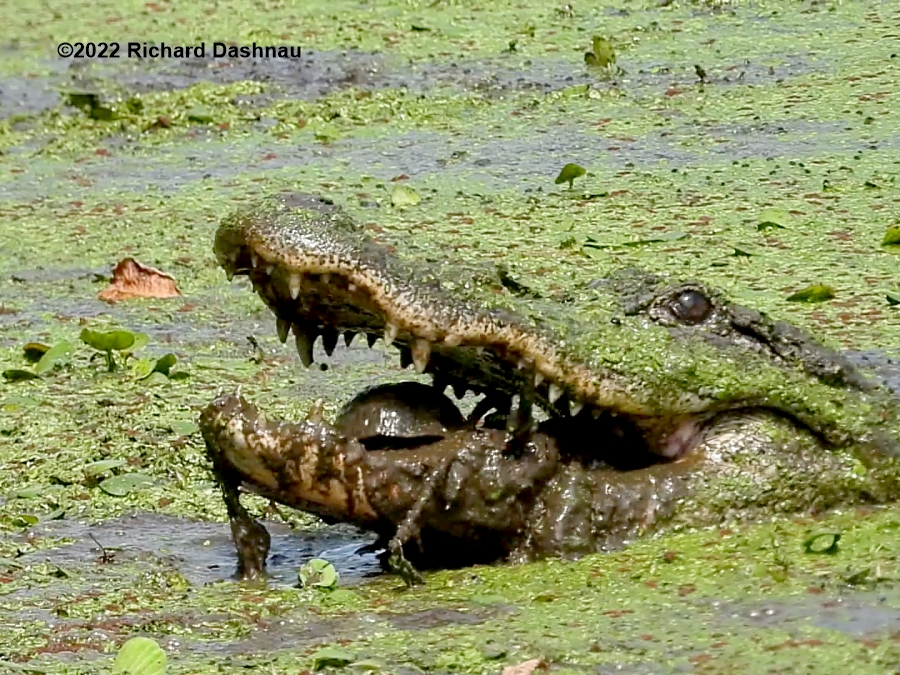
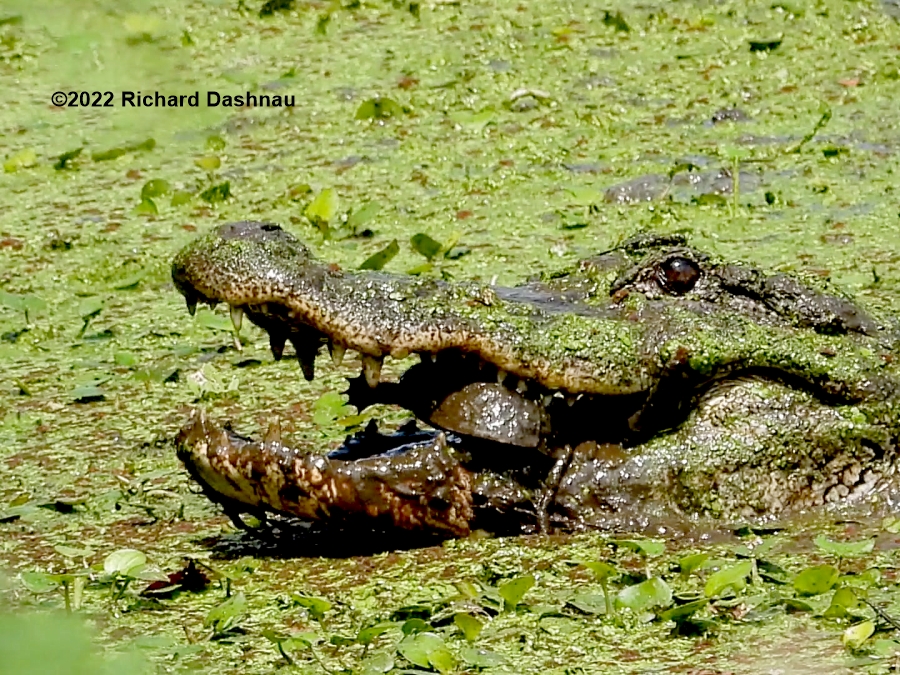
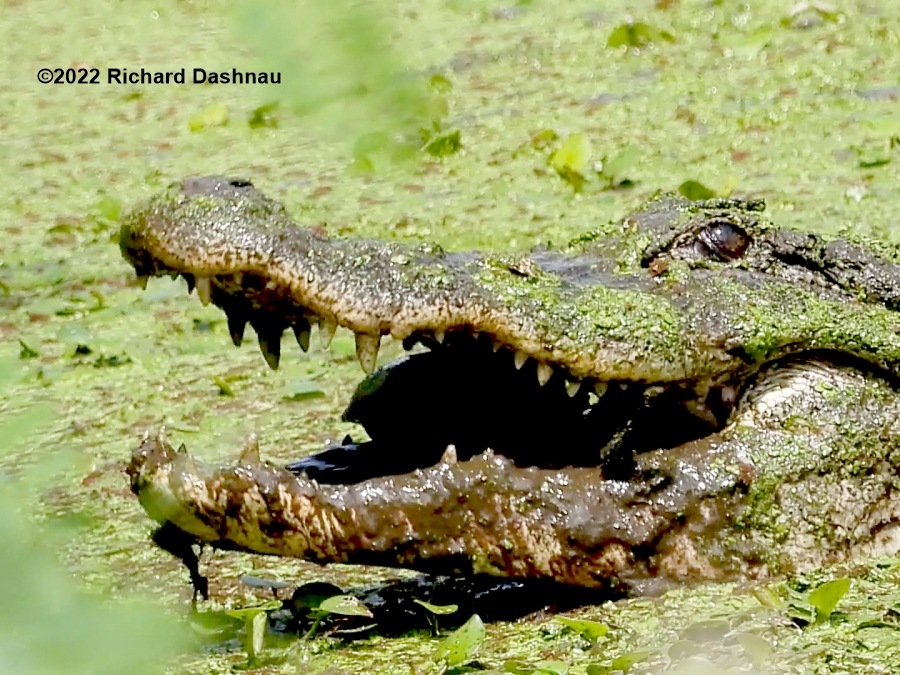
First, on 07/10/2022 an alligator was pushing through the mud from
Pilant lake when
it found a Stinkpot. The turtle had a slight advantage because it could
move over the
mud, but even though the alligator had to struggle to move, it could
still move faster than the turtle.
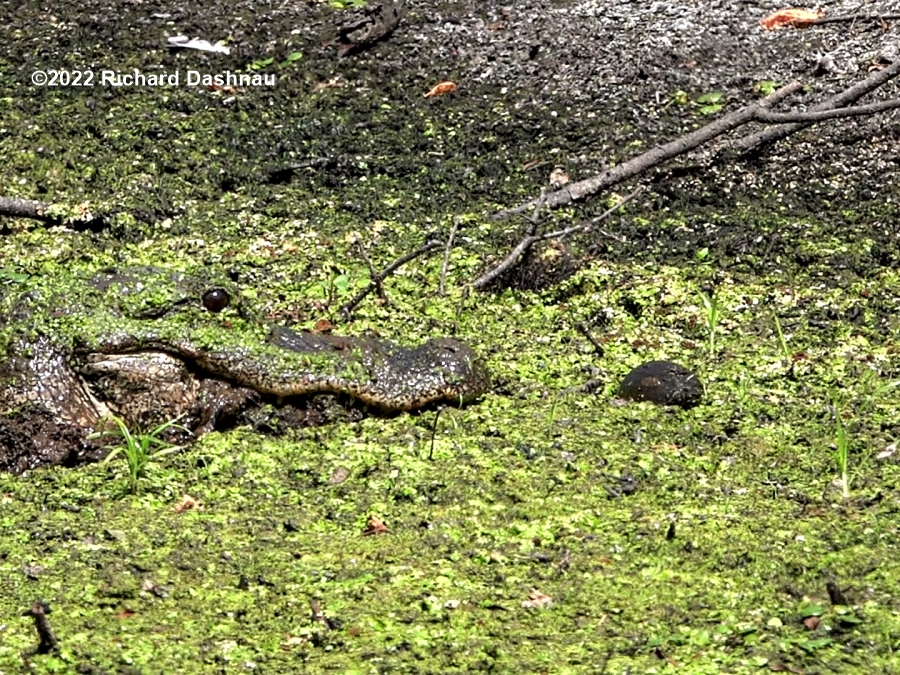
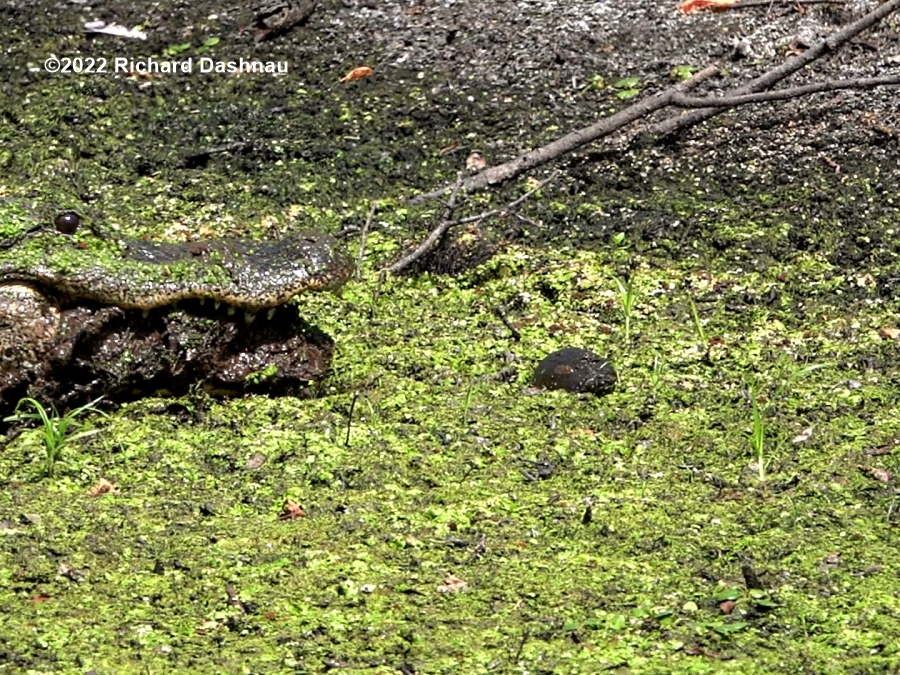
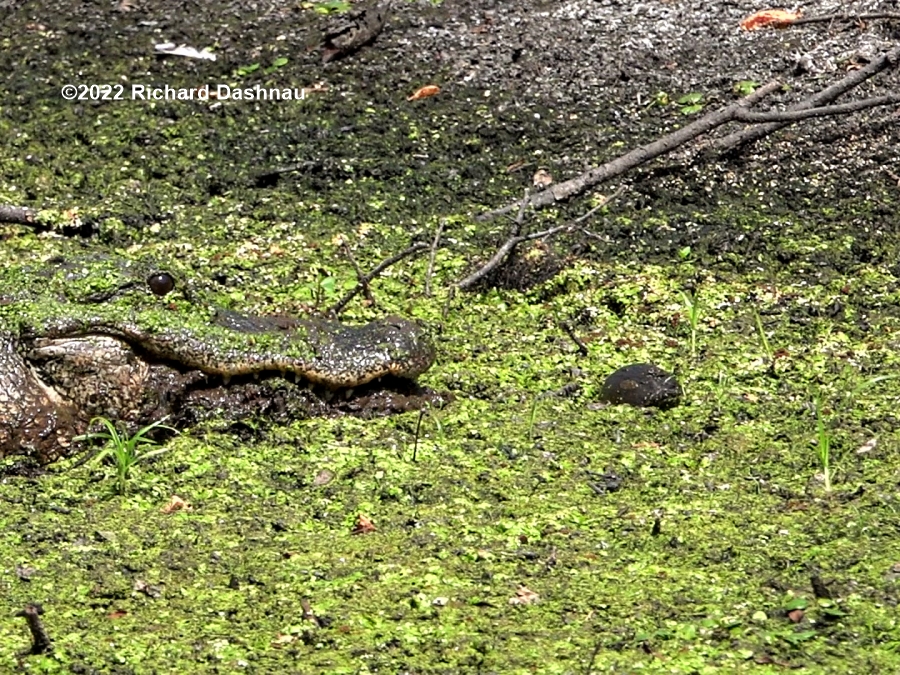
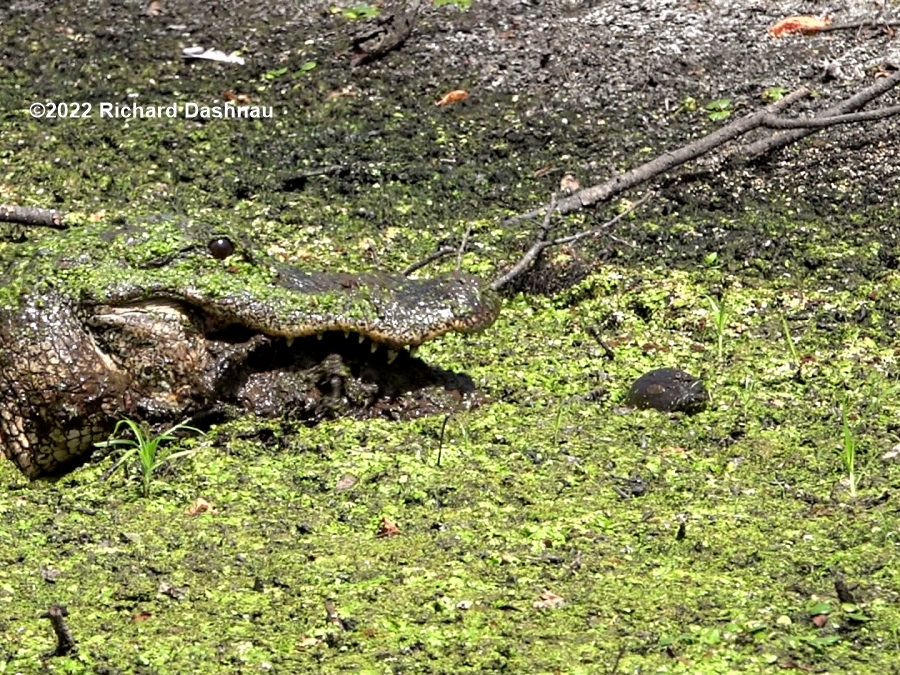
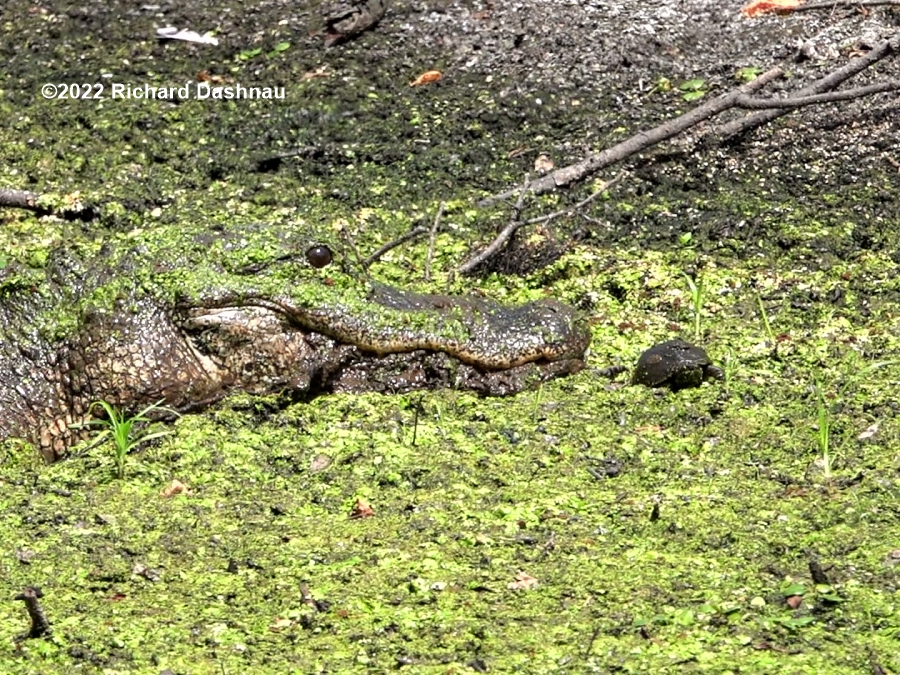
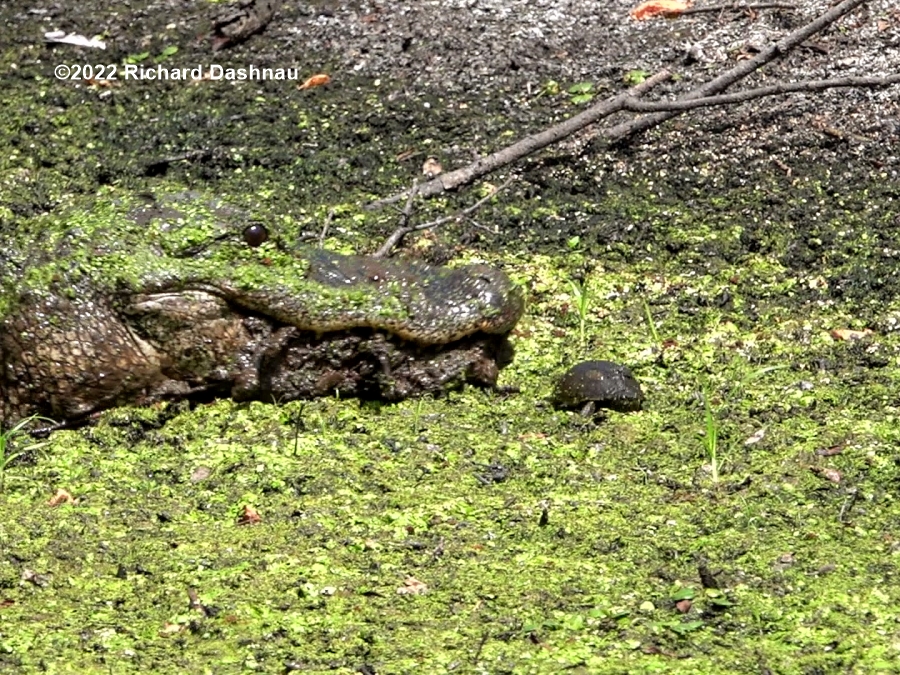
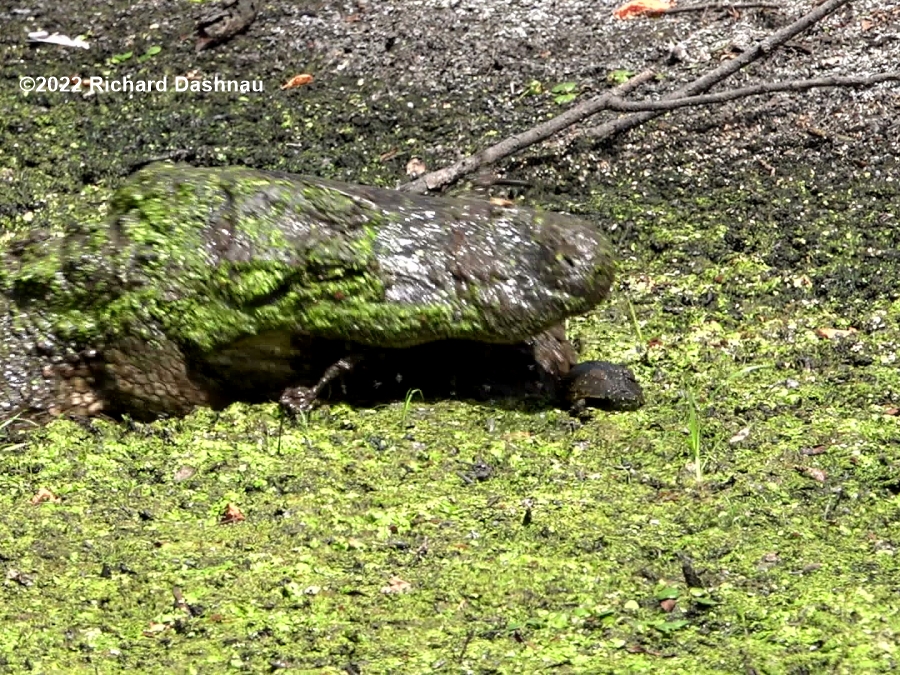
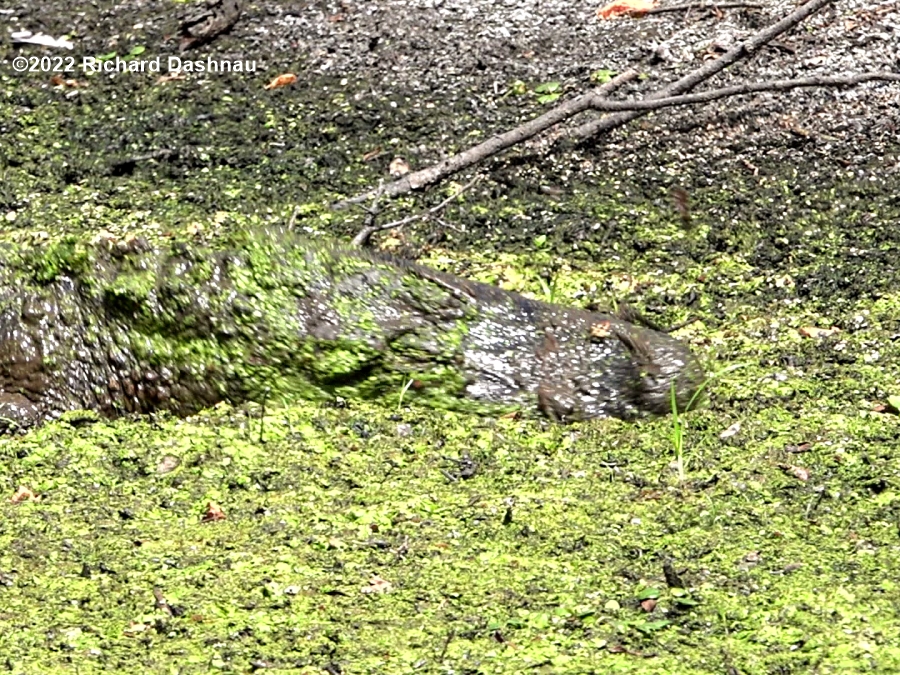
The alligator caught the
turtle, along with a huge mouthful of mud.
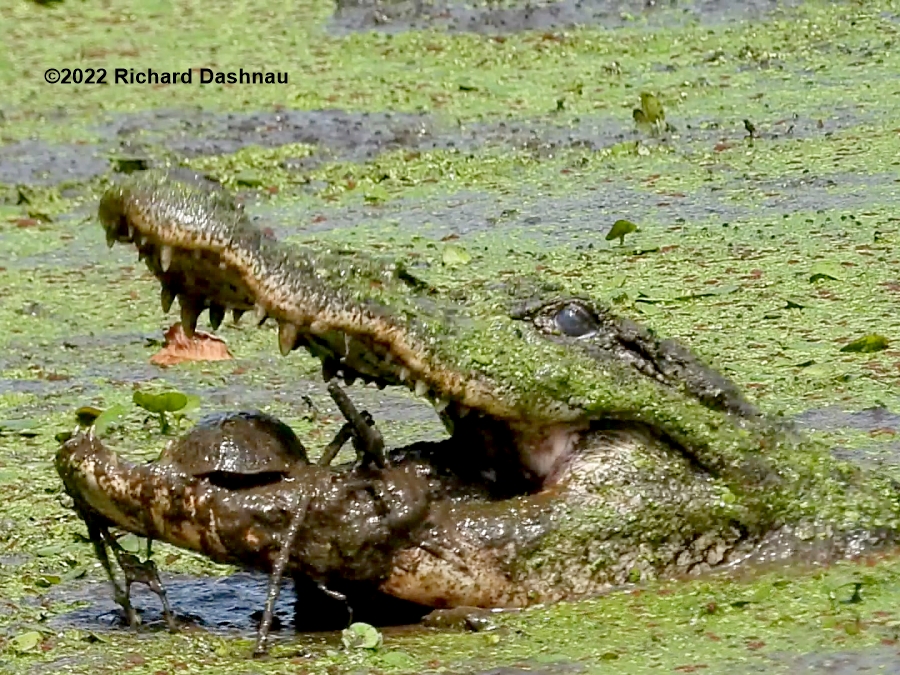
Even though an alligator's tongue has limited mobility, this
gator was able to discard almost all of the mud while keeping the
turtle inside its jaws!
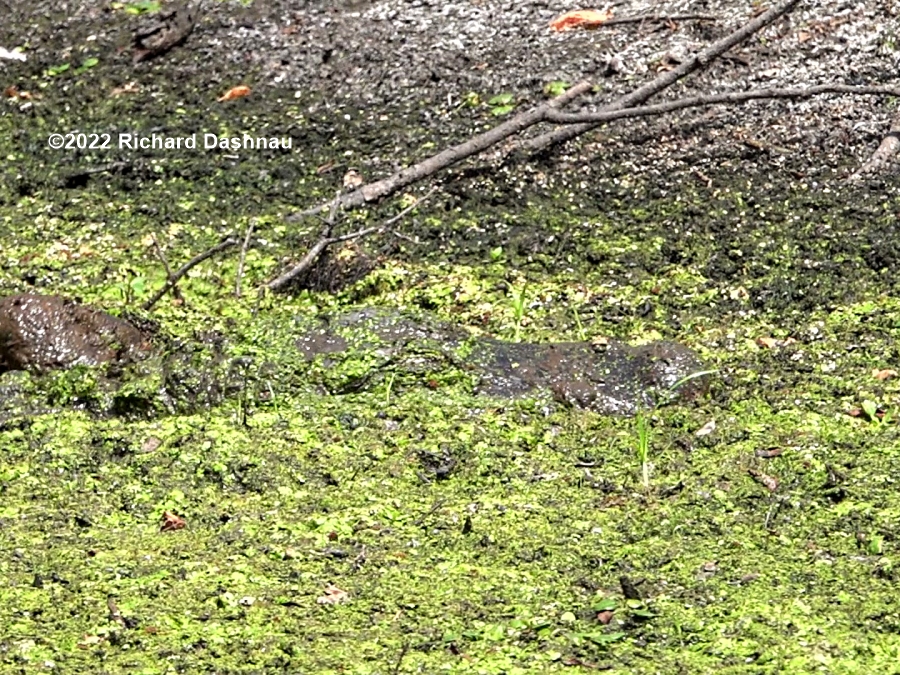
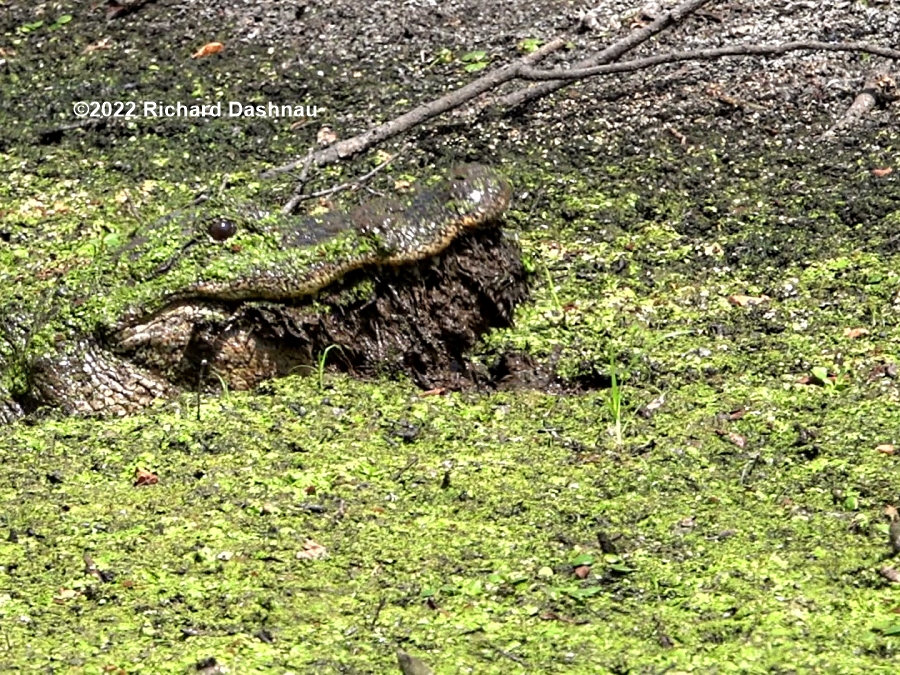
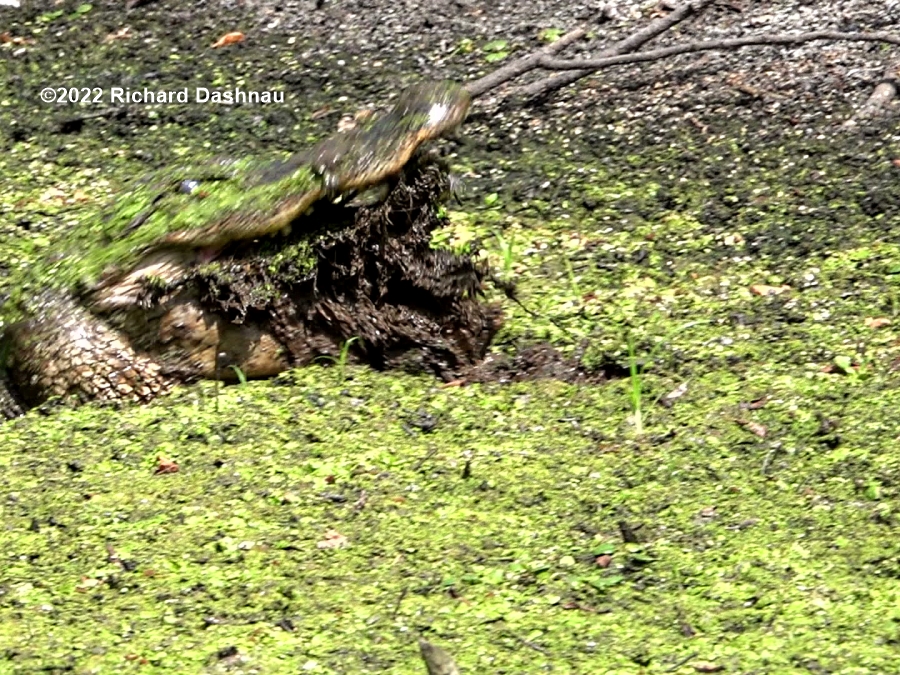
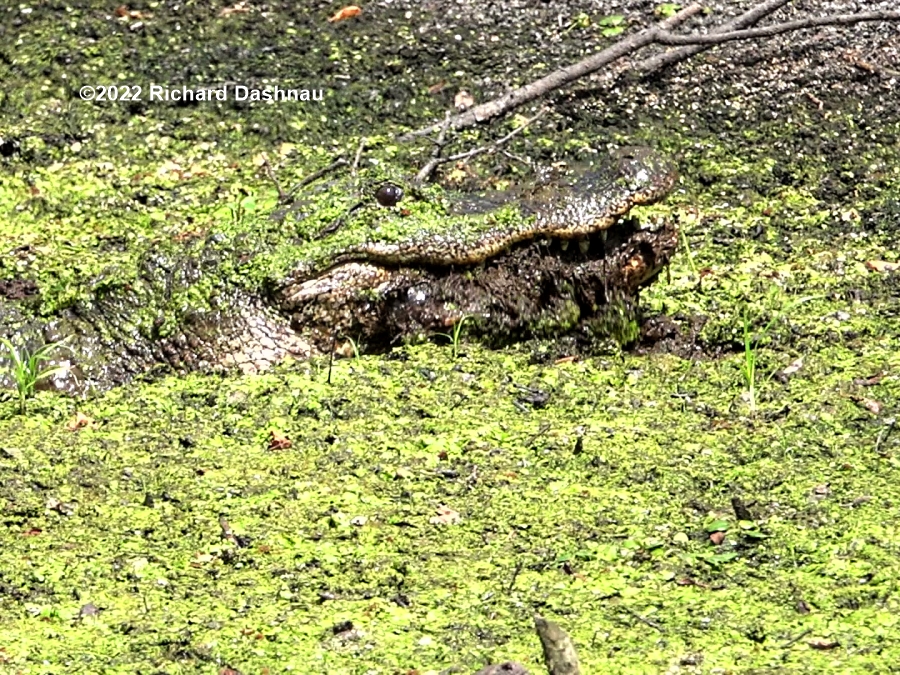
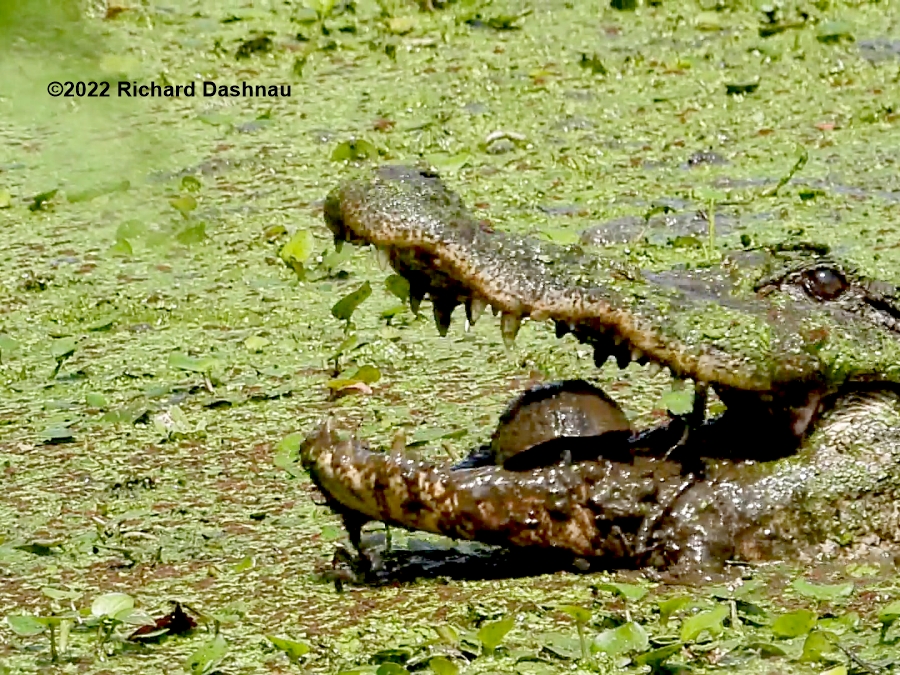
The alligator turned and
moved back to the center of the "channel".
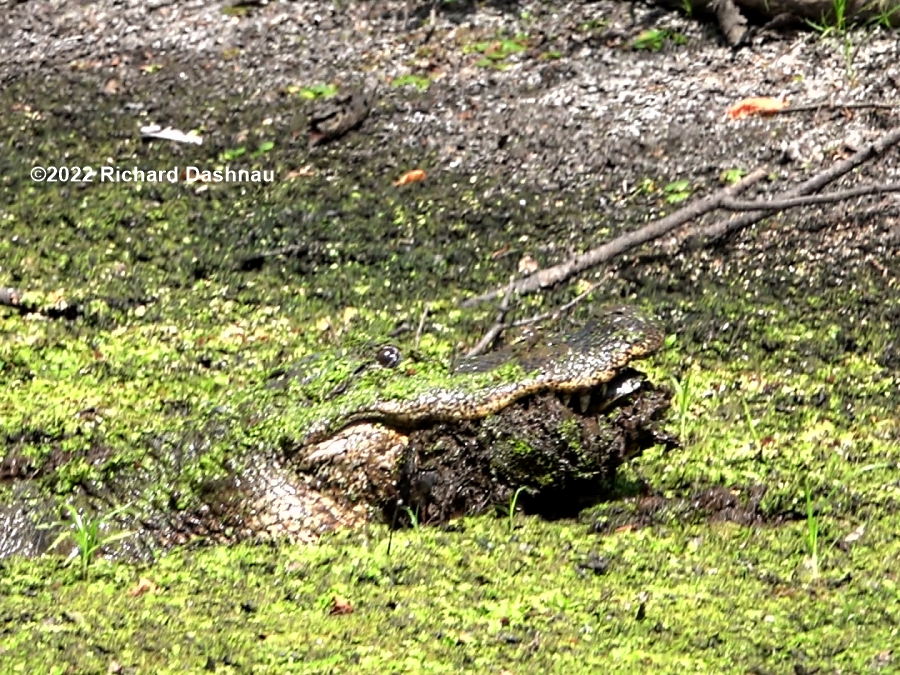
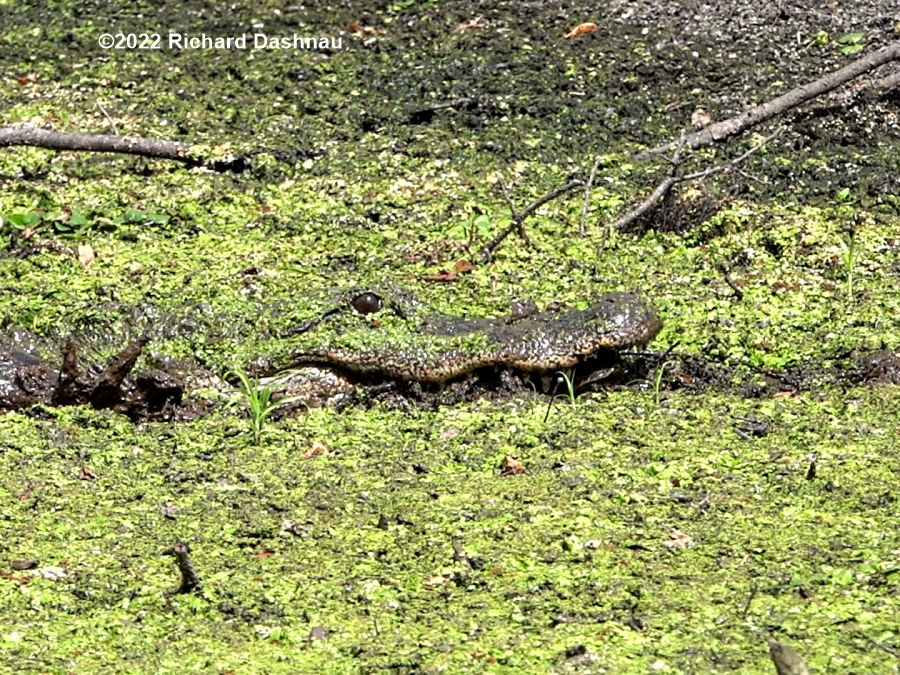
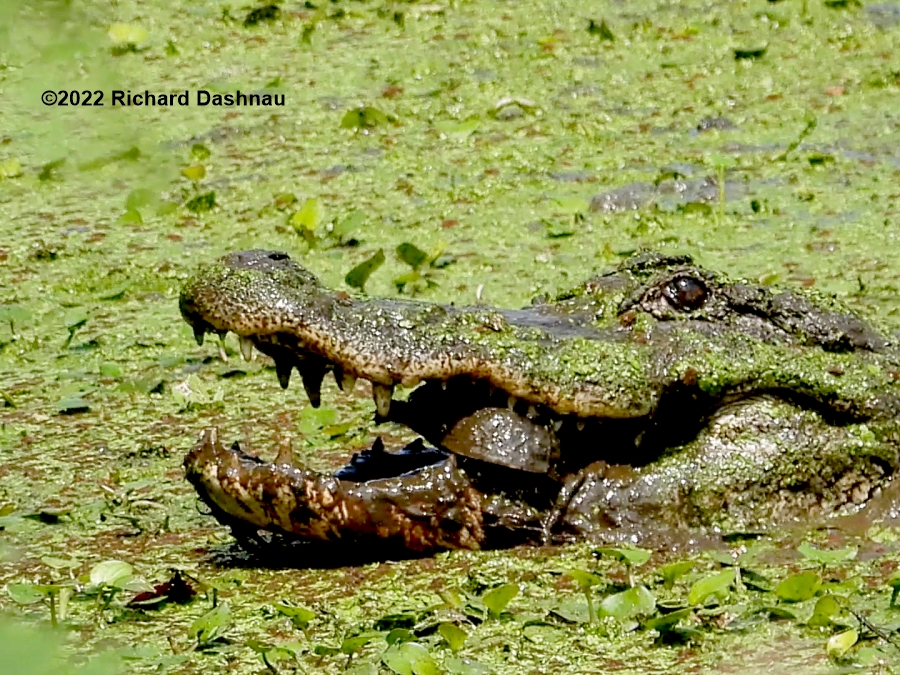
The final images show that most of the mud has gone. The
gator only squeezed the turtle a few times (without causing the
usual
catastrophic shell damage) before swallowing it--while avoiding
swallowing the stick which was also in its mouth. That's all
visible in the video clip.
Then
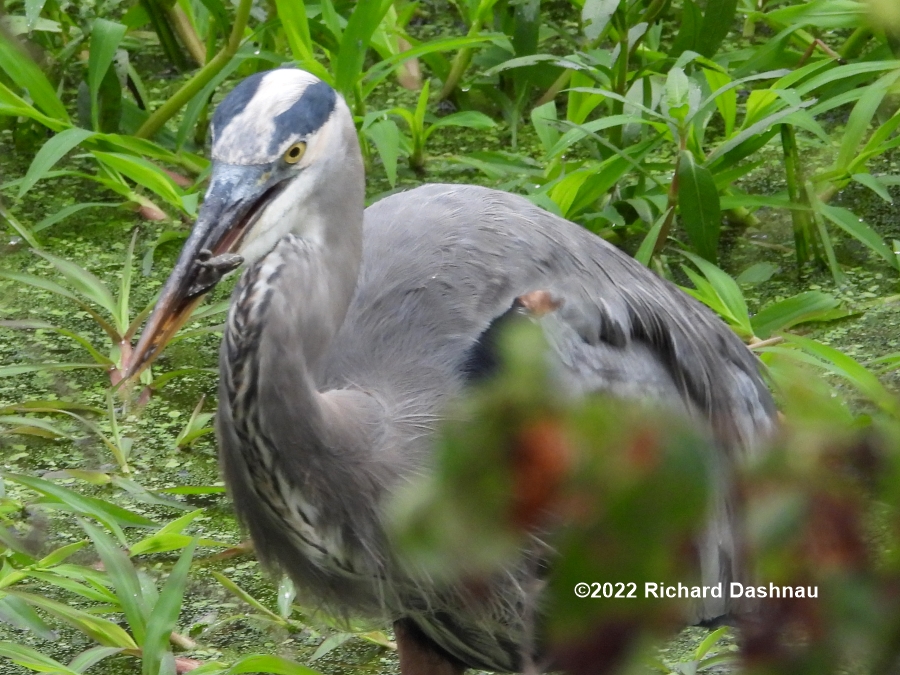
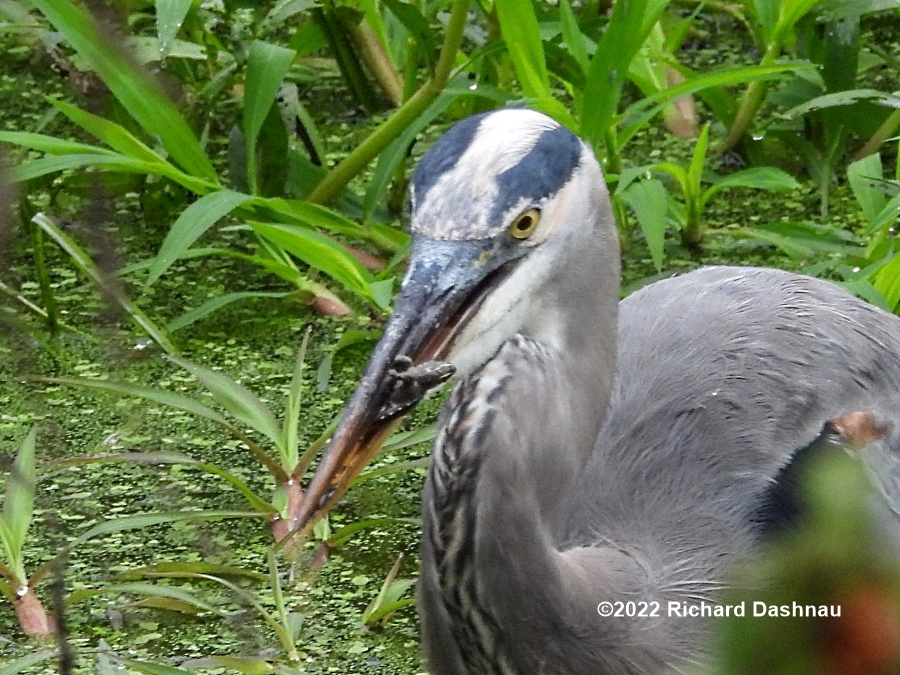
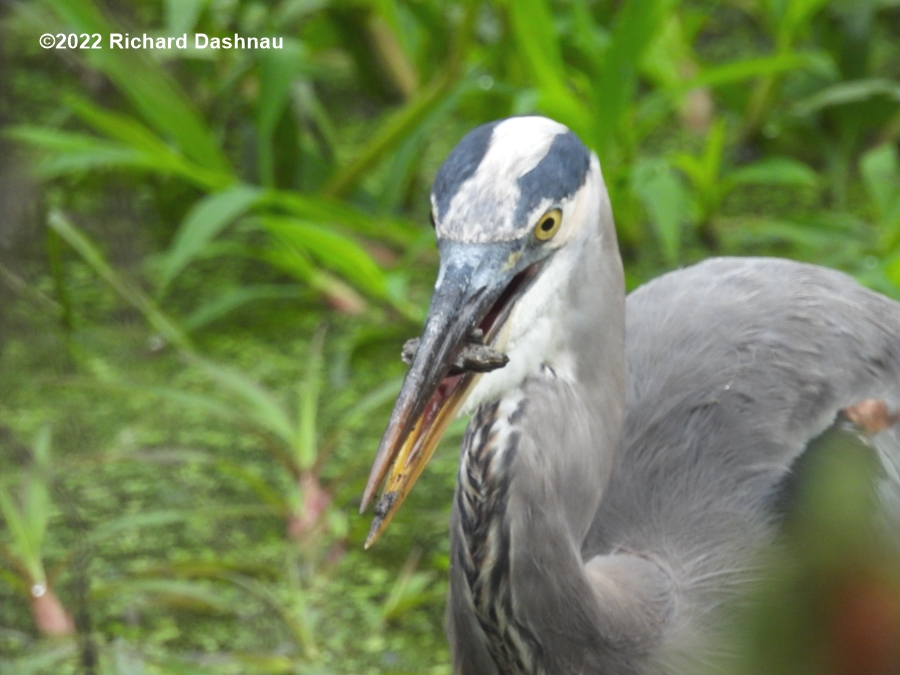
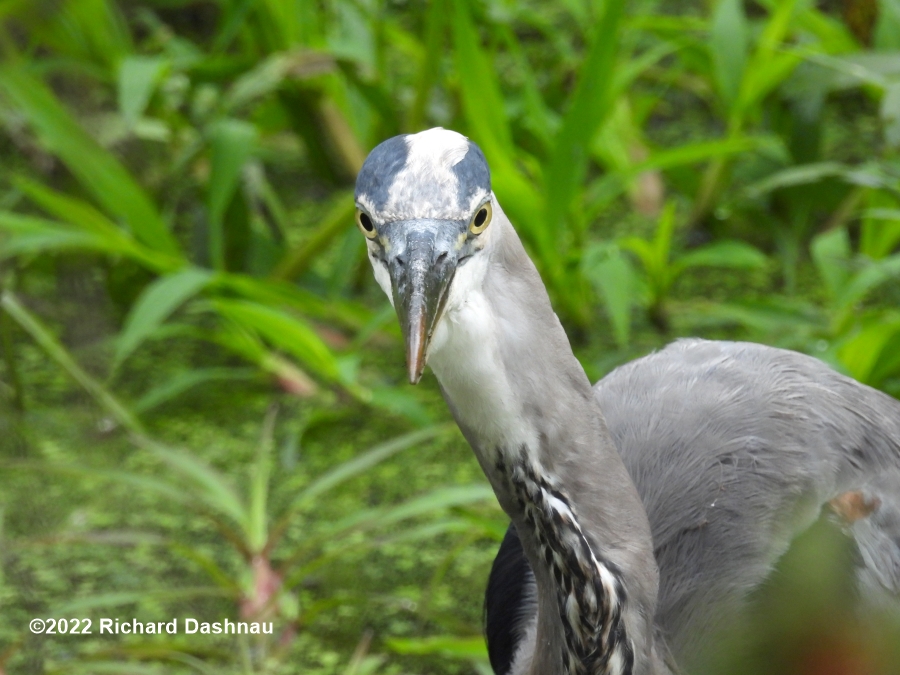
on 09/04/2022 I was on the Spillway Trail again. The area had been dry
for some time. I was passing by a Great Blue Heron (in the same area
where the alligator above had been moving)
when it stabbed down.
When its beak came up, I was surprised to see that it had
caught
a turtle! I could only get a few quick pictures before the turtle was
devoured. At first I thought it had
caught a baby Snapping Turtle
(the colors and even the head and neck are similar) but the shell is
the wrong shape, there's no long tail and there are stripes on
the head. I think it was a Stinkpot.
The next part is about
breathing. I'd
learned that some turtles can do some interesting tricks with oxygen
conservation, or even respiration, during cold months. Musk Turtles (Sternotherus
odoratus)
can extract oxygen directly from the water, mostly by using their
tongues! That means that they can stay submerged-in water with enough
dissolved O2-indefinitely! This study had the
most
information about how Musk Turtles can do this: "The Comparative
Physiology of Diving in North American Freshwater Turtles I.
Submergence Tolerance, Gas Exchange, and Acid-Base
Balance" by G.R . Ultsch, C.V. Herbert, ans D.C.
JACKSON 1984
4 species of aquatic turtles were tested: Snapping turtles, Chelydra serpentina serpentina;
musk turtles, Sternotherus
odoratus; soft-shelled turtles, Trionyx spiniferus asperus;
Western
Painted turtles, Chrysemys
picta bellii.
I've read a few other similar...endurance studies for other species.
Although the results are interesting, the test subjects usually do not
fare well in this
type of study. For the test, turtles of each
species (I couldn't find how many of each) were submerged in anoxic (no
dissolved Oxygen) and normoxic (with dissolved oxygen) water at 10°C;
and
then subjected to various tests to see the effects. None of
the species did well in anoxic water.
The musk turtles and softshell turtles did very well in normoxic water (>100 days!!),
much better than the other two species. Further blood
chemical tests in the study indicated that those two
species
were getting oxygen from the water. Also, those turtles were
better at expelling excess CO2 using the same physiology.
Next is
the equipment that Musk Turtles use for this direct gas
transfer.
That was in this study: "The Fish in the Turtle: On the Functionality
of the Oropharynx in the Common Musk Turtle Sternotherus odoratus (Chelonia,
Kinosternidae) Concerning Feeding
and Underwater Respiration" by E. HEISS, N. NATCHEV, C.
BEISSER, P. LEMELL, AND J. WEISGRAM 2010
This
study highlights the tongue and the papillae that cover it and
oropharynx (tongue/throat area). These papillae are filled with extra
blood vessels. The authors demonstrate that the tongue of
a
Stinkpot is of little use in handling or catching prey. Younger turtles
can take food on land, but then move into water to eat it, while adult
turtles only take prey underwater, and capture it using
"suction
feeding" by rapid expansion of the oropharynx. The tongue has been
modified for another use instead of handling food. Musk turtles can
absorb enough oxygen from the water (with
their tongue) to
survive; if the water has enough oxygen (whatever concentration that
may be) in it. An interesting point--turtles buried in mud actually
create an anoxic environment
(encapsulated by mud, refreshed
water cannot reach the turtle), so in chillier environments, buried
Stinkpots may dig out of the mud periodically to reach oxygenated
water. That's pretty cool!
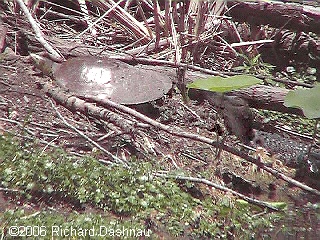
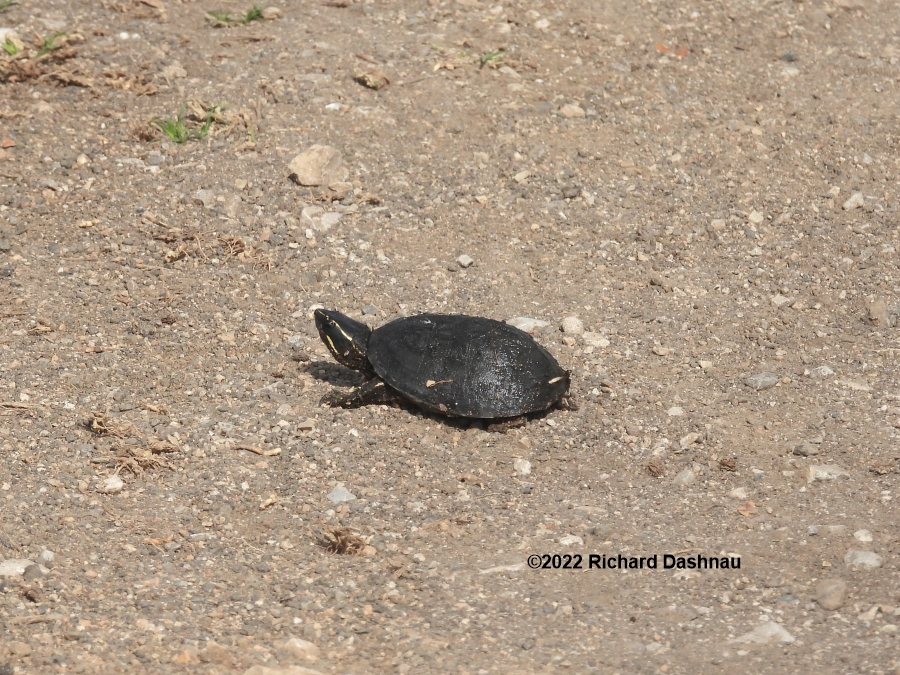
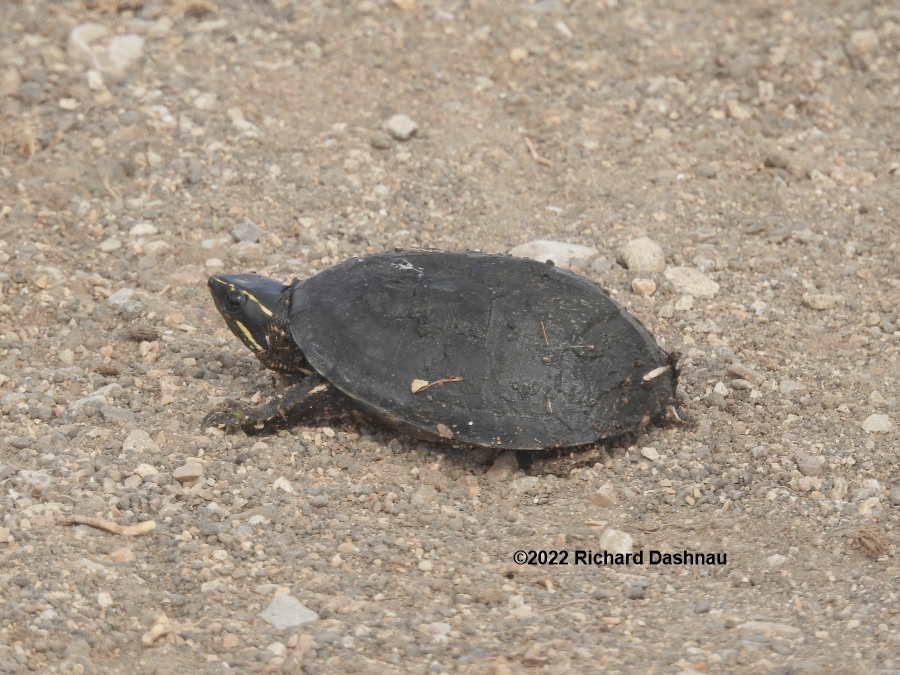
06/25/2022 As
the various lakes were drying, many creatures moved across the trails
as they looked for a new place to hide. This Eastern Musk Turtle was
too far away for me to catch
up with. I knew it would be gone by the
time I near it, so I took a couple pictures from some distance away.
Compare this turtle to the one I saw in August of 2021
(below).
Not much similarity
there.
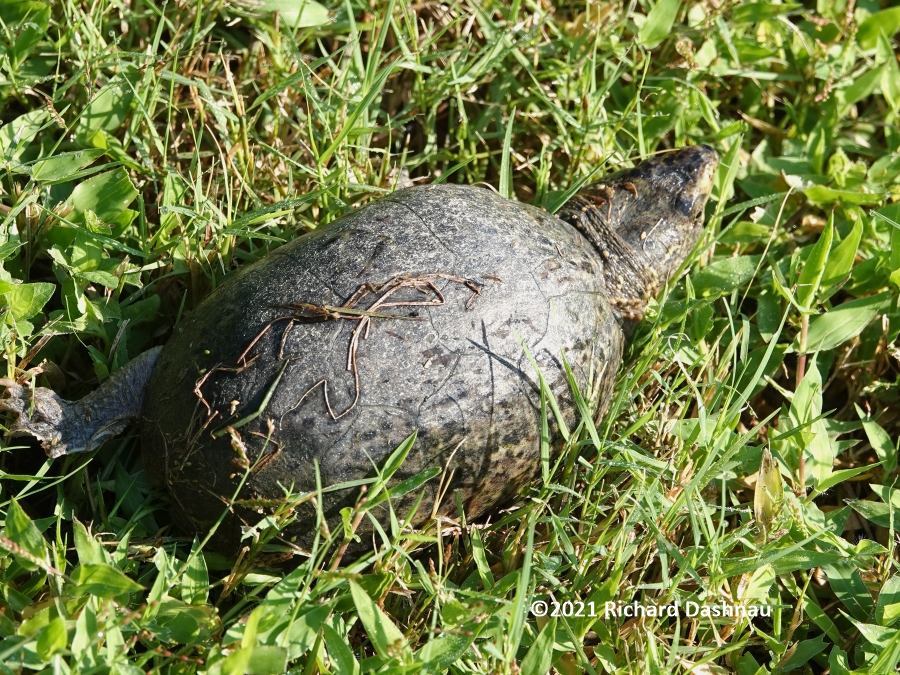
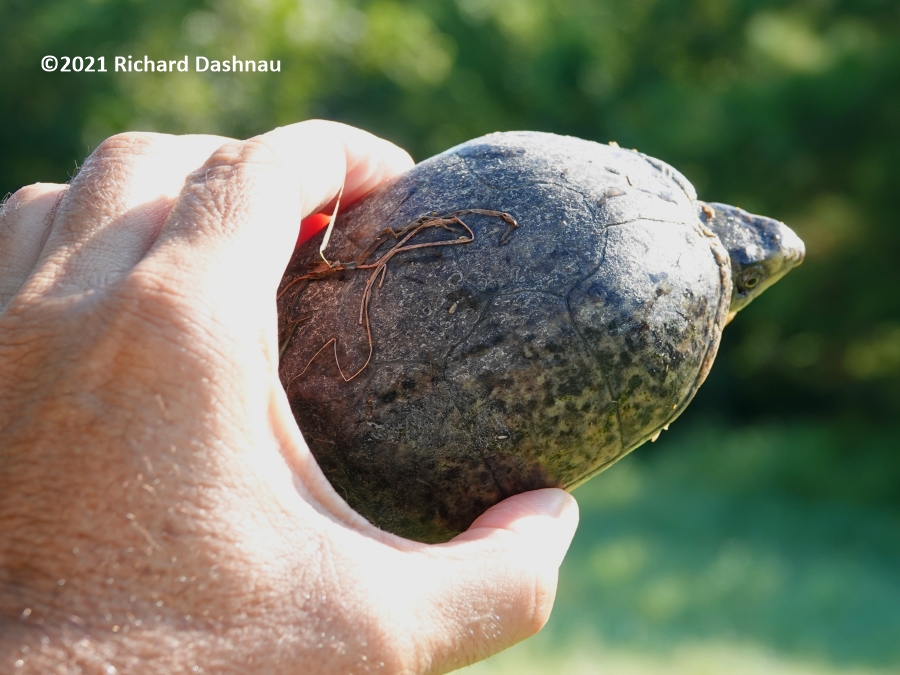
08/17/2021 (added 2/10/23) I
was walking around the trail at Fiorenza Park North, on the West side
of the North Loop when I noticed this turtle right at the edge of the
trail! It was moving
East,
towards the water; which is pretty far away from that part of the
trai.(about 200 yards away and 20 feet lower, measured in
Google). I
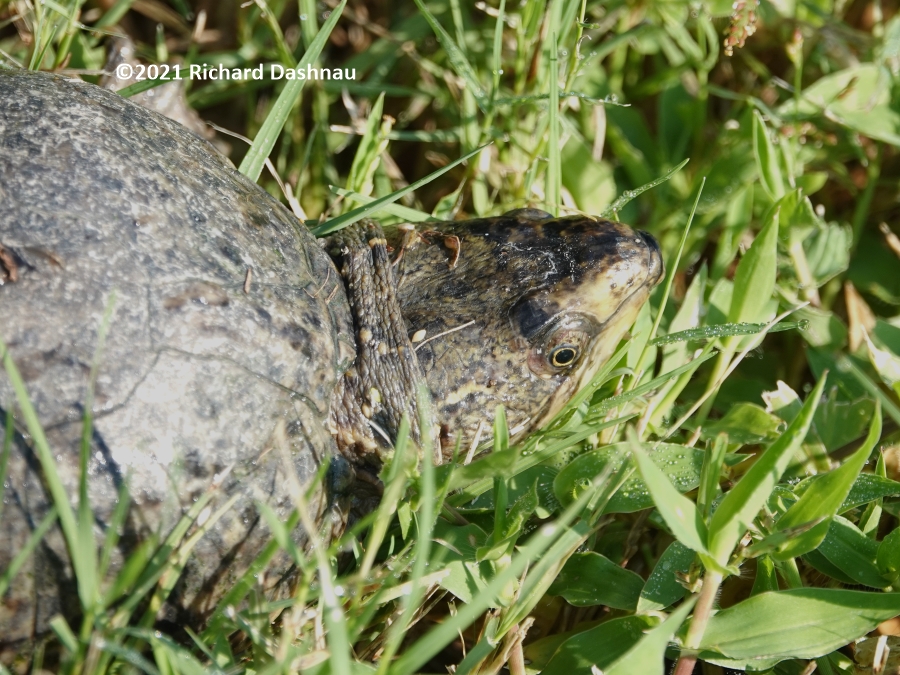
knew it was a Musk Turtle, or a Mud Turtle
because
of the shape of
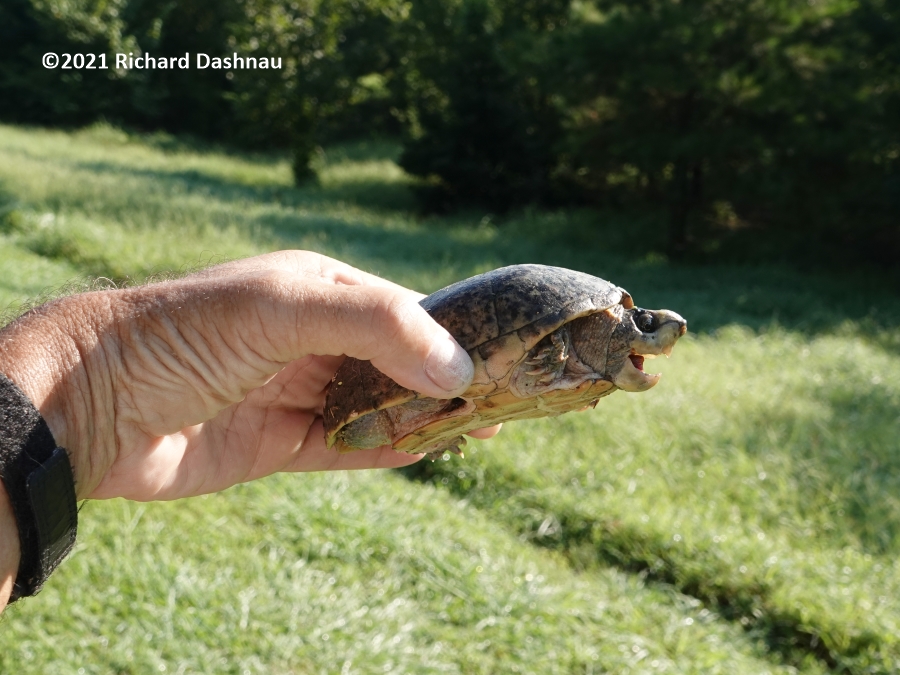
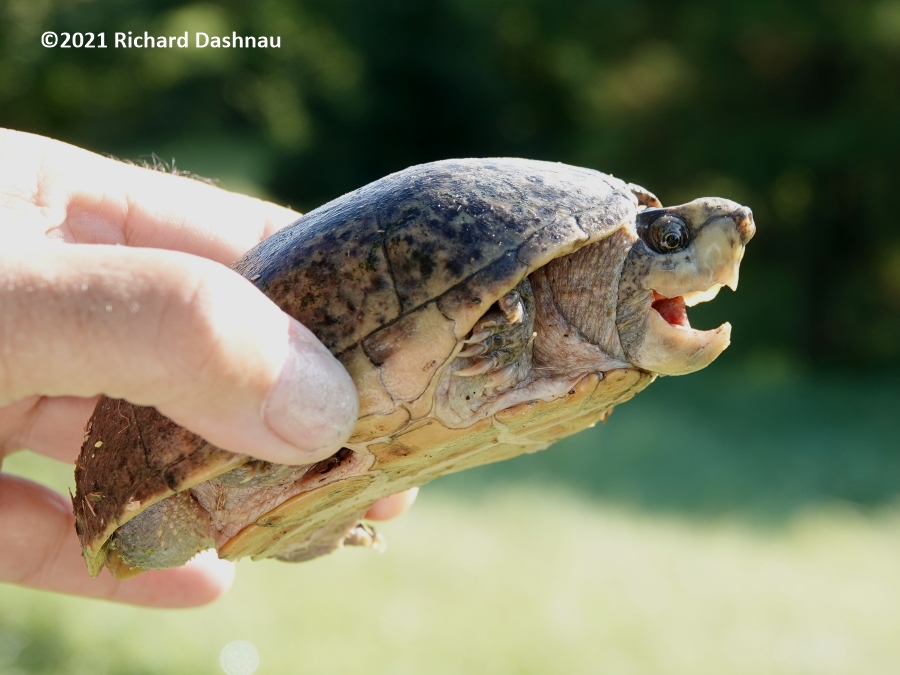
the shell. But, it was bigger than most of the ones I usually see, and
it was colored differently. So I picked it up and took a lot of
pictures. After taking the pictures, I
walked
down hill a little and released the turtle into the grass.
I'm
sure it's NOT a Common Musk Turtle-often called a "stinkpot"(Sternotherus
odoratus). But I"m
not sure what kind of turtle it is.
I'm using a copy of the "CITES Identification Guide –
Turtles
& Tortoises (c)1999", and in the
yellow section, it seems to resemble a Loggerhead Musk Turtle (Sternotherus
minor); because
of spots on shell and face, 2 barbells under chin
(against
the shell in pic #6), and the notched beak. I
couldn't identifiy the
hinge (or hinges), but the bottom shell (plastron) pattern also seems
to match the drawing there. If I get any other ID
I'll
update it here.
05/05/2021 I
was walking around the trail at Fiorenza Park North and looking East,
towards the morning sun, when I saw a shiny lump in the grass far ahead
of me. Even at that
distance I could recognize the high domed
shell of a box turtle. I took a few pictures as I got closer,
then walked by it. I didn't see any point in bothering the
turtle, but it noticed
me anyway. It turned around, and
started walking back into the nearby stand of trees. And,
that
was the encounter. But I've got these pictures!
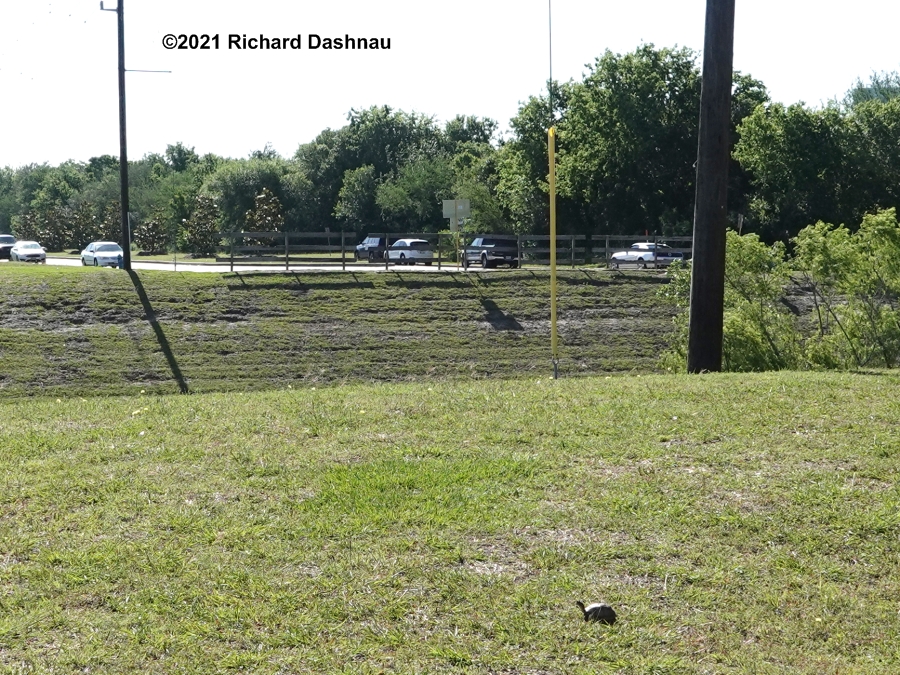
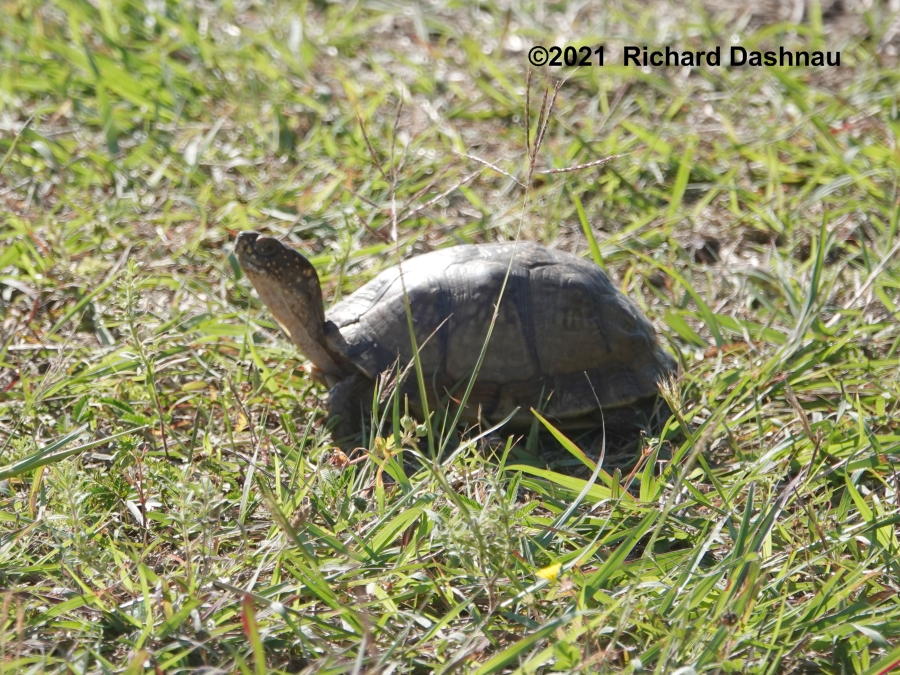
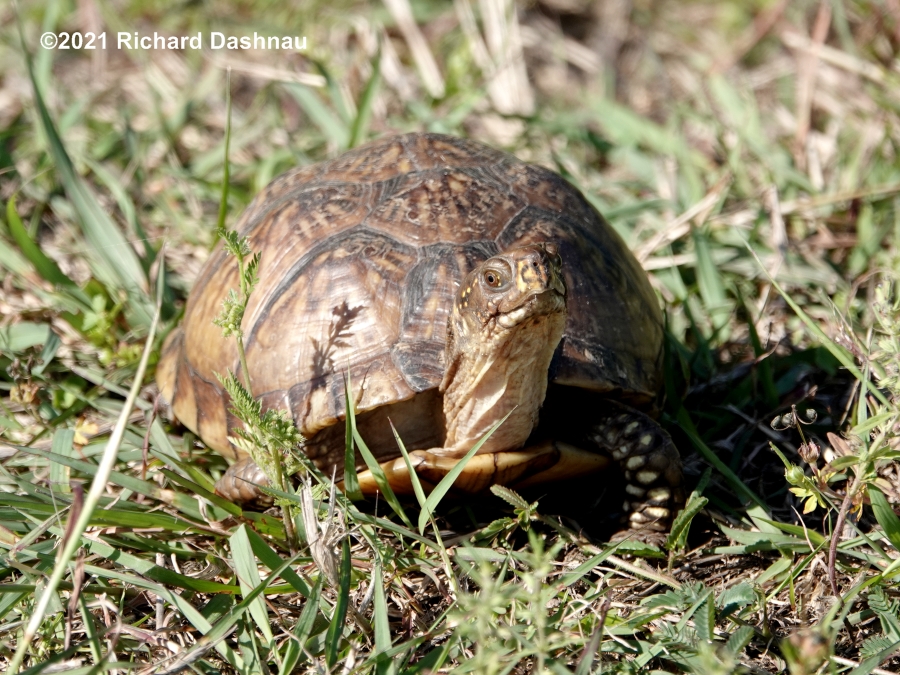
There's the turtle ahead of me.
Shining in the morning sun.
3-toed
Box turtle, front.
According
to varied sources, Texas is home for 2 species of box turtle.
There is the Ornate (Terrapene ornata ornata) and the Eastern
(aka 3-toed) Box Turtle (Terrapene carolina triunguis).
The Ornate
Box Turtle has a darker carapace with bright yellow spots-quite unlike
this one. So, that leaves the 3-Toed Box Turtle.
The
health of the populations of Box Turtles in Texas are of
concern, and various organisations are recording sightings of box
turtles. This link
has a PDF; but the Texas Parks and Wildlife website suggests
using the "Herps of Texas iNaturalist project".
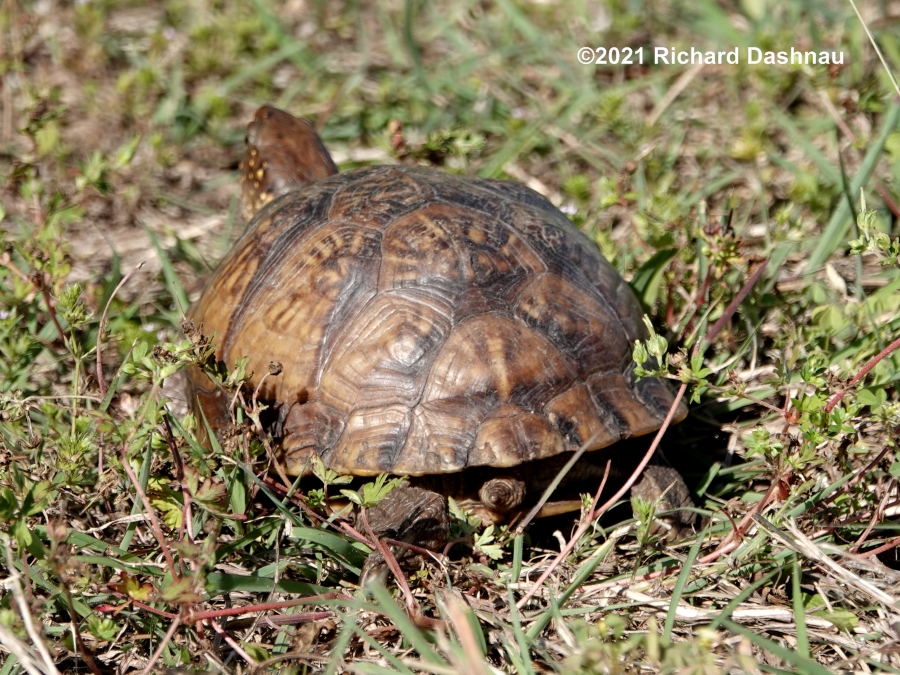
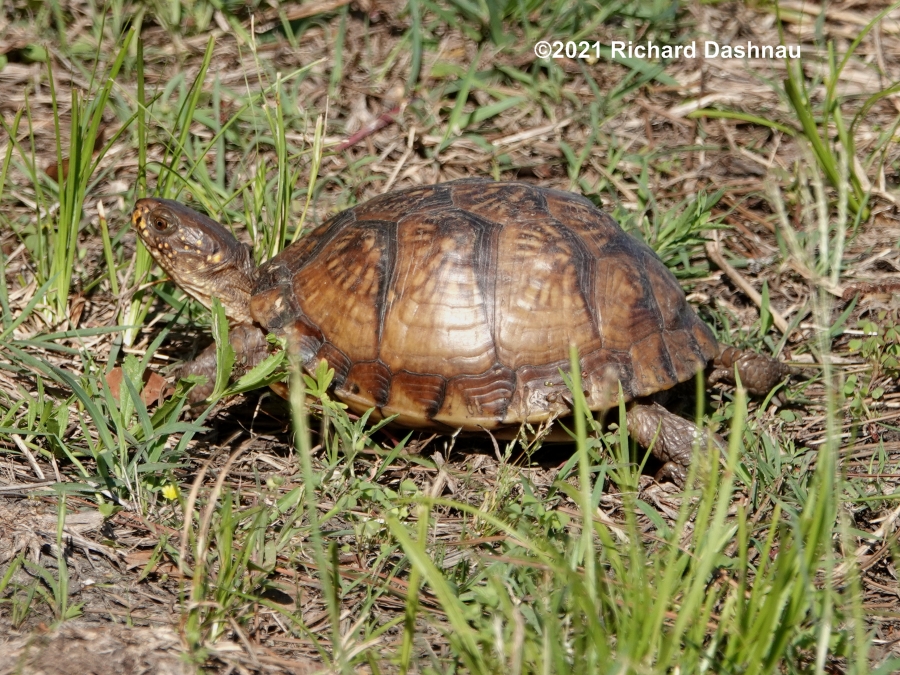
3-toed
Box turtle, rear.
3-toed Box turtle, side.
(note
added 5/16/21)
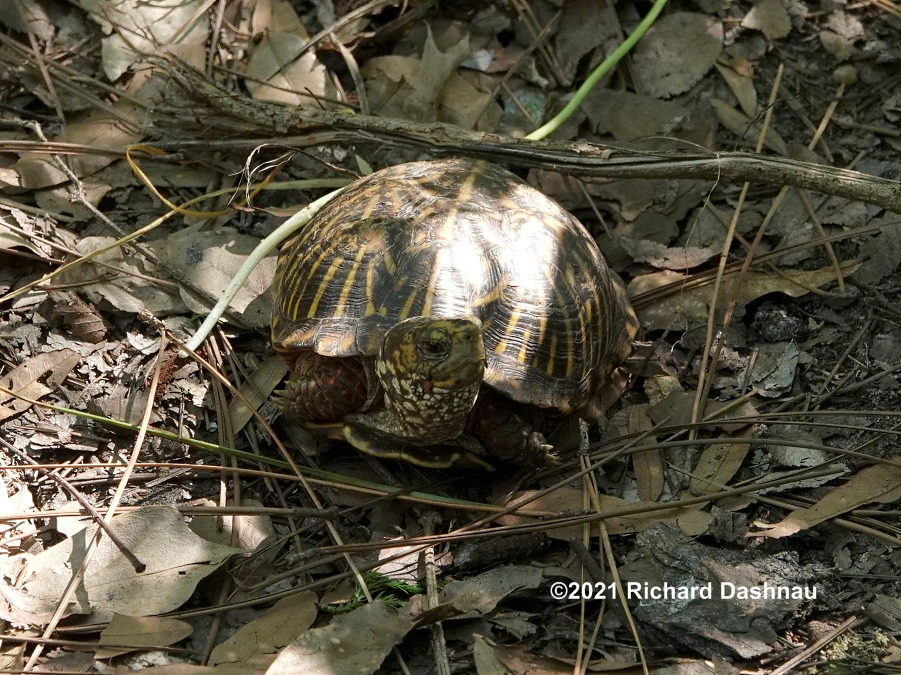
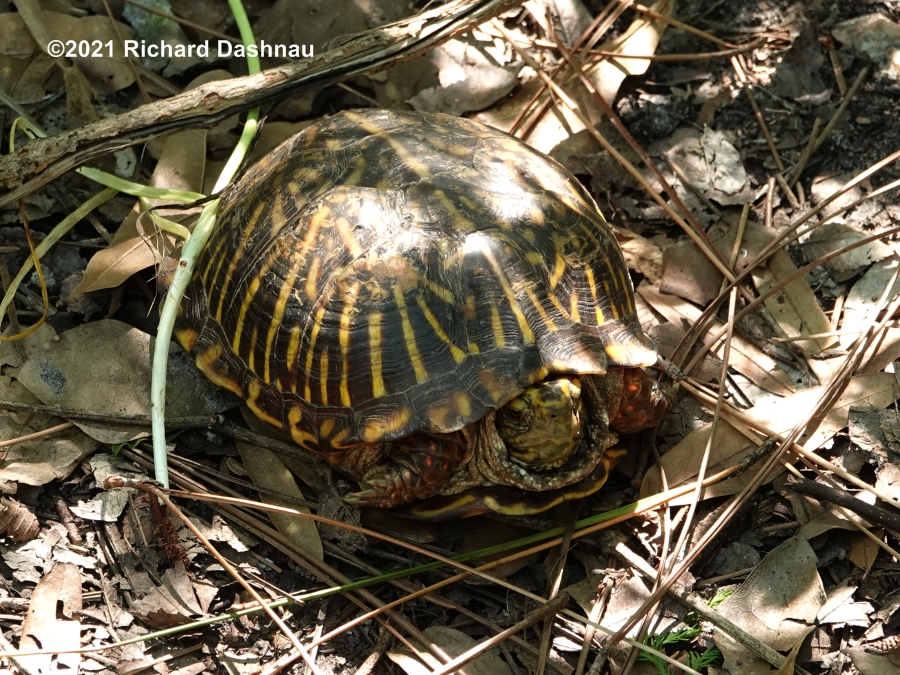
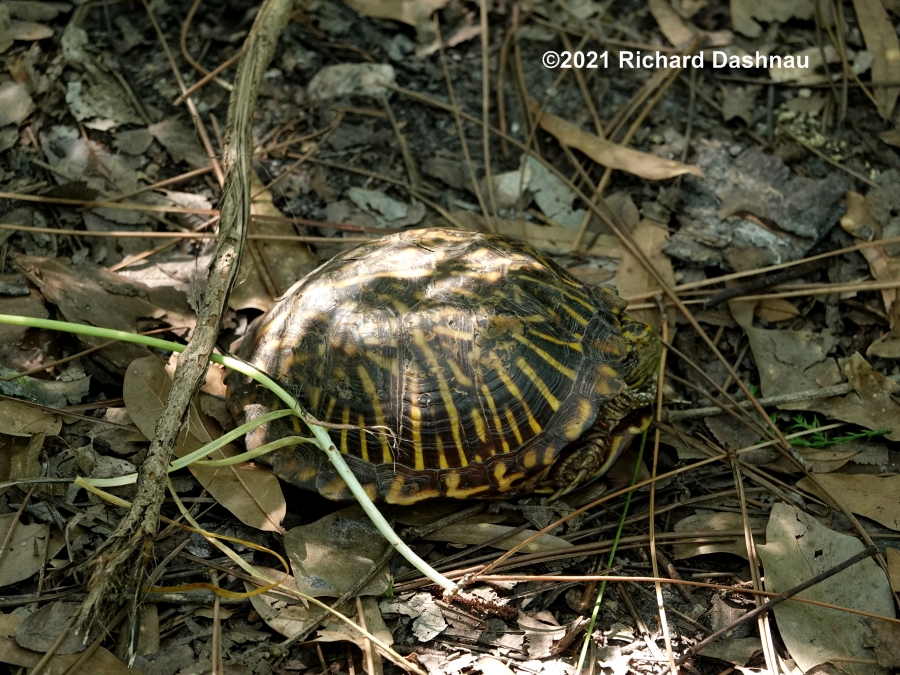
I'd actually gotten some pictures of an Ornate Box Turtle a few weeks
before, at Russ Pitman Park on 4/22/2021.. I'd considered
posting
them, but had decided against it
for a number of reasons. 1) I found
the turtle being carried by some children at that park. They were
headed towards the small "pond" to place the turtle in the water.
Although their intentions were
good, I decided to talk to them about
what they had found. Box turtles are terrestrial turtles, and
don't swim very well. Unlike pond turtles (like Red-eared Sliders), Box
Turtles don't live in water.
It would be better-I suggested-to put
the Box Turtle down in a sheltered/shaded area. So, the
children
did that, while I explained to the parent with them that Box Turtles
have a hinged bottom shell
which allows it to close tightly. I
didn't show them bthe hinges because I'd have had to handle
the
turtle, because I preferred to show the example of leaving the turtle
alone. They all left, and I took
some quick pictures of the turtle and then I
also left it alone. So I didn't get any good walking pictures.
I
did report the turtle sighting to the Discovery Center staff (instead
of going online with a report);
because I figured that they were
familiar with most turtles on their property--or that someone may have
released it there. Compare the markings and colors on the
shell
of this Ornate Box Turtle
(Terrapene
ornata ornata) and the difference between them is easy to see..
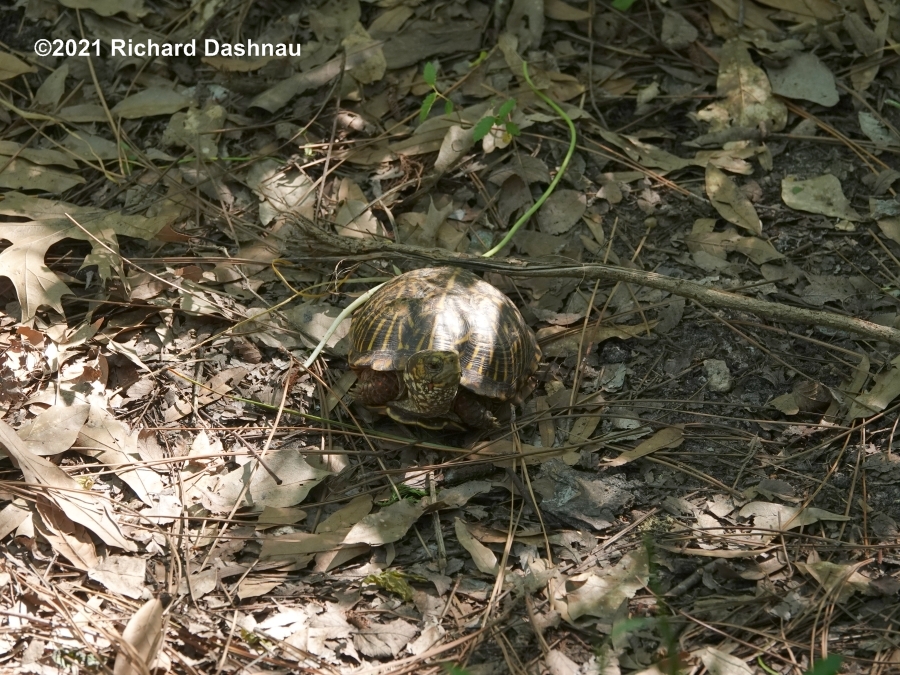
Ornate Box Turtle did take a peek.
Shining in the morning sun.
Then it got shy again.
Then from the side.
08/04/2019 I
was walking on the East Loop of the Elm Lake Trail when I noticed a
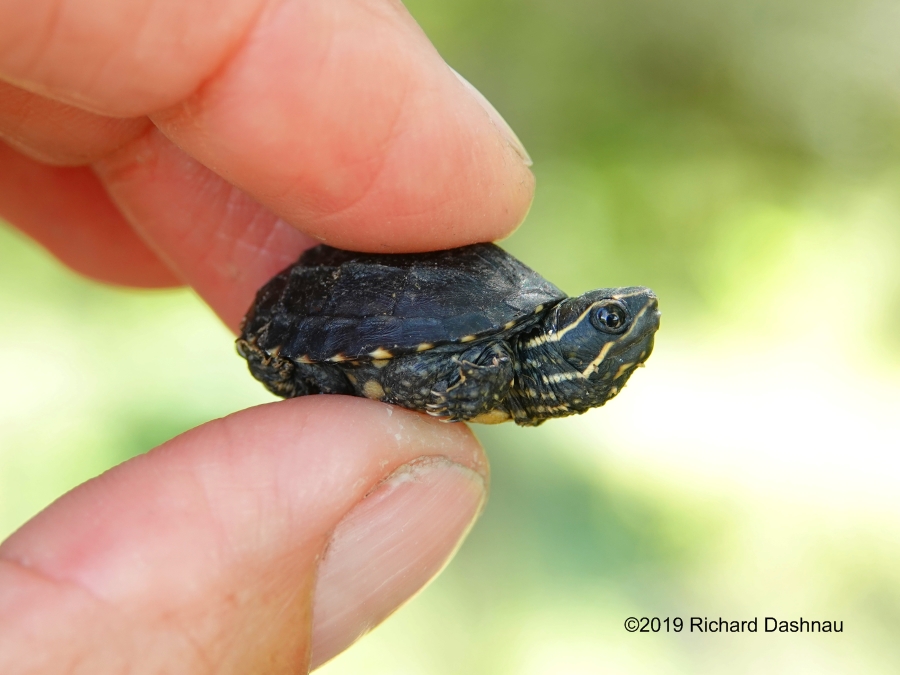
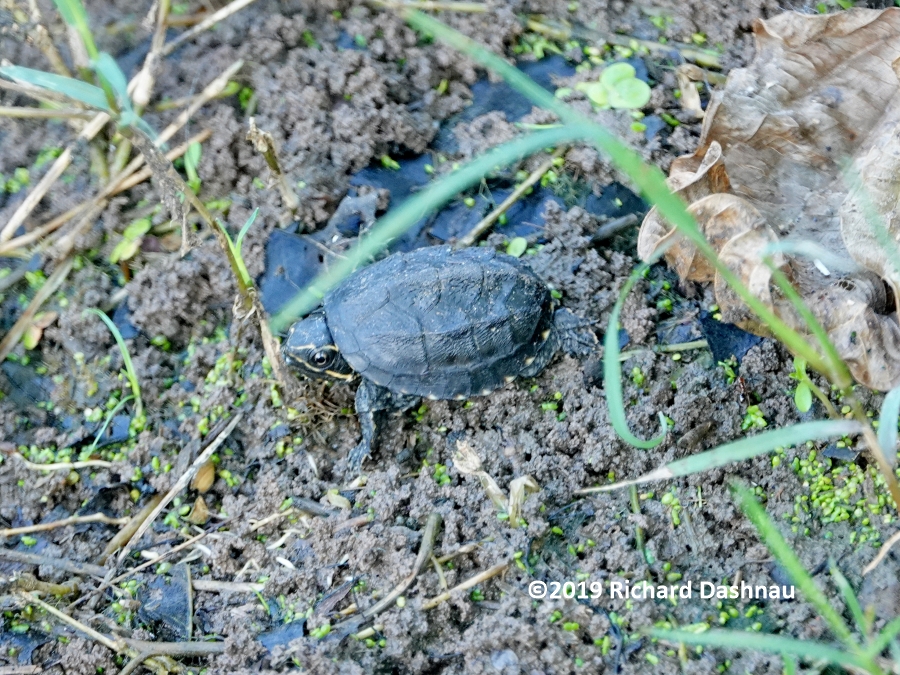
tiny dot moving towards the trail. It was a baby Common Musk Turtle (Sternotherus odoratus)!
I stopped to
take
a few pictures, then released it near the lake. When I'd found it, I
thought it might have just hatched, and I searched the area for other
baby turtles, but it was the only one.
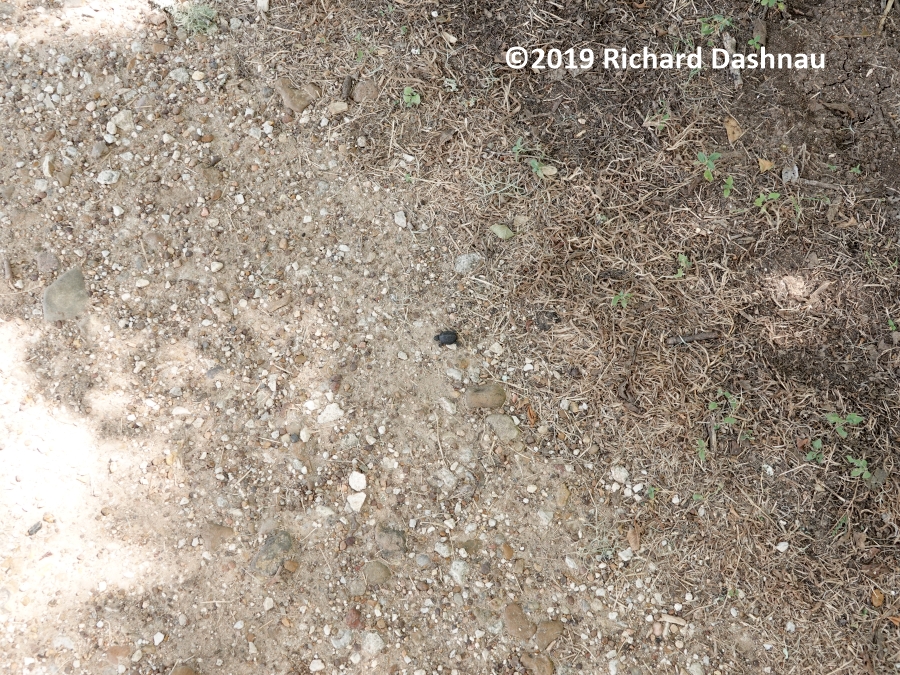
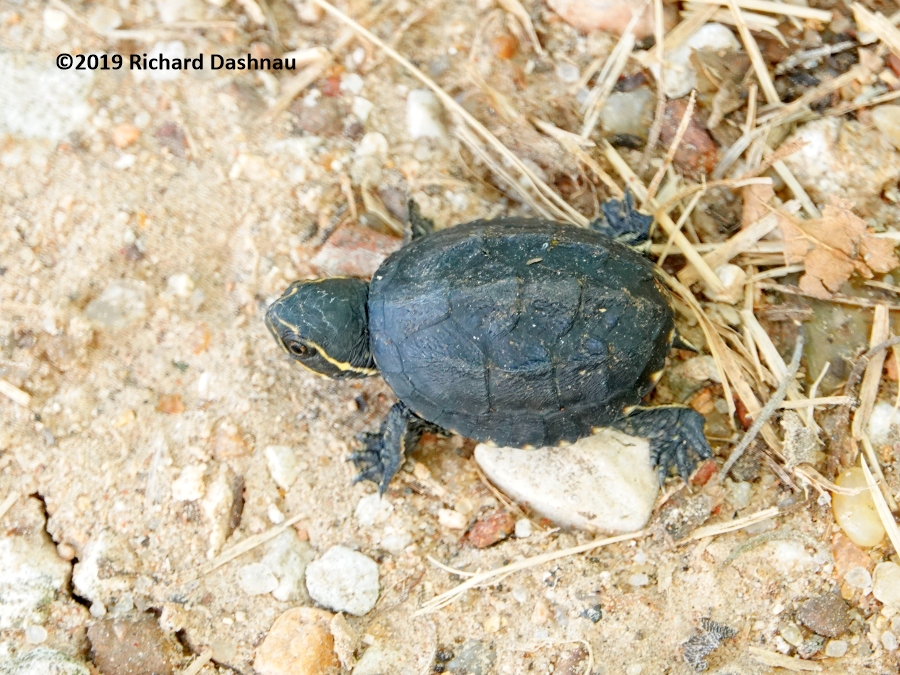
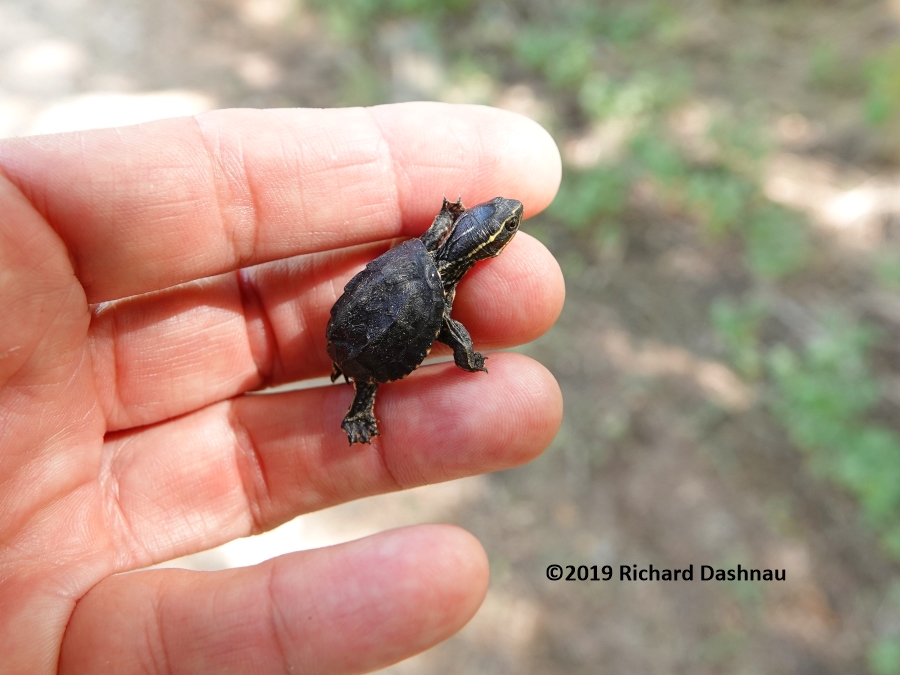
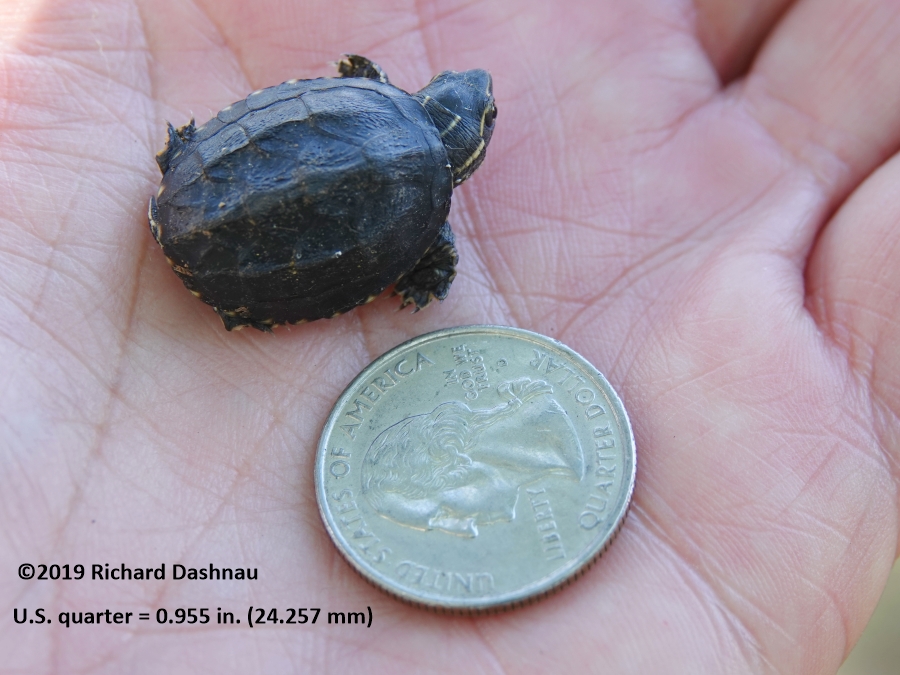
This
young turtle already shows the high-humped shell profile and yellow
lines on the head shown on adult turtles. It also has interesting keels
on the its top shell (carapace) which will become
smooth as the
turtle matures. Its shell will also become a more regular oval shape
when viewed from above, a little different than this slightly-tapered
towards the back appearance.
09/04/2017. About a week after Hurricane
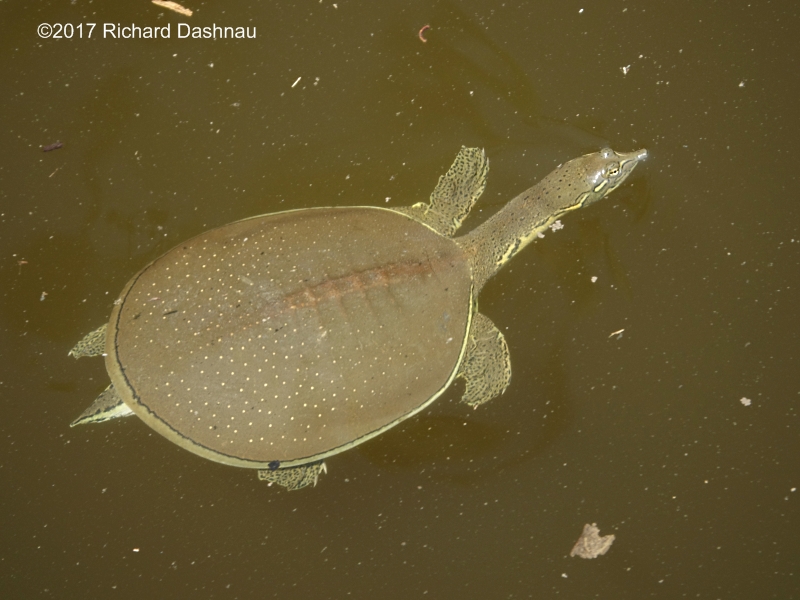
Harvey left, I was on a bridge over one of the bayous when I noticed a
Softshell Turtle
swimming
below me. I was still coping with the damage done to our area, and the
sight of this beautiful turtle swimming in a bayou water
which had
been about 20 feet higher a week before....really helped calm my
spirit. I took a few pictures, and a video clip. I used my photo to
identify
the turtle. It is a Spiny Softshell turtle (Apalone spiniferus),
and after a bit more
research, I discovered that there a number of different species of
Softshell
turtles in Texas! According to two sources I have--Audubon Society
Field Guide to North American Reptiles and Amphibians p.486 1992 and
Peterson
Field Guide to Reptiles and Amphibians of Eastern and Central North
America p.80 2nd ed. 1975--I believe this could be
a Texas
Softshell Turtle
(Trionyx spiniferus emoryi Note
11/20/2017: since I first posted this-11/18/2017-I have discovered that
the taxonomic name for this turtle was changed
in 1987. This
has been changed to Apalone
spiniferus emoryi). But
it seeems to be out of its range--but I'm not too good at "keying-out"
critters.
(I've found a turtle identification key for Texas
turtles on the TPWD website! Here's the link: https://tpwd.texas.gov/publications/pwdpubs/media/pwd_lf_w7000_1667.pdf
)
The video clip can be seen be following this link.
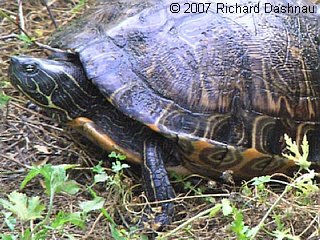
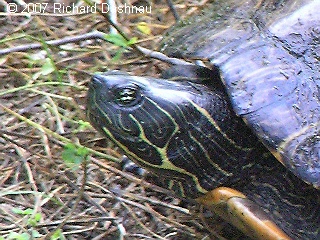
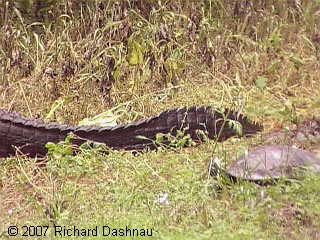
04/23/2007---This
drama took about 45 minutes to unfold.
I
discovered
this turtle (probably one of the "cooters", possibly a Florida cooter
Chrysemys
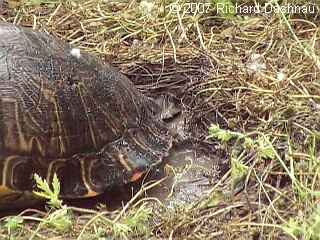
f. floridana) excavating a nest on the Spillway trail. I
thought
it would be a good opportunity to film.
After a few minutes
of watching,
I decided to move a bit closer to find a better camera position. As I
did,
I happened to look down at the water's edge, and straight into the eyes
of a stalking
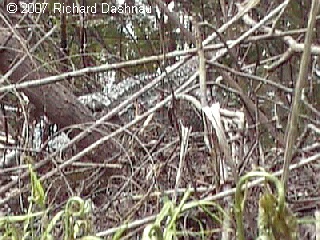
alligator! The images and video clips below
show the
turtle at work, and a few panning shots to establish the relationship
between
the alligator and the turtle. Note the puddle at the turtle's
hindquarters.
The turtle urinates on the ground to soften it for digging. It is
during
trips back and forth to the water for "refills" that the turtle is
vulnerable.
 -
- -
- -
- -
-
Video
clips--- part1
turtle
digging wmv 4.3mb part2
pan from gator wmv 1.7mb part3
pan after camera moved wmv 2.6mb
- -
-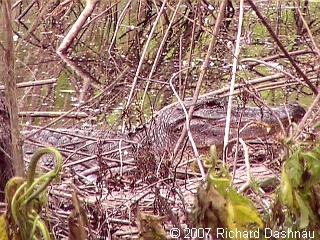
It
was
about 20 feet away, and below me. The raised head, the body out of the
water, and its alert appearance told me that it was probably stalking
the
turtle--as unlikely as that sounds. I'd
heard that alligators
would
lie in wait for the nesting turtles and pick them off as they'd return
to the water from a park visitor a couple years ago. It
appeared
that I'd blundered into such a
situation. I decided to back
off and
see what happened. I moved my camera back, to where I thought
I'd
be out of the alligator's perceived threat range. After a few minutes,
the alligator
backed into the water, but stayed in position. The turtle
continued working.
After
a few minutes more, the alligator climbed ashore, and began to climb
the
bank. Although it moved slowly, it did NOT move silently. It made a
large
amount of racket, crackling branches
and brush. I've mentioned before
that
I thought alligators move quietly on land. They do, sometimes. Not this
time. When it was within the growth, the alligator stopped to rest for
a few minutes.
The turtle kept working. The
alligator moved
a bit more, climbing, and stopped to rest for a few more
minutes.
The turtle kept working. The alligator moved again, and
finally pushed
through
the weeds at the edge of the trail. There was a LOT of
noise.
Not quite the stealthy movement of a stalking
hunter.
However, turtles
don't have ears. So, the turtle kept working. The
alligator
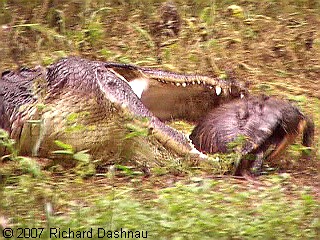
moved forward, rested, and then grabbed for the
turtle, which--finally
aware of the alligator--moved out of the alligator's jaws! But only for
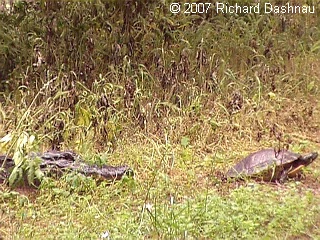
a few steps. Whereupon both reptiles stopped and
eyed each other at
touching
distance. What was going on here? Were they both resting? Were they, in
their reptilian way, trying to determine the next course of action?
Imagine
the nightmare
of watching something that wanted to eat you gathering
the
energy to do so while YOU were trying to gather the energy to escape--
if
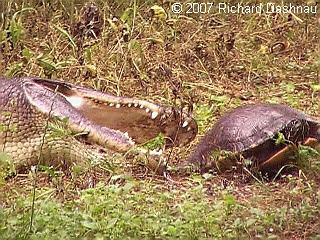
that is what was happening. The images and video
clips below
show
this next exchange. Most of the images here are single frames from the
video. I couldn't hope to keep the action in frame for the
video
while shooting photos at the same time.
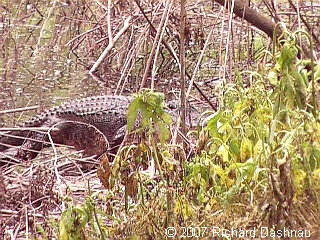 -
- -
- -
- -
-
Video
clips--- part4
alligator
starts up hill wmv 4.5mb part5
breaks through the weeds wmv 5.4mb part6
first grab wmv 4.2mb
----------------------------------------------------------------------------------------------------part6
SLOW MOTION wmv 2.6mb
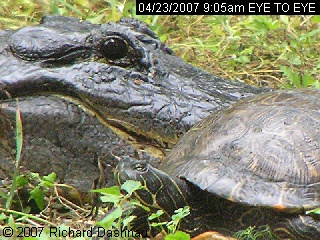
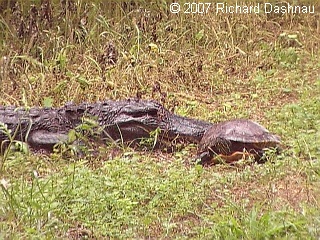
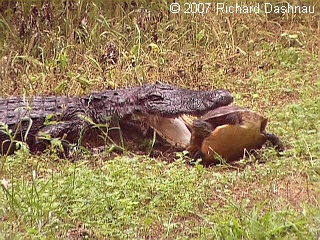
The
alligator tried again, and missed while the turtle slipped out of its
jaws.
And actually tried for a total of 5 times. Each time, the turtle moved
just enough to avoid being grabbed. During
one rest period, a
couple
humans on bicycles passed by, but neither reptile seemed to notice
them.
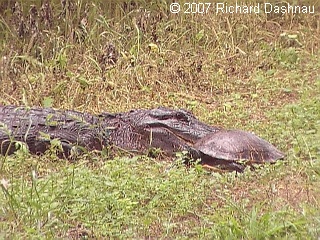
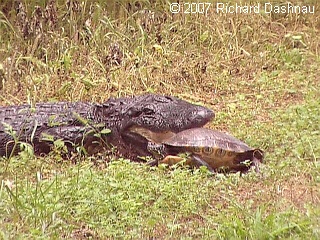
While reviewing the video, I noticed an odd sideways tilting of the
turtle's
shell towards
the alligator's jaws. It looks like the turtle was
pushing
up with the legs on the opposite side. It seemed to prevent the
alligator
from getting its bottom jaw under the turtle's shell so it
could
pick
up
the turtle. The alligator rested from 2 to 5 minutes between each
attempt--while
the turtle stayed right there near it. Perhaps it's possible that this
is a defensive strategy against the
alligator's response to
movement.
The images and video clips below show this next exchange.
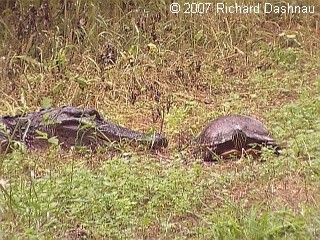 -
-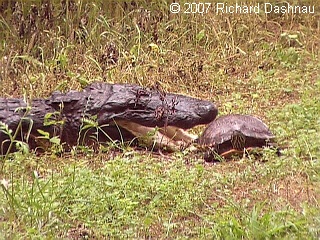 -
- -
- -
-
Video
clips--- part7
another
grab wmv 3.0mb part8
and another grab wmv 2.7mb part9
and yet another grab wmv 2.3mb
----------------------------------------------------------------------------
-------part9
SLOW MOTION wmv 3.8mb
- -
- -
-
After
one more try, the alligator---GAVE UP! One of the park
Kabotas was
on the end of the trail, by the water station, at least 100 yards away.
I don't think it drove the alligator off. The
alligator walked back
down
to the water's edge, while the turtle watched it leave. When the Kabota
approached, the turtle quickly crossed to the other
side of the
trail (away from the alligator
and across the path of the approaching
large
vehicle) and entered the water there. If this is because the
alligator
entered the closest water to the turtle, then
perhaps turtles are
more aware
than we realize. The alligator stayed near the
area, and
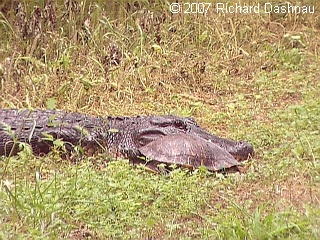
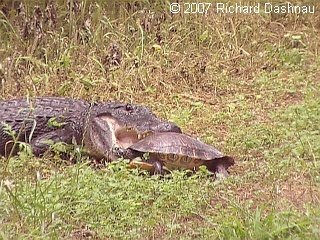
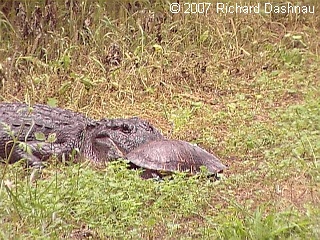
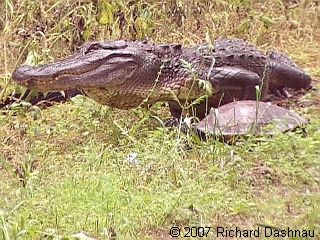
even bellowed some time later. The images and video clips
below show
this next exchange.
 -
- -
- -
- -
-
Video
clips--- part10
last
grab wmv 7.2mb part11
alligator walks off wmv 8.0mb
 -
- -
-
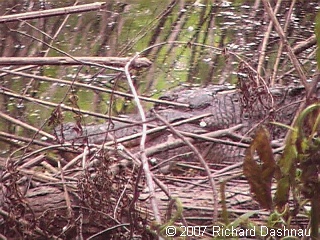
How
did the alligator know the turtle was up there? It couldn't see it,
even
though it could have seen it leave the water. If so, then how did it go
through all the plants and come out directly behind
the turtle? I
believe
that the cloudy skies, which prevented the sun from showing much at
all,
is what saved the turtle. Although it wasn't cold,
the alligator
wasn't warmed up enough for vigorous
movement. This is the second time
I've seen an alligator's unsuccessful attempt at attacking a
turtle.
You can see another attempt on this page,
just scroll down to the entry for 4/30/2006.
I
learned
a few things from this. First, a hungry alligator will move from
distance
from the water if it perceives a possible meal. Second, once out
of the water, an alligator is not nearly as efficient
a hunter as it is
in the water. I suspect if the alligator was warmer, the turtle might
not
have made out so well. It also seems strange the the turtle moved around
the alligator's head, instead of just
moving straight away from it.
Wouldn't
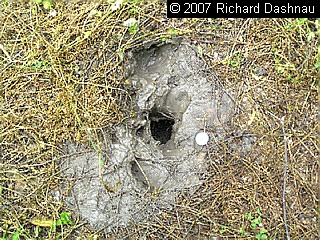
YOU? This last image shows the unfinished turtle's nest. You can see
how
how the ground was moistened, and also how the deep excavation
had
progressed.
She scooped up loads of mud with her paddle-like back feet, and smeared
them to the side. I wouldn't want to dig in this medium with tools, but
the turtles can do it. I tentatively
identified the turtle as
a "Cooter"
because my field guide to reptiles says that these turtles have a
marking
that resembles a small "c" on the top edge of the second scute of the
carapace
(A
Field Guide to Reptiles and Amphibians of Eastern and Central North
America, by Roger Conant 2nd Ed. page 61). My identification is
tentative
at best.
One
other point. Most of us think of a turtle using its shell as a sort of
"box". That is-if something threatens it-the turtle withdraws into its
shell. Box Turtles have hinges on their lower shell
(plastron) that
allows
their shells to close tightly. Many of us have seen turtles of all
sizes
hide by withdrawing into their shell (I have), with the exception of
Snapping
Turtles. Snapping Turtles
use their shell in a more dynamic
manner,
as shown on this page
under the entry for May 8, 2005. Snapping turtles use a
combination
of shell dipping, circling, and snapping for their defense
on land.
If
this
Cooter had merely withdrawn into its shell, it would probably have been
crunched-up alligator food by now. However, this turtle didn't withdraw
at
all! Instead, it remained
fully-extended, and responded to
direct attack
with a mobile defensive strategy. How does it work? Is it merely the
mechanics
of the shape of the shell working with the force of the jaws
closing
to
"squirt" the turtle out? Or is it some combination of the smoothness of
the shell foiling the teeth's ability to snag and/or penetrate along
with
the turtle actively responding to force (jaw
compression) by moving out
of its way as its brought to bear? That is, its reflexes and instincts
respond this way--the turtle isn't thinking about it. In any case, do
NOT
try this at home--or
anywhere else. Very impressive!
----------------
03/11
thru 03/27/2007---It's
spring! With the spring
comes Alligator Mating Season, and the return of all the reptiles and
arthropods
I like to see. With water levels still high throughout the
park, I'm
hoping
for lots of alligator nesting this year. I thought
I'd share
a few images of what's been going on at the park. This is, of course,
Brazos
Bend State Park.
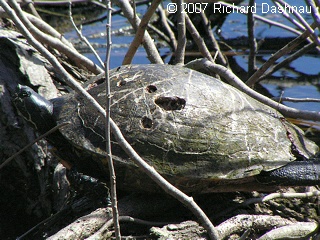
The
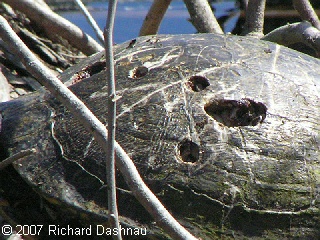
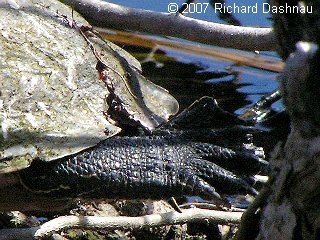
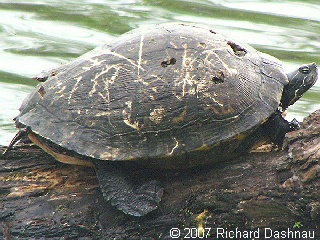
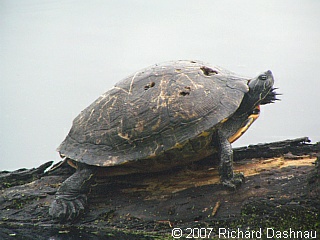
images below show a pond turtle that has apparently had a narrow
escape.
There is a line of deep holes across the top of its shell, a number of
scratches, and the rear of its shell is
cracked. I first saw it on
March
11. The last time (so far) I've seen it is March 27. In all cases, I've
only seen it basking. In the last couple days I saw it, it was basking
on the same log. I hope
the turtle survives. I wonder how it escaped
the
alligator in the first place. Many turtles don't escape, and I have
examples
of this on my pages here.
 -
- -
- -
-
-LUCKY
ON MARCH 11, 2007 -
--MARCH 11,
CLOSER-----
-----MARCH
11, REAR OF SHELL-
--LUCKY
ON MARCH 26, 2007-
- -
-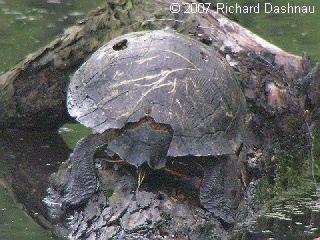
-LUCKY
ON MARCH 27, 2007-
LUCKY
ON MARCH 27, 2007
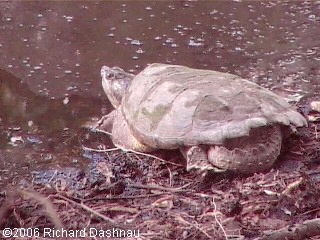
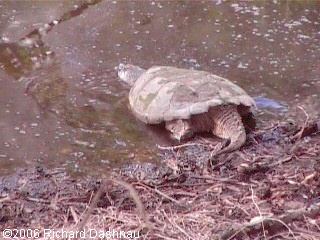
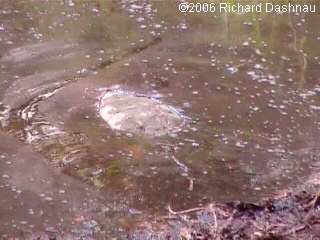
July
09, 2006--I was about 3
miles away from BBSP
when I passed a large Common Snapping Turtle walking towards the road.
I turned around, picked it up, and put it into my car. Then,
when I got
to the park, I rigged a makeshift bag from a towel, and carried the
turtle
about a half-mile into the park, where I released it. I treated the
turtle
gently at all times, and the towel
worked well to keep it subdued and
unable
to bite.
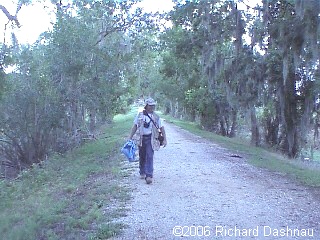
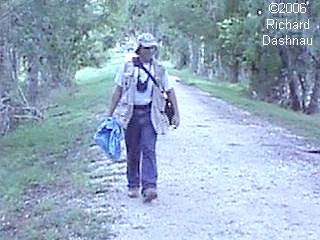
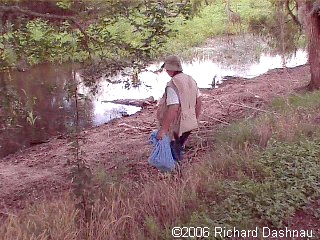
I
shot
some video of this little adventure. The images below are frames from
the
video, and there are two clips below. The first clip shows
me walking
towards
the camera with the turtle(I trimmed it for length). One really cool
thing
about the clip--besides the fact that I'm walking with one of my
favorite
creatures safely in hand--is
that I am WALKING. I'm walking on my new
titanium-ceramic
hip that's just over a year old. THAT is really
cool!
 -
- -
- -
-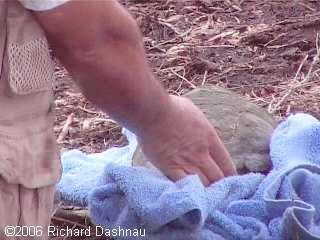 -
-
HERE I
COME
WALKING UP THE
TRAIL
TO THE WATER'S
EDGE
I WANT
MY TOWEL BACK
Rick
walks with the turtle
clip 3000 kb wmv
Rick
releases the Snapping
Turtle clip 21,000 kb wmv
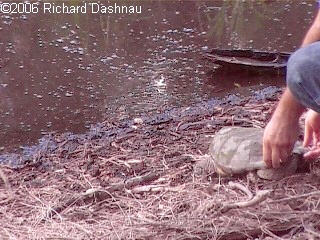
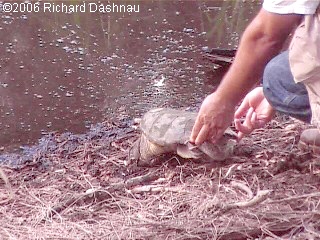
BY THE
EDGE OF THE SHELL
MOVING A LITTLE CLOSER
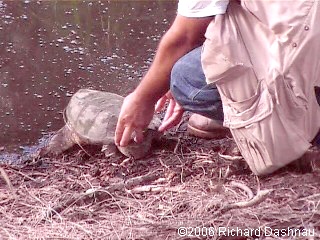 -
- -
- -
-
LOOK!
WATER!
IS IT
SAFE?
THERE IT
GOES!
SUBMERGED
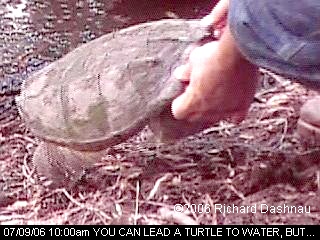
The
second clip shows the turtle being released. Note that I when I held it
by the rear edges of its shell, I kept its back feet off the ground.
This
prevented it from being able to turn quickly. Then,
when it tried to
turn
with the front legs, I let the thrust move it forward
instead of
around. That gave it a kind of "wheel-barrow" motion as it tried to to
turn alternately with each leg. When I finally
got it to the water's
edge,
the turtle waited about 15 minutes before it extended its head finally
moved into the water. Again, I've edited the clip for length. It's only
about 2 minutes long. You can
see other clips and photos of
other
Snapping Turtles I've encountered on this
page.
While
I was watching the turtle, I was also watching for alligators. I chose
the spot I did because the water had recently risen there, and the
current
(which flows to my left) would bring the turtle to
deeper water and
better
cover from alligators. A few weeks before I'd seen a very interesting
alligator
reaction very near where I was. A turtle on the bank is in high risk
position
for notice by an
alligator, and I watched to be sure none were
approaching
while the turtle was in that vulnerable spot (squatting at the water's
edge also put ME in a vulnerable spot. Do NOT do
this!). That
was why I didn't toss the turtle into the water, or do anything else to
disturb the surface or make too much noise. At any rate, the turtle was
in a much better position than the one I found it in--on
the edge of a
highway.
Note
that I've moved a turtle only a few miles. I did it only because I
didn't
want to leave it on the road. Releasing a turtle that's been in
captivity
for a long time, or a
non-native turtle can pose some hazards. In both
cases, those turtles can harbor parasites or disease organisms in large
quantities. Releasing the turtle in those cases can also
release
organisms dangerous to the native turtles.
Oh...in
the second clip I'm bending and squatting with that new prosthetic hip,
too. That is just unbelievably GREAT!
4/30/2006--For
about a week, a very large softshell turtle had been swimming in Elm
Lake
near piers 4 and 5. I encountered it myself. Later, I saw it on one of
the islands across from the piers which had recently had all the trees
cut down. Directly behind the turtle was a small alligator, about 3 or
4 feet long. It appeared that the softshell turtle was digging a nest.
It also appeared that the alligator was aware of this. Here are two
short
clips condensed from video footage I shot while I watched what happened.
What
happens in the clip (
softshell_w_gator (mp4) 4 minutes )
could be perhaps the most laid-back alligator "pounce" I've ever
seen---or
it could be a more subtle attempt to remove the "lid" from a nice pile
of fresh turtle eggs.
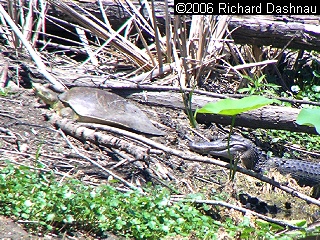 -
-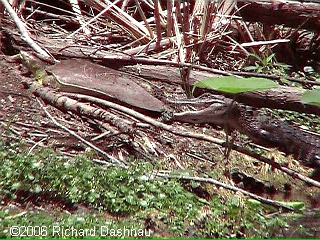 -
-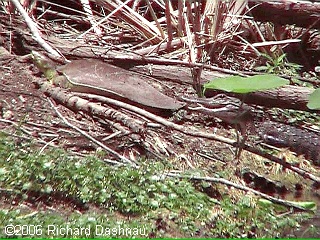
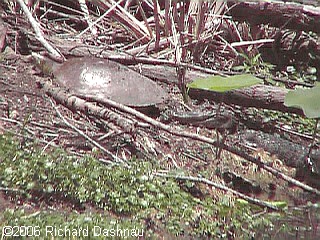
THIS CAN'T BE
GOOD
COME WITH ME, I'M
FEARSOME!
COME
WITH ME, ER, PLEASE?
AT
REST
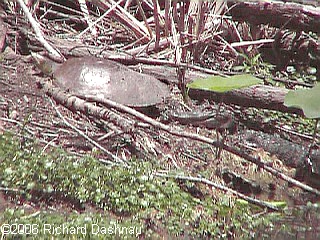
REAR SHELL TIPS
UP
As
the
clip shows, however, the turtle is not without some defense,
though
I couldn't tell if the move was deliberate or not. There's a
slow-motion
view of the turtle's move. It appears that no
contact was actually made.
--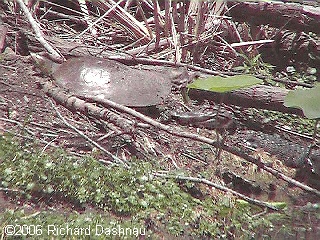 -
-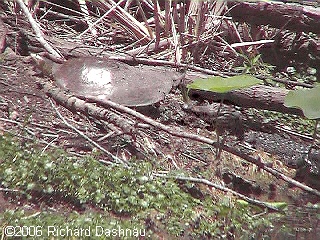 -
-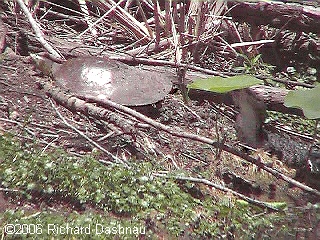 -
-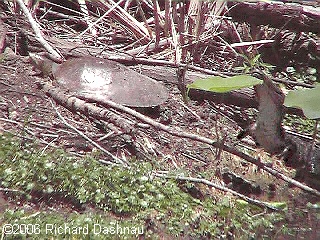
"BAM!" OR
"SWISH!"
THE FOOT GOES
BACK
FINALLY, GATOR
REACTS
DANG! TURTLE IS *QUICK*!
The
second clip included in the video (
softshell_w_gator (mp4) 4 minutes )
shows another attempt by the alligator, with different--though not more
desireable--results. I don't know what made the
alligator retreat after
this, though I have my suspicions. Female turtles are known to soften
the
ground they are excavating for a nest by urinating on it. If an
alligator's
nose happened to be
nearby when this softening occurred, it might
be...less
than pleasant.
August
07, 2005-- This
started about a month ago. One of the BBSP volunteers (that would be
John),
reported a Softshell Turtle (these are probably Eastern Spiny
Softshells)
laying eggs near
one of the trail. I've already mentioned how the
turtles
(most frequently Redeared Sliders) can be observed laying eggs through
the spring (see this page
for more details). Softshell eggs are
quite uncommon. I've
seen adult
Softshell turtles from time to time at the park, but they're very shy.
I rarely see one in camera range. It was decided to retrieve the eggs
and
hatch them. I believe
this was either in late May or Early June.
Finally,
the eggs were ready to hatch! The decision to hatch them was made after
one actually poked its nose through its eggshell around August
3rd.
They
were given a few more days to hatch on their own, and when they didn't,
the eggs were opened. I just happened to walk in to the VC/NC when this
was being done, and watched a few eggs
opened.
Then,
I got one of the last ones and hatched it myself! Not one to waste a
photo
opportunity (well, I can usually take advantage of
one), I would
make a few cuts, put down my scissors,
pick up my camera, and take a
picture:
then pick up the scissors, and continue. Sometimes pictures taken at
the
spur of the moment come out, sometimes they don't. I believe I got
lucky
this
time. The RICKUBISCAM shows one of my pictures.
So,
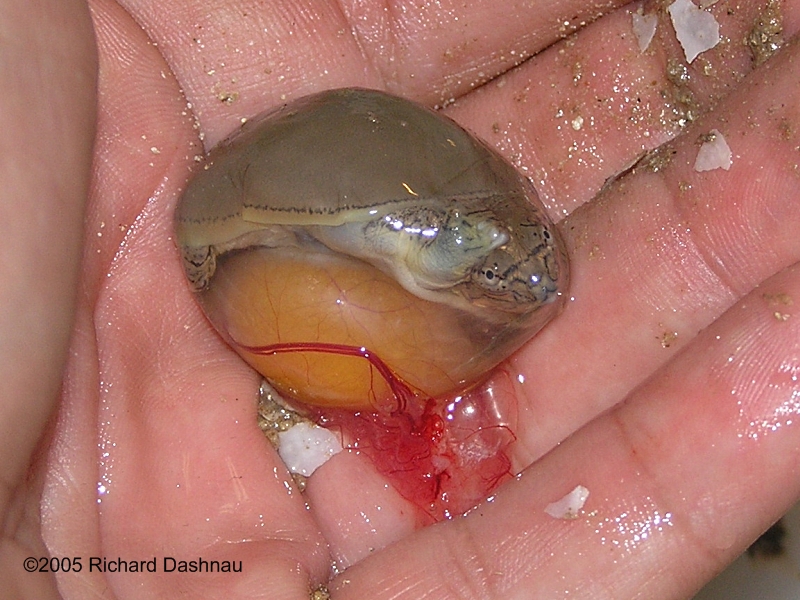
the following series shows the entry of a brand-new Softshell Turtle
into
the world.
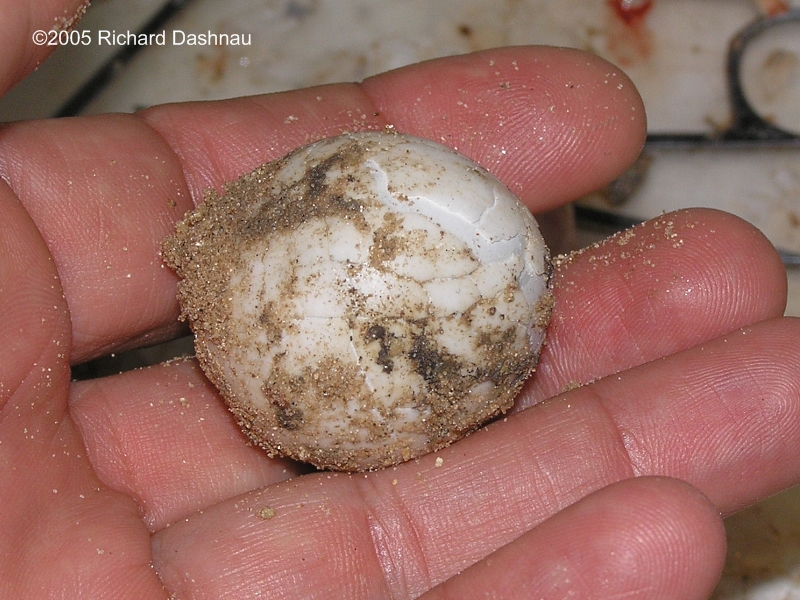 -
-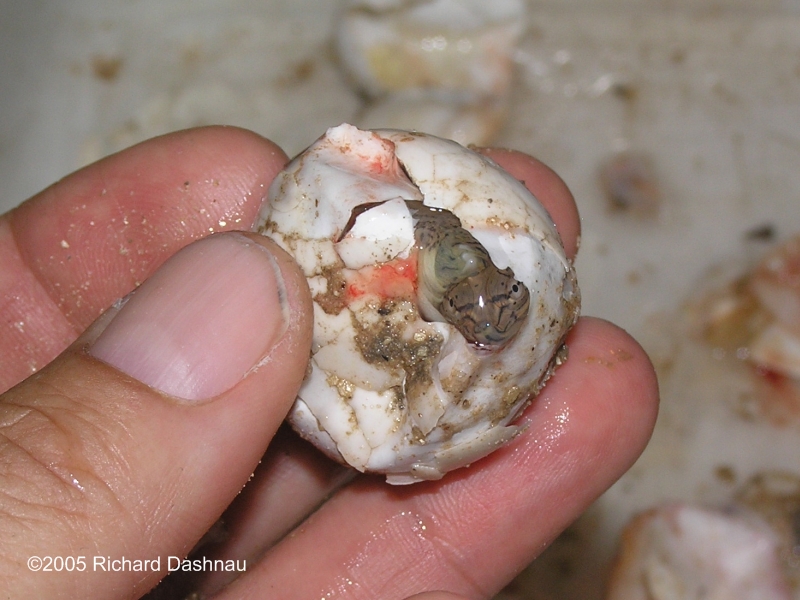 -
-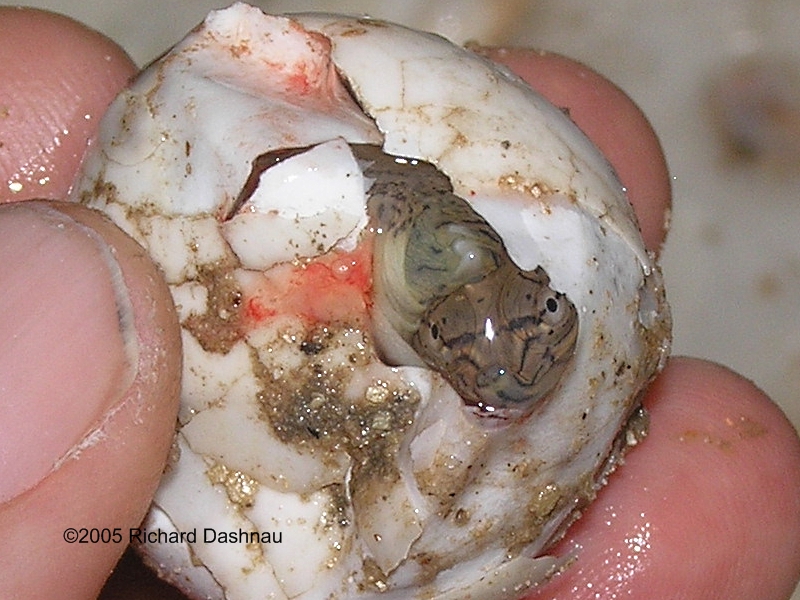 -
- -
-
THE
EGG
FIRST FEW
SNIPS
DANG!
IT'S BIG OUT THERE!
GET ME OUT OF THIS
BAG
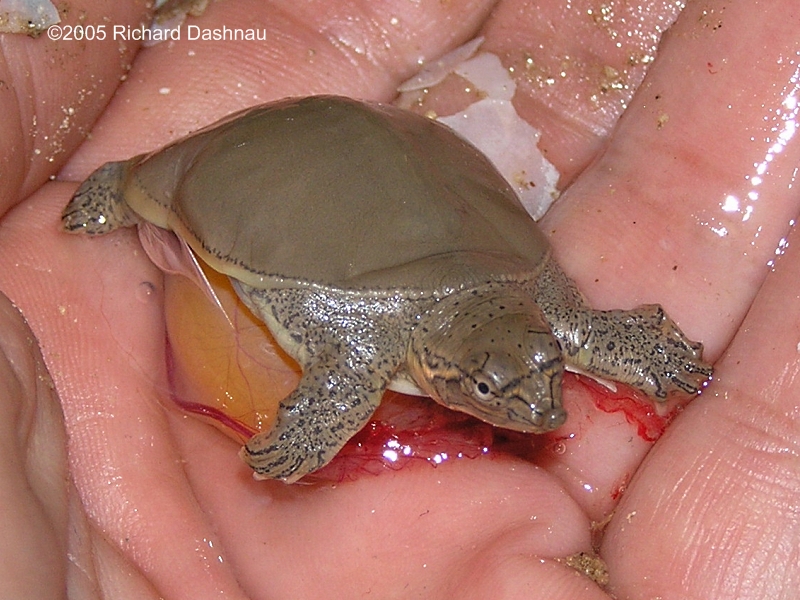
I'M FREE!
The
egg is small and almost round (see THE EGG, above). I carefully and
gently
broke through the shell with the point of my scissors, and opened a
small
spot. A tiny face peered out of the
hole (see FIRST FEW, and DANG,
above).
Working quickly and carefully, I pulled the rest of the shell away from
the turtle. It remained inside another membrane, which was
crystal-clear.
Still,
you can see how he's tightly bundled in it, with those wide eyes
staring out (see GET ME OUT, above).
I
wasn't
quite sure how to proceed, since I couldn't tell where the membrane
was.
As I
watched, though, the turtle broke free on its own, stretching its
neck and legs. Then, it took its first breath of air (see I'M FREE,
above).
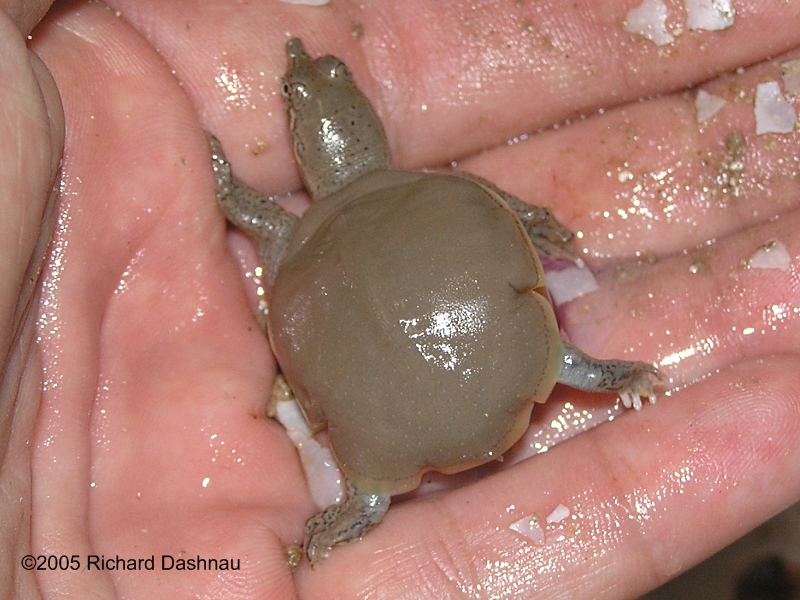
This turtle had a somewhat larger yolk sac then the others.
A look at
its
back shows the creases in its shell (pointed out be Sharon)
that
allowed it to fold into the ball-shaped egg (see CREASED FROM
PACKAGING,
below). Right from the start, these
youngsters moved with vigour and
wide-eyed
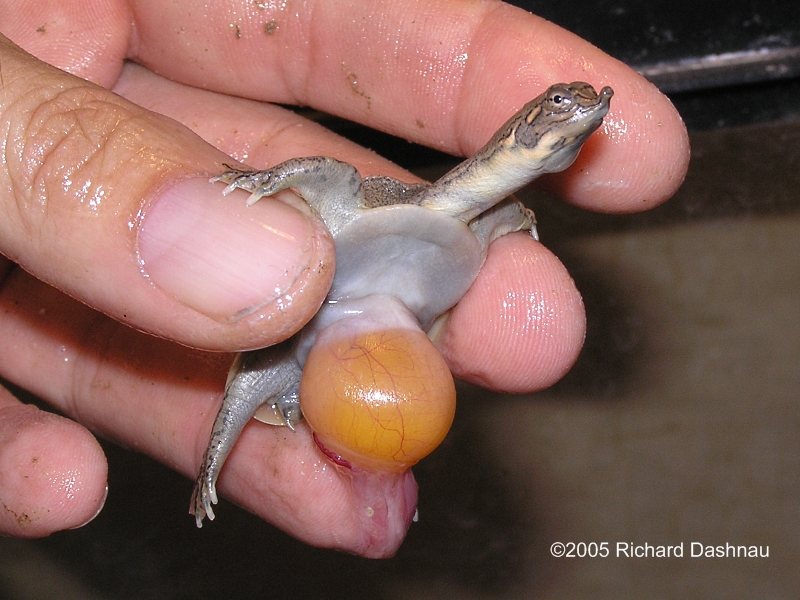
attention. A few minutes after placing "my" hatchling in with the
others,
I picked one at random and took picture showing its yolk sac (see
YOLK
SAC, below). Notice how it's holding on and pushing with its
legs--wide-eyed
and ready to get to the job of survival! Finally, I took a few pictures
trying to get a group of them--which was difficult
because they were
moving
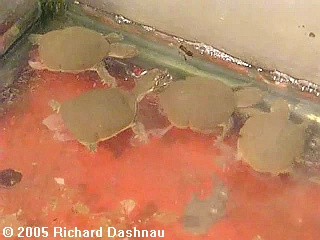
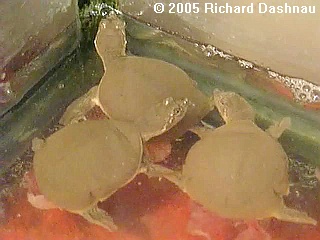
around (see CLUSTER OF BABIES, below). While doing this, I took a few
video
clips, and here are two short ones, which I show a frame of each from.
(see SHORT
VIDEO 01, and O2, below). We hatched out 16 babies. I heard
today that one of them (possibly mine, but I hope not) didn't make
it.
While that may seem sad, consider that if these eggs had
been left
where
they had been deposited there is a very good possibility that all
of them would not have survived. The eggs might have died outright from
the dryness, or be being plundered by
raccoons or some other animal.
The
hatchlings (with those soft shells) would be easy prey for any number
of
native carnivores in the park.
 -
- -
-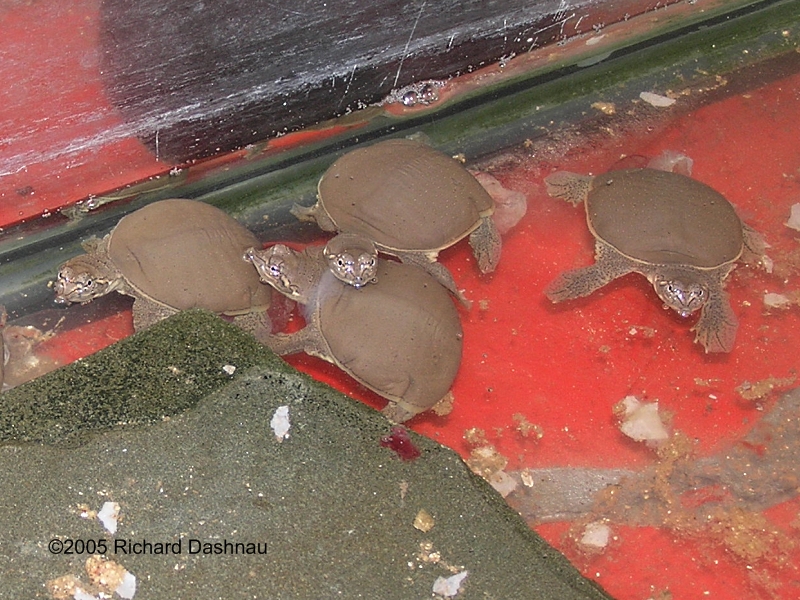 -
- -
-
CREASED
FROM
PACKAGING
THE YOLK
SAC
CLUSTER OF
BABIES
SHORT
VIDEO CLIP O1 287kb SHORT
VIDEO CLIP O2 250kb
As
if
this wasn't enough baby turtles--the same day a very nice young girl
came
in to the visitor center with something cupped in her hand. She had
rescued
it walking on one of our trails.
When she opened her hand, we were all
surprised. It was a baby Musk Turtle, or Stinkpot! What was amazing was
the size of this fully-formed baby turtle. It was TINY! The picture
below
shows the little one resting on my fingers (see LITTLE STINKPOT, below).
------------------------------------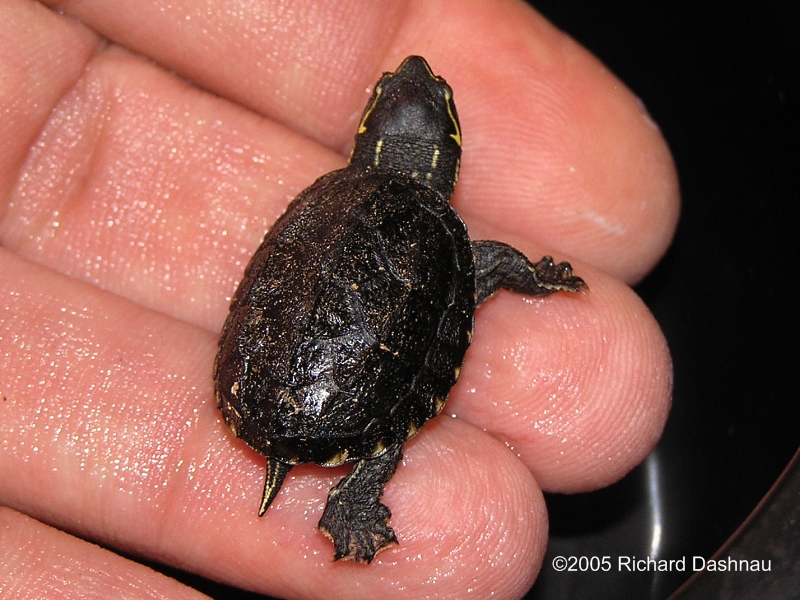
LITTLE STINKPOT
May
08,
2005As
I was driving towards the Visitor Center/Nature Center at the park,
Park
Naturalist Sharon Hanzik, who was driving ahead of me, pulled over and
motioned for me to do
the same. When I walked up, she told me that a
Snapping
Turtle had just crossed the road. She then left, and I was able to take
some more pictures of one of my favorite reptiles.
As
I
approached the turtle, it reared up in the typical defense posture.
Unlike
the other Snapper that I had taken pictures of, this one was on its own
ground, and felt as if it could defend itself.
As
I
watched, I saw that the Snapping Turtle's defensive strategy is
actually
quite a bit more complex than just snapping at whatever moves in front
of it. First, as I approached it, it pushed up
with its rear legs,
which
elevated the back of the shell--which is armed with sharpened scutes
along
the rear edge--and also lowered the front of its shell, and drew its
head
back into the shell.
Along with this, it would slowly turn so its front
was always towards me.
Now,
I only did the following for educational purposes. I don't encourage
antagonizing
or bothering any wildlife. I also
didn't have any other choice but to
lift
the turtle as I did. I did it only briefly each time. Ever since I was
a young, I've handled Snapping Turtles this way, and would not have if
I thought it would
injure the turtle. According to the website Chelydra.org,
this is not the preferred manner of handling a large Snapper. I want to
make this clear to everyone.
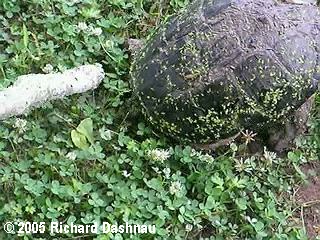
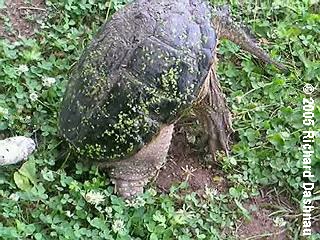
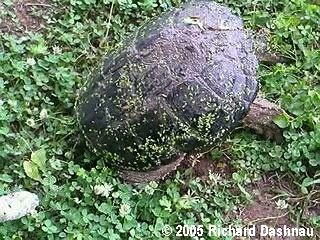
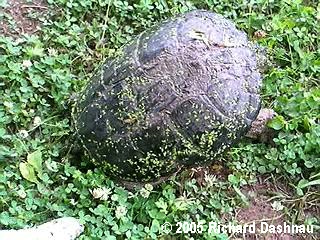
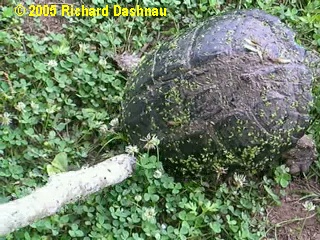
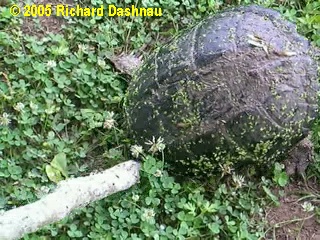
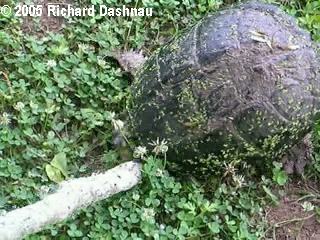
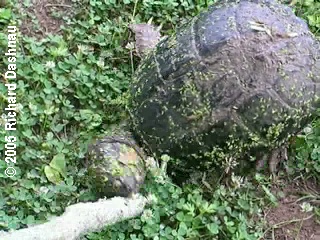
Grabbing
a large stick, I slowly placed it near one side of the turtle. It
lifted
its shell as I described, leaning towards the stick, as the images
below
(frames from a video clip)show. When I
moved the stick around to the
other
side, the turtle leaned towards it on that side.
 -
- -
- --
--
STICK ON
THE
RIGHT
TREMENDOUS
HIND
LIFT
STICK TO THE
LEFT
LEAN TO THE LEFT
It
appears
to me that the turtle, although moving slowly, is using its shell as an
effective shield towards percieved attack. Since its shell doesn't
cover
much (images are below), the Snapping
Turtle uses its shell much like a
gladiator would use his shield. That is, moving it to where it was
necessary.
That's
not all, though. This interesting posture affords a bit more strategy
as
well,
as this next series of 8 frames shows. As I moved the stick a
little
closer to the shell, as an inquisitive or hungry animal might do, the
slow-moving
defensive lump suddenly launched an attack!
I used successive frames
for
the last 7 images in the sequence, and my digital camera shoots clips
at
24 frames per second. That head is quick!
Sometimes, the turtle
will push with some
or all of its feet, launching the shell forward,
and
extending the reach and power of its strike.
 -
- -
- -
-
CAN
I GET FOOD UNDER
HERE?
SNIFF
SNIFF
YOU'D
BETTER
By
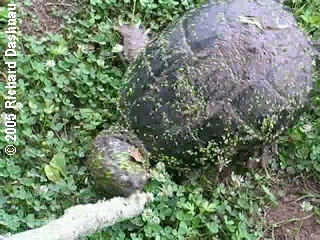
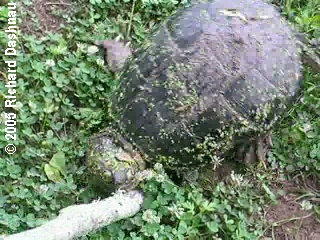
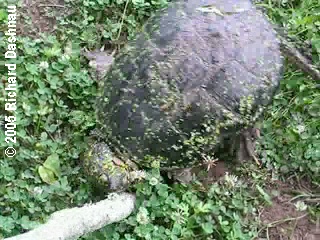
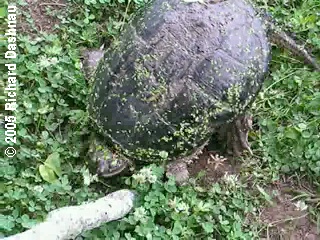
pushing up with its hind legs and pulling in the front, the Snapper
makes
it much more difficult to lift the front of the shell. The pulled-in
front
legs are also cocked and ready to push the shell
in either direction if
necessary. The tilted shell also hides most of the head, and makes it
difficult
to see where the head is, and where the defensive attack will come from.
 -
- -
- -
-
LEAVE
ME
ALONE!
GET IT?
With
the added to the rotating behavior I've already mentioned, a possible
predator
would always be confronted by the downward-tilted front of the shell as
the predator circled the turtle. If it
(the predator) became more
frustrated,
it might try to move in and lift the front of the shell, with
disastrous
results. It seems like a quite efficient defence. The turtle
forces
its antagonist to
concentrate on the obstacle of moving around the
shell,
meanwhile causing the focus to be on the front of its shell--which is
where
it best counterattacks with surprising speed. Although not
shown here,
that neck and broad head can extend for a long distance over the
turtle's
back, and if the turtle is somehow seized from
behind, it can just
about reach anywhere on its shell. The
sudden snap to the
rear, as
well as clawing from the strong-webbed rear legs (today's RICKUBISCAM),
can make a predator release its hold--which would allow the turtle to
turn
and defend
again. Here are two short video clips
of
the
defensive behavior. The first is a single
"lean" with snap (554kb). The second is a few
"leans" with the high tilt, and a snap (828kb).
---------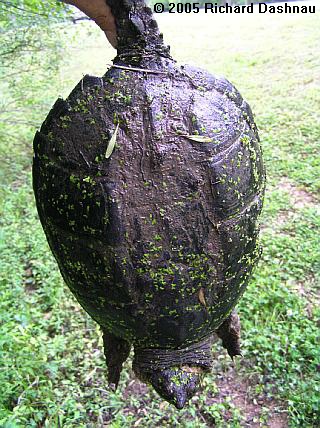 --------------
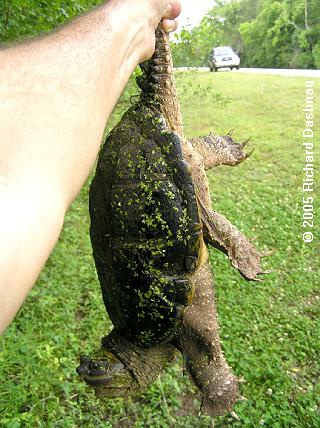 -----------------------------
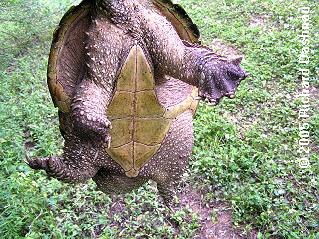 -
-
FROM THE
TOP
FROM THE
SIDE
THE REVEALING BOTTOM
To
show
the turtle's shell clearly, I lifted the turtle by its tail (sorry,
folks)
and took the pictures above. The top of the shell (carapace) shows the
broad, smooth surface with saw teeth on the rear
edge. The
side view
shows the massive clawed, webbed feet, and the general
"prehistoric-looking"
aspect of the turtle. I'm holding the turle out at arm's length. The
bottom
shows the very
small bottom shell (plastron). This affords very little
protection.
I
finally
brought the turtle into the trees (in the direction it had been
crawling)
and released it. It may not be noticeable at first
glance,
but I
saw that there was a healed crack on the edge of the turtle's shell,
possibly
from an old encounter with a car. See the image below. (CRACKED
SHELL)
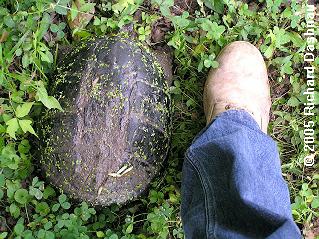
I also took a picture of
the turtle with my foot to show some scale.
Pretty
good sized turtle! Also, I had to move because the turtle started
turning
towards my foot....
------------------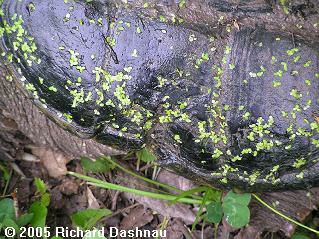 ---------------------
CRACKED
SHELL
CLOSER VIEW
February
21, 2005
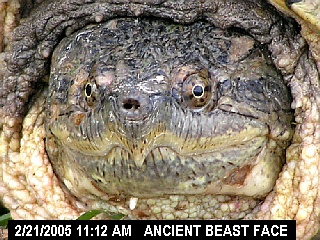
The image below (ANCIENT FACE) shows a close-up of a very old friend of
mine. This is the face of a Common Snapping Turtle (Chelydra
Serpentina).
I was on my
way to BBSP when I happened to see this turtle on the side
of the road as I hurtled by at 50-plus miles an hour. I slowed down,
turned
around to pick it up.
-------------------------------------------------------
ANCIENT
FACE
I
tried
to do the same thing once last year, but the Snapper was halfway across
the highway. I'd turned around, and was speeding back towards the
turtle
when I saw a truck coming the other
way swerve over and hit
it--blasting
it to smithereens. What kind of a pinhead toad would do such a thing?
This
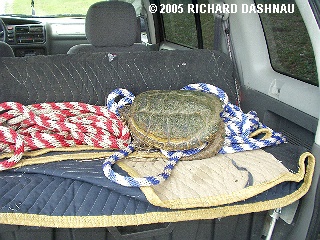
time, I was successful, and I picked the turtle up and put it in the
back
of my car.
(see PUNGENT HITCHHIKER, below)
We
continued
on to the park, where I decided on a spot near an alligator-free zone
to
release it. There was a bit of suspense when I opened the back
door and
the turtle was gone. I found it (it had crawled forward onto the back
seat),
and carried the turtle out and laid it gently onto the ground, and
waited
until it decided it was safe to move.
I figured it was probably quite
disoriented.
-- --
-- --
--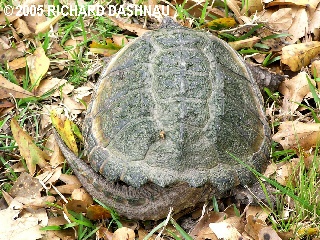 --
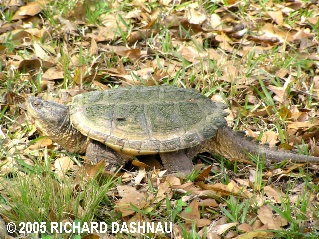
--
PUNGENT
HITCHHIKER
HITCHHIKER
CLOSER
FROM THE
TOP
STARTING TO WALK
The
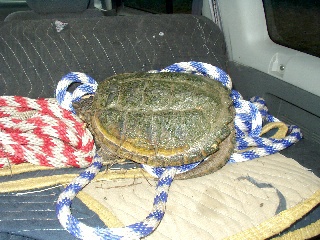
Common Snapping Turtle is pretty easy to identify. (see FROM THE TOP
and
STARTING TO WALK, above) The upper shell is smooth on top,
with serrations
(saw teeth) on the back of
the shell. It has a huge tail (for a
turtle)--almost
as long as the shell. This turtle was about 12 inches long, but they
get
to about 20 inches long (I swear I've seen them bigger when I was a
child).
The only turtle similar to this species is the Alligator Snapper--but
they
have much more prominant keels on the top of the shell, and also an
extra
row of shell scutes on the middle side of the
upper shell. That is
there
are about 4 or 5 scutes in 2 short rows between the ring of small ones
on the edge; and the big ones across the top. There are other
differences
as well, which I won't
go into here.
Both
species have evolved large heads with long necks. The plastron (the
lower
shell) of the Snapping turtle is quite small and offers little
protection.
The Snapper has evolved
their aggressive defence to make up for this. A
Snapper cornered on land (unless it's been whisked from a road and
carried
overland at many times the speed it's used to) will often face
it's
antagonist.
Then, it will raise its hindquarters slightly and lower the front of
its
body. The Snapper will sometimes open its mouth and keep its head
withdrawn.
If the antagonist tries to move
around the turtle, it will also turn,
keeping
its head facing the attacker. If the attacker approaches, then the
Snapping
Turtle "fires" its head out, with the jaws closing sometimes with and
audible
"snap". The turtle will occasional lunge its entire body forward during
this defensive attack. And, the turtle is not bluffing. If its jaws
catch
something, it will grab on and try to bite through.
-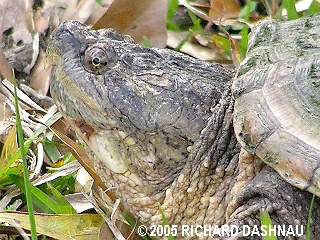 --
--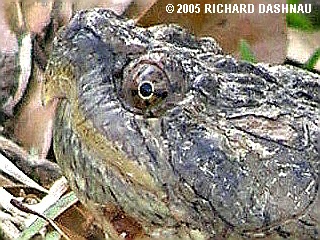 --
-- --
--
IS IT
SAFE?
HOOKED
BEAK
WHERE'S MR.
DEMILLE?
RICK AND MINN
Time
passed, and the Snapper extended its head and started to move (see IS
IT
SAFE?, above). Note how the eyes are close to the nose, so that a very
small amount of the head is exposed
at the surface of the
water.
The hooked, sharp beak is excellent for catching prey, and tearing
apart
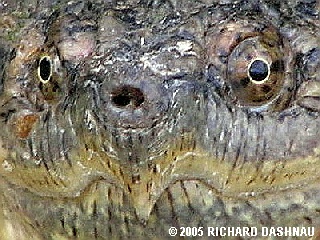
carrion. (see HOOKED BEAK, above). The eyes are camoulflaged to blend
in
with the rest
of the face (see MR. DEMILLE, above). When I
was growing
up-among the mountains in New York-I spent many summer days following
and
watching Snapping Turtles. I'd caught a few, also,
and let them go
later.
On
summer
days, there was a period during the early evening when breezes would
still;
and the surface of a lake or a pond would be like a huge pane of glass.
This is
when the large Snappers would come to the surface, and I would
watch for them.
Out
in the middle of the lake, a shallow hump (the shell) would break
water;
or sometimes a small, irregular
knob (the eyes and nose) could be seen.
In either case, soon the top of the head and the shell would break the
surface, and sometimes-as the turtle took in more air and became
more
bouyant-the
tip of the tail would show some distance from the shell. To my youthful
eyes, I saw prehistoric creatures cruising around out there. Once,
during
one of those few lazy summer days,
I was drifting around the lake in a
flatbottom rowboat. I was just lying there, enjoying the sun,
when
I felt a slight bump. I slowly and quietly moved to the side of the
boat,
and saw that my oars
were slowly drifting back and forth. It was an oar
that made the slight bump when it would come near the boat. What made
this
interesting was the foot long or so Snapping Turtle that
seemed
to be
following
the oar (it was about the same size as the wide part of the oar) as the
oar drifted back and forth. When the oar drifted away from it, the
turtle
slowly paddled towards it with its
head and neck extended. When the oar
drifted towards the turtle, the turtle would paddle backwards while
withdrawing
its head, but still facing the oar. I watched this for a few
minutes
until I
shifted from my awkward position and scared the turtle away.
I
came
to love many aspects of nature as I was growing up. Probably one of my
most important influences (and probably a big reason
I came to enjoy
Snapping
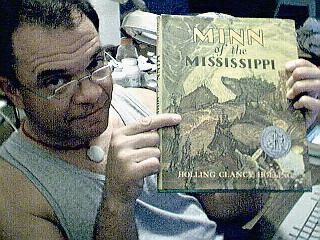
Turtles so much) was a book that I'd read back in Elementary School (I
read a LOT while growing up). The name of the book is Minn of
the
Mississippi, by Holling Clancy
Holling (see RICK AND MINN, above), and
yes, I own a copy of it. That's a webcam shot I took yesterday. The
book
is the life story of a Snapping Turtle, illustrated with terrific
detailed
paintings
and sketches. The margins of the pages are filled with all
kinds
of natural history facts.
I
hope
I can inspire just one person with these pages as much as that book
inspired
me so many years ago.
---- -------
 -------
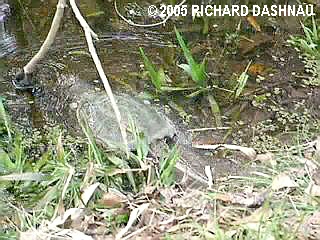 --------
TURTLE BEGINS
WALKING
TURTLE WALKING
BY
SWIMMING TO FREEDOM!
VIDEO
CLIP 01 434KB
VIDEO
CLIP 02 476KB
VIDEO
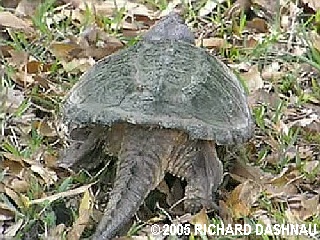
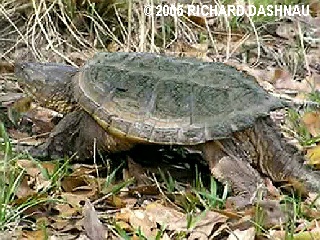
CLIP 03 295KB
This
turtle began walking, and I shot some pictures and some video clips
(see
TURTLE BEGINS, and WALKING BY above, or VIDEO
CLIP 01 434KB
and VIDEO
CLIP 02 476KB .)
I decided it was time to
release it, so I brought it to the water's
edge.
This time, there was no waiting. The turtle saw the water, and went
right
for it. (see SWIMMING TO FREEDOM, above, or VIDEO
CLIP 03 295KB
) Compare
the speed and grace in the water with the plodding movement
on
land. What a difference!
I've
been at BBSP at least once a week for over 3 years and have never seen
a Snapping Turtle in the water,
or anywhere else there. I've seen Pond
Turtles, Sliders, Musk Turtles, Box Turtles and Softshell Turtles, but
no Snappers. I was very happy to see this one.
June
13, 2004You
just never know what you will run into on any given day at Brazos Bend
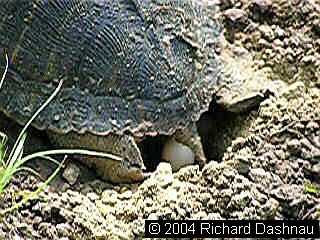
State Park. The image below (TURTLE FACTORY) shows the eggs of a
Red-Eared
Slider (or Red-Eared
Pond Slider, Chrysemys scripta elegans)
as
they are being deposited by a female turtle. ourse. Actually,
I've
seen a number of turtles excavating their nests. I've just never been
able
to catch one
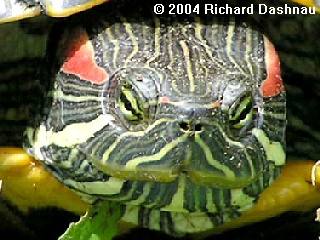
laying eggs. The picture below left (DIFFERENT FEMALE)
shows
the face of turtle I caught excavating a nest back in May. There is a
closer
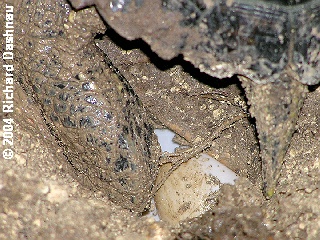
look at the eggs (ANOTHER LOOK), and then the
remaining two pictures
are
frames from short video clips that I took.
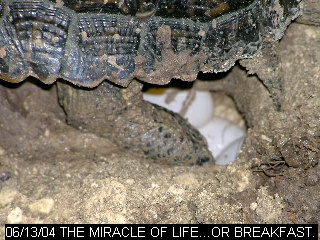 -
- -
- -
- -
-
TURTLE
FACTORY
A DIFFERENT FEMALE
ANOTHER LOOK AT THE EGGS
AN EGG DROPS INTO THE NEST
ONE
EGG DROPS VIDEO 391KBCOVERING
NEST VIDEO 1,232KB
DROP
AND ARRANGE EGG VIDEO
664KB
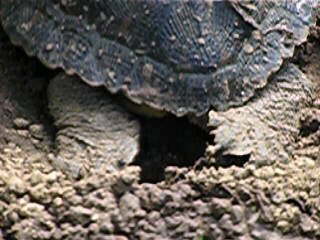
COVERING THE NEST
I
didn't leave one of the
clips full length, because of file size, but I was able to catch to
eggs
dropping with the pause between them. After each egg was deposited, the
female would reach
under and set it into place with her left foot (see
the DROP
AND ARRANGE EGG VIDEO 664KB
), then she'd lean
over and release the next egg. One of the park visitors asked me a
couple
questions
I couldn't answer. According to my Audubon Society Field
Guide
to Reptiles and Amphibians, these turtles nest in June and July. The
female
lays 1-3 clutches (nests like this one) of 4-23 oval
eggs. (That was
one
of the questions.) Hatchlings emerge in (and therefore incubation time
is) 2 - 2 1/2 months (that was the second question), but often
overwinter
in the nest.
When
she finished, the female
efficiently covered the nest, using her broad, webbed hind feet as
shovels
and trowels (see COVERING
NEST VIDEO 1,232KB
). Watch as she sweeps
dirt in, and
packs it down with the "knuckles" of her rear feet; then
sweeps
in more.
My
comment about "breakfast"
is unfortunately often true. You'd have to see the surface that these
females
sometimes
excavate in to believe how hard it is. One thing that the
female
will do is urinate on the ground to soften in for her digging. Although
she covers her nest well, this urine may leave a distinctive
odor that
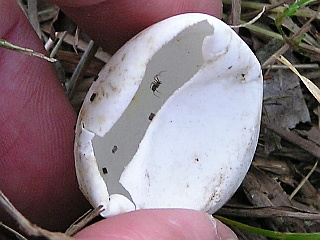
egg-stealing carnivors (raccoons, and possibly otters) can detect. I
often
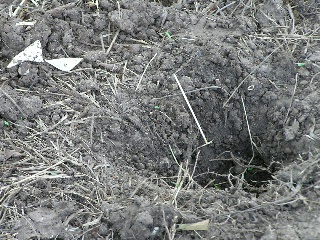
see the curled, white remnants of turtle eggs plundered and eaten. In
the
images below, I show one of these
nests. The first image (PLUNDERED
NEST,
below) the excavated nest is in the foreground, and the curled remains
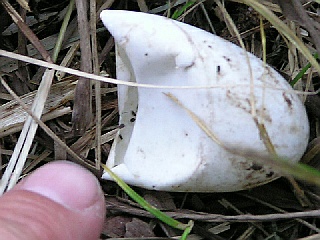
of two shells in the upper left. The next image (RARELY INTACT,
below)
shows more of an egg than normally remains. By the way, there were
eggshell
remnants from this nest were close (about 1-2 feet) to the water's
edge.
A hint, perhaps of where the egg
stealers came from and went to. The
last
image (SPIDER RESIDENT, below) shows a very small spider has taken
advantage
of the turtle's disaster by making a home in the shell. No...I don't
think
that spiders raided the nest.
---- ---------
 -----
-----
PLUNDERED NEST AND
EGGSHELLS
RARELY INTACT
SHELL
SPIDER RESIDENT IN SHELL
Remember
folks, animals at the park belong to the *park*. It is against the law
to harrass, capture or kill just about all of them ; and this includes
our reptiles--such as turtles laying eggs
along our trails (one *may*
legally
fish in the park (following applicable state fish licensing laws). No
frogging
(of ANY kind) or taking of crayfish is allowed.). Please leave our
reptiles
and amphibians alone, and let other park visitors enjoy sights
like
this
one.
A
couple
more items: THEY'VE FIXED THE PILANT SLOUGH
FLOODGATE! Now,
if we can get some rain and fill it, the Slough should remain filled!
Excellent!
And...I've
seen large
groups of Nephila Clavipes spiders. Evidently, mass
hatchings
have occurred over the last couple weeks (I was busy elsewhere in the
park,
so missed checking on the area with the
highest concentration of these
spiders for about 2 weeks. Rats....I wanted to see that.) I've tried to
photgraph the groups I've seen, but can't get a good shot that shows
both
the size
of the clump, and what is *in* the clump.
-------------------------------------------------
RED-EARED SLIDER
May
15, 2004; I saw this
female turtle (see RED
EARED SLIDER, above), digging a hole to lay eggs into next to one of
the
trails.
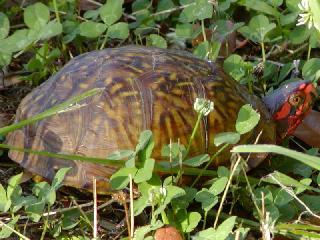
June
02, 2002 Now
TODAY started out nicely.
As I was driving into the park, I noticed a van coming in the opposite
direction had stopped. When I got closer, I saw that its
driver was
allowing a turtle to cross the road. When I got closer, I saw
it was a
Box Turtle! I stopped, and carried the turtle across the road. Then I
ran
back, got my camera, and snapped a picture.
(BOX TURTLE,
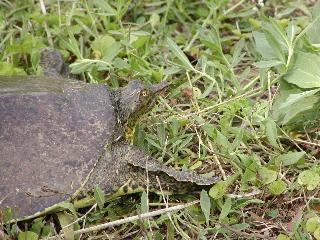
below) Finally,
after a busy day, I was on my way back to the Visitor's
Center, when
I noticed a park visitor looking closely at something in the
grass.
As I drove by, I
saw him pick up something that looked like a turtle.
So,
I turned around and checked to see what it was. It annoys me when
visitors
harass our animals. It was a Spiny Softshell Turtle,
which
I'd been
trying to get a picture of. So, here it is.
(SOFTSHELL,
below.)
The visitor, it turned out, had rescued the turtle as it was crossing
the
road. He was taking pictures of it,
also. After this, he released the
turtle.
---- ---------
BOX
TURTLE
SOFTSHELL
If
you'd like to know more about the park follow these links:
Brazos
Bend State Park
The main page.
Brazos
Bend State Park Volunteer's Page The
volunteer's main page.
Go back to my home page, Welcome
to rickubis.com
Go
back to the RICKUBISCAM
page.
Go
back to the See
the World
page.